 Add to Chrome
 Add to Firefox
 Add to Edge
Beer-Lambert Autoencoder for Unsupervised Stain Representation Learning and Deconvolution in Multi-immunohistochemical Brightfield Histology Images
Jan 16, 2026
Separating the contributions of individual chromogenic stains in RGB histology whole slide images (WSIs) is essential for stain normalization, quantitative assessment of marker expression, and cell-level readouts in immunohistochemistry (IHC). Classical Beer-Lambert (BL) color deconvolution is well-established for two- or three-stain settings, but becomes under-determined and unstable for multiplex IHC (mIHC) with K>3 chromogens. We present a simple, data-driven encoder-decoder architecture that learns cohort-specific stain characteristics for mIHC RGB WSIs and yields crisp, well-separated per-stain concentration maps. The encoder is a compact U-Net that predicts K nonnegative concentration channels; the decoder is a differentiable BL forward model with a learnable stain matrix initialized from typical chromogen hues. Training is unsupervised with a perceptual reconstruction objective augmented by loss terms that discourage unnecessary stain mixing. On a colorectal mIHC panel comprising 5 stains (H, CDX2, MUC2, MUC5, CD8) we show excellent RGB reconstruction, and significantly reduced inter-channel bleed-through compared with matrix-based deconvolution. Code and model are available at https://github.com/measty/StainQuant.git.

INSIGHT: Spatially resolved survival modelling from routine histology crosslinked with molecular profiling reveals prognostic epithelial-immune axes in stage II/III colorectal cancer
Dec 24, 2025Routine histology contains rich prognostic information in stage II/III colorectal cancer, much of which is embedded in complex spatial tissue organisation. We present INSIGHT, a graph neural network that predicts survival directly from routine histology images. Trained and cross-validated on TCGA (n=342) and SURGEN (n=336), INSIGHT produces patient-level spatially resolved risk scores. Large independent validation showed superior prognostic performance compared with pTNM staging (C-index 0.68-0.69 vs 0.44-0.58). INSIGHT spatial risk maps recapitulated canonical prognostic histopathology and identified nuclear solidity and circularity as quantitative risk correlates. Integrating spatial risk with data-driven spatial transcriptomic signatures, spatial proteomics, bulk RNA-seq, and single-cell references revealed an epithelium-immune risk manifold capturing epithelial dedifferentiation and fetal programs, myeloid-driven stromal states including $\mathrm{SPP1}^{+}$ macrophages and $\mathrm{LAMP3}^{+}$ dendritic cells, and adaptive immune dysfunction. This analysis exposed patient-specific epithelial heterogeneity, stratification within MSI-High tumours, and high-risk routes of CDX2/HNF4A loss and CEACAM5/6-associated proliferative programs, highlighting coordinated therapeutic vulnerabilities.
CORE - A Cell-Level Coarse-to-Fine Image Registration Engine for Multi-stain Image Alignment
Nov 12, 2025Accurate and efficient registration of whole slide images (WSIs) is essential for high-resolution, nuclei-level analysis in multi-stained tissue slides. We propose a novel coarse-to-fine framework CORE for accurate nuclei-level registration across diverse multimodal whole-slide image (WSI) datasets. The coarse registration stage leverages prompt-based tissue mask extraction to effectively filter out artefacts and non-tissue regions, followed by global alignment using tissue morphology and ac- celerated dense feature matching with a pre-trained feature extractor. From the coarsely aligned slides, nuclei centroids are detected and subjected to fine-grained rigid registration using a custom, shape-aware point-set registration model. Finally, non-rigid alignment at the cellular level is achieved by estimating a non-linear dis- placement field using Coherent Point Drift (CPD). Our approach benefits from automatically generated nuclei that enhance the accuracy of deformable registra- tion and ensure precise nuclei-level correspondence across modalities. The pro- posed model is evaluated on three publicly available WSI registration datasets, and two private datasets. We show that CORE outperforms current state-of-the-art methods in terms of generalisability, precision, and robustness in bright-field and immunofluorescence microscopy WSIs
TIAViz: A Browser-based Visualization Tool for Computational Pathology Models
Feb 15, 2024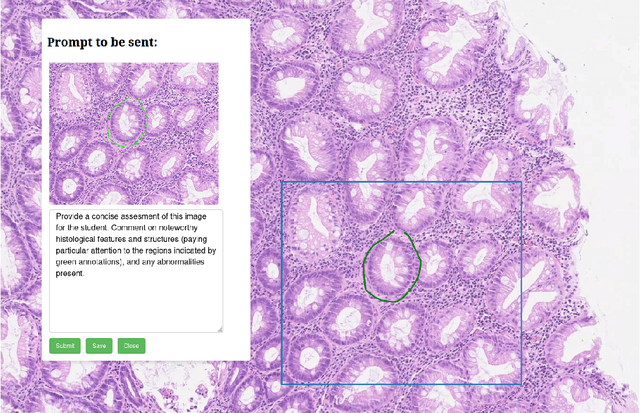
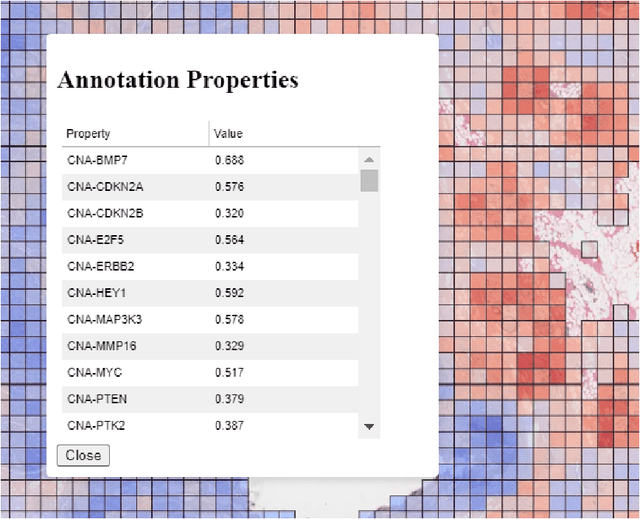

Digital pathology has gained significant traction in modern healthcare systems. This shift from optical microscopes to digital imagery brings with it the potential for improved diagnosis, efficiency, and the integration of AI tools into the pathologists workflow. A critical aspect of this is visualization. Throughout the development of a machine learning (ML) model in digital pathology, it is crucial to have flexible, openly available tools to visualize models, from their outputs and predictions to the underlying annotations and images used to train or test a model. We introduce TIAViz, a Python-based visualization tool built into TIAToolbox which allows flexible, interactive, fully zoomable overlay of a wide variety of information onto whole slide images, including graphs, heatmaps, segmentations, annotations and other WSIs. The UI is browser-based, allowing use either locally, on a remote machine, or on a server to provide publicly available demos. This tool is open source and is made available at: https://github.com/TissueImageAnalytics/tiatoolbox and via pip installation (pip install tiatoolbox) and conda as part of TIAToolbox.
MesoGraph: Automatic Profiling of Malignant Mesothelioma Subtypes from Histological Images
Feb 23, 2023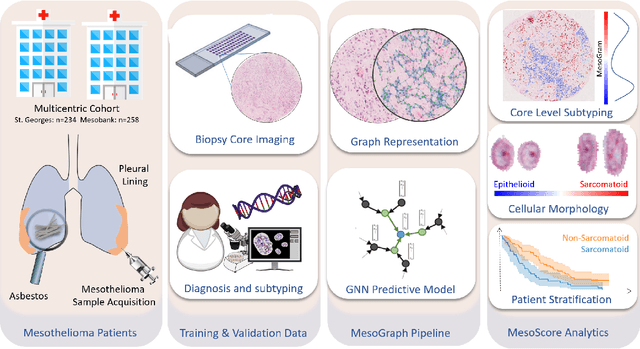
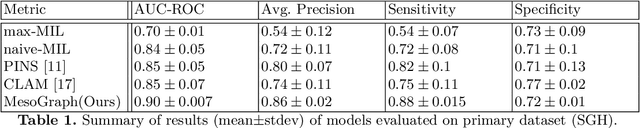
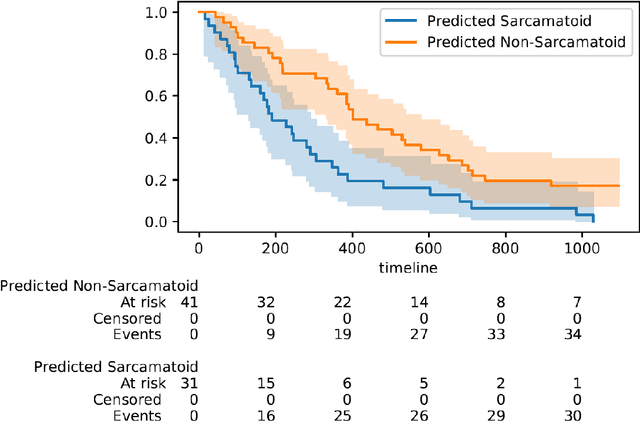
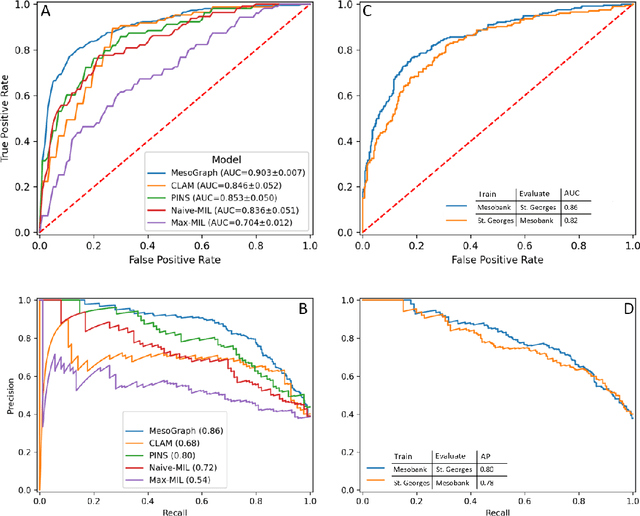
Malignant mesothelioma is classified into three histological subtypes, Epithelioid, Sarcomatoid, and Biphasic according to the relative proportions of epithelioid and sarcomatoid tumor cells present. Biphasic tumors display significant populations of both cell types. This subtyping is subjective and limited by current diagnostic guidelines and can differ even between expert thoracic pathologists when characterising the continuum of relative proportions of epithelioid and sarcomatoid components using a three class system. In this work, we develop a novel dual-task Graph Neural Network (GNN) architecture with ranking loss to learn a model capable of scoring regions of tissue down to cellular resolution. This allows quantitative profiling of a tumor sample according to the aggregate sarcomatoid association score of all the cells in the sample. The proposed approach uses only core-level labels and frames the prediction task as a dual multiple instance learning (MIL) problem. Tissue is represented by a cell graph with both cell-level morphological and regional features. We use an external multi-centric test set from Mesobank, on which we demonstrate the predictive performance of our model. We validate our model predictions through an analysis of the typical morphological features of cells according to their predicted score, finding that some of the morphological differences identified by our model match known differences used by pathologists. We further show that the model score is predictive of patient survival with a hazard ratio of 2.30. The code for the proposed approach, along with the dataset, is available at: https://github.com/measty/MesoGraph.
An Aggregation of Aggregation Methods in Computational Pathology
Nov 02, 2022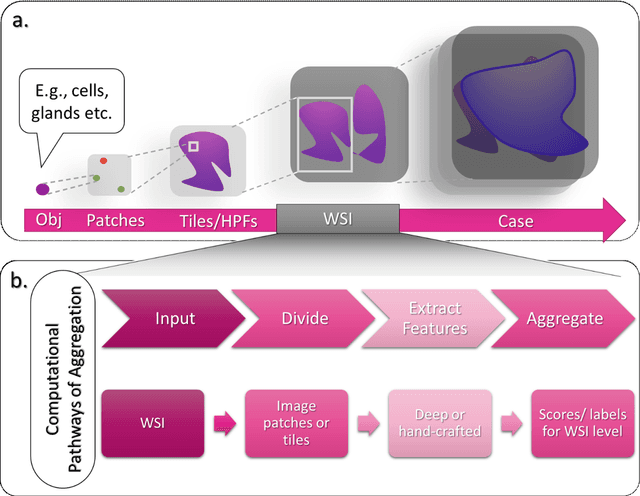
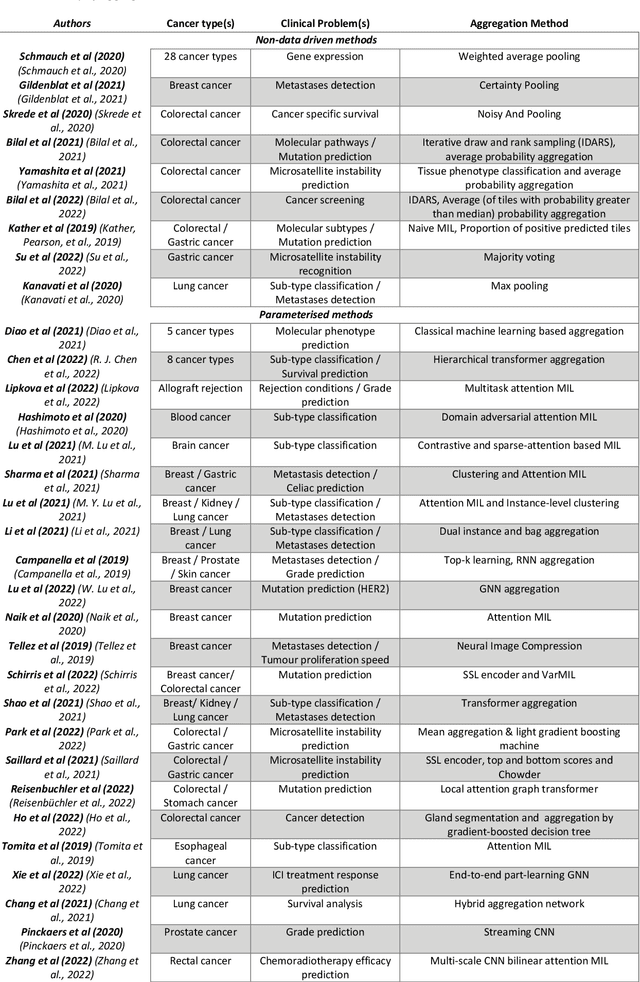
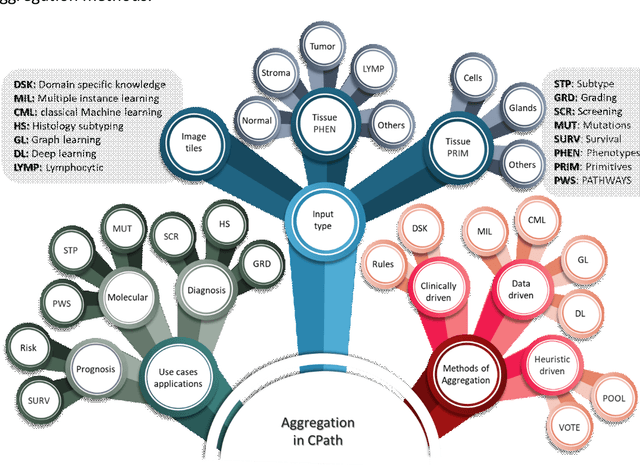
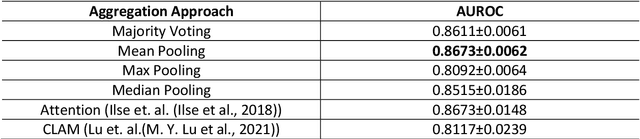
Image analysis and machine learning algorithms operating on multi-gigapixel whole-slide images (WSIs) often process a large number of tiles (sub-images) and require aggregating predictions from the tiles in order to predict WSI-level labels. In this paper, we present a review of existing literature on various types of aggregation methods with a view to help guide future research in the area of computational pathology (CPath). We propose a general CPath workflow with three pathways that consider multiple levels and types of data and the nature of computation to analyse WSIs for predictive modelling. We categorize aggregation methods according to the context and representation of the data, features of computational modules and CPath use cases. We compare and contrast different methods based on the principle of multiple instance learning, perhaps the most commonly used aggregation method, covering a wide range of CPath literature. To provide a fair comparison, we consider a specific WSI-level prediction task and compare various aggregation methods for that task. Finally, we conclude with a list of objectives and desirable attributes of aggregation methods in general, pros and cons of the various approaches, some recommendations and possible future directions.