 Add to Chrome
 Add to Firefox
 Add to Edge
\k{appa}-LoRA: Condition Numbers Reveal Which LoRA Matrices Worth Updating
Jul 24, 2026
Low-Rank Adaptation (LoRA) has become a widely adopted technique for efficient neural network fine-tuning, decomposing model updates into low-rank matrices. However, LoRA remains computationally costly because it updates all matrices uniformly, regardless of their actual contribution to adaptation. This cost is especially prohibitive for large-scale models with billions of parameters and for resource-constrained settings such as edge deployment and on-device fine-tuning. We show for the first time that not all LoRA matrices are equally worth tuning: matrices with smaller condition numbers (the ratio of largest to smallest singular value) are already well-balanced across directions and contribute only marginally to adaptation, whereas matrices with larger condition numbers contain underdeveloped directions that span richer subspaces and drive most of the performance gains. This observation itself is a key contribution of our work, and it motivates a more selective approach to fine-tuning. Building on this insight, we propose \k{appa}-LoRA, a method that optimizes LoRA by focusing updates on the matrices with the largest condition numbers, which capture the most informative directions of change. By restricting LoRA updates to the top 50% of weight matrices ranked by condition number, \k{appa}-LoRA halves the trainable parameter count and correspondingly reduces compute and memory cost. Extensive experiments across multiple benchmarks show that this design cuts fine-tuning time by 16.2% on average while matching the accuracy of standard LoRA and reducing memory cost by 4.5%. Further analysis reveals that the condition numbers of the selected matrices consistently decrease over training, suggesting that \k{appa}-LoRA's effectiveness stems from targeted spectral rebalancing rather than parameter selection alone.

Reducing the GPU Memory Bottleneck with Lossless Compression for ML -- Extended
May 29, 2026Machine learning (ML) training and inference often process data sets far exceeding GPU memory capacity, forcing them to rely on PCIe for on-demand tensor transfers, causing critical transfer bottlenecks. Lossy compression has been proposed to relieve bottlenecks but introduces workload-dependent accuracy loss, making it complex or even prohibitive to use in existing ML deployments. We explore lossless compression as an alternative that avoids this deployment complexity. We identify where lossless compression can be integrated into ML pipelines while minimizing interference with GPU execution. Based on our findings, we introduce Invariant Bit Packing (IBP), a novel lossless compression algorithm designed to minimize data transfer time for ML. IBP identifies and eliminates invariant bits across groups of tensors, improving throughput through GPU-optimized decompression that leverages warp parallelism, low-overhead bit operations, and asynchronous PCIe transfers. We provide easy-to-use APIs, showcasing them by adding IBP support to GNN training, as well as DLRM and LLM inference frameworks. IBP achieves, on average, 74% faster GNN training, 180% faster DLRM embedding lookup, and 24% faster LLM inference.
* Extended version of paper published at 21st European Conference on Computer Systems (EUROSYS '26), April 27-30, 2026, Edinburgh, Scotland Uk
Nonparametric Teaching of Attention Learners
Feb 24, 2026Attention learners, neural networks built on the attention mechanism, e.g., transformers, excel at learning the implicit relationships that relate sequences to their corresponding properties, e.g., mapping a given sequence of tokens to the probability of the next token. However, the learning process tends to be costly. To address this, we present a novel paradigm named Attention Neural Teaching (AtteNT) that reinterprets the learning process through a nonparametric teaching perspective. Specifically, the latter provides a theoretical framework for teaching mappings that are implicitly defined (i.e., nonparametric) via example selection. Such an implicit mapping is embodied through a dense set of sequence-property pairs, with the AtteNT teacher selecting a subset to accelerate convergence in attention learner training. By analytically investigating the role of attention on parameter-based gradient descent during training, and recasting the evolution of attention learners, shaped by parameter updates, through functional gradient descent in nonparametric teaching, we show for the first time that teaching attention learners is consistent with teaching importance-adaptive nonparametric learners. These new findings readily commit AtteNT to enhancing learning efficiency of attention learners. Specifically, we observe training time reductions of 13.01% for LLMs and 20.58% for ViTs, spanning both fine-tuning and training-from-scratch regimes. Crucially, these gains are achieved without compromising accuracy; in fact, performance is consistently preserved and often enhanced across a diverse set of downstream tasks.
Efficient and Adaptable Detection of Malicious LLM Prompts via Bootstrap Aggregation
Feb 08, 2026Large Language Models (LLMs) have demonstrated remarkable capabilities in natural language understanding, reasoning, and generation. However, these systems remain susceptible to malicious prompts that induce unsafe or policy-violating behavior through harmful requests, jailbreak techniques, and prompt injection attacks. Existing defenses face fundamental limitations: black-box moderation APIs offer limited transparency and adapt poorly to evolving threats, while white-box approaches using large LLM judges impose prohibitive computational costs and require expensive retraining for new attacks. Current systems force designers to choose between performance, efficiency, and adaptability. To address these challenges, we present BAGEL (Bootstrap AGgregated Ensemble Layer), a modular, lightweight, and incrementally updatable framework for malicious prompt detection. BAGEL employs a bootstrap aggregation and mixture of expert inspired ensemble of fine-tuned models, each specialized on a different attack dataset. At inference, BAGEL uses a random forest router to identify the most suitable ensemble member, then applies stochastic selection to sample additional members for prediction aggregation. When new attacks emerge, BAGEL updates incrementally by fine-tuning a small prompt-safety classifier (86M parameters) and adding the resulting model to the ensemble. BAGEL achieves an F1 score of 0.92 by selecting just 5 ensemble members (430M parameters), outperforming OpenAI Moderation API and ShieldGemma which require billions of parameters. Performance remains robust after nine incremental updates, and BAGEL provides interpretability through its router's structural features. Our results show ensembles of small finetuned classifiers can match or exceed billion-parameter guardrails while offering the adaptability and efficiency required for production systems.
RAP: KV-Cache Compression via RoPE-Aligned Pruning
Feb 01, 2026Long-context inference in large language models is increasingly bottlenecked by the memory and compute cost of the KV-Cache. Low-rank factorization compresses KV projections by writing $W \approx A * B$, where A produces latent KV states and B can be absorbed into downstream weights. In modern RoPE-based LLMs, this absorption fails: RoPE forces latent KV states to be reconstructed to full dimension, reintroducing substantial memory and compute overhead. We propose RoPE-Aligned Pruning (RAP), which prunes entire RoPE-aligned column pairs to preserve RoPE's 2x2 rotation structure, restore B absorption, and eliminate reconstruction. Our evaluation on LLaMA-3-8B and Mistral-7B shows that RAP enables joint reduction of KV-Cache, attention parameters, and FLOPs by 20-30%, all at once, while maintaining strong accuracy. Notably, RAP reduces attention latency to 83% (prefill) and 77% (decode) of baseline.
FOCUS: DLLMs Know How to Tame Their Compute Bound
Jan 30, 2026Diffusion Large Language Models (DLLMs) offer a compelling alternative to Auto-Regressive models, but their deployment is constrained by high decoding cost. In this work, we identify a key inefficiency in DLLM decoding: while computation is parallelized over token blocks, only a small subset of tokens is decodable at each diffusion step, causing most compute to be wasted on non-decodable tokens. We further observe a strong correlation between attention-derived token importance and token-wise decoding probability. Based on this insight, we propose FOCUS -- an inference system designed for DLLMs. By dynamically focusing computation on decodable tokens and evicting non-decodable ones on-the-fly, FOCUS increases the effective batch size, alleviating compute limitations and enabling scalable throughput. Empirical evaluations demonstrate that FOCUS achieves up to 3.52$\times$ throughput improvement over the production-grade engine LMDeploy, while preserving or improving generation quality across multiple benchmarks. The FOCUS system is publicly available on GitHub: https://github.com/sands-lab/FOCUS.
MAESTRO: Multi-Agent Evaluation Suite for Testing, Reliability, and Observability
Jan 01, 2026We present MAESTRO, an evaluation suite for the testing, reliability, and observability of LLM-based MAS. MAESTRO standardizes MAS configuration and execution through a unified interface, supports integrating both native and third-party MAS via a repository of examples and lightweight adapters, and exports framework-agnostic execution traces together with system-level signals (e.g., latency, cost, and failures). We instantiate MAESTRO with 12 representative MAS spanning popular agentic frameworks and interaction patterns, and conduct controlled experiments across repeated runs, backend models, and tool configurations. Our case studies show that MAS executions can be structurally stable yet temporally variable, leading to substantial run-to-run variance in performance and reliability. We further find that MAS architecture is the dominant driver of resource profiles, reproducibility, and cost-latency-accuracy trade-off, often outweighing changes in backend models or tool settings. Overall, MAESTRO enables systematic evaluation and provides empirical guidance for designing and optimizing agentic systems.
Query-based Knowledge Transfer for Heterogeneous Learning Environments
Apr 12, 2025Decentralized collaborative learning under data heterogeneity and privacy constraints has rapidly advanced. However, existing solutions like federated learning, ensembles, and transfer learning, often fail to adequately serve the unique needs of clients, especially when local data representation is limited. To address this issue, we propose a novel framework called Query-based Knowledge Transfer (QKT) that enables tailored knowledge acquisition to fulfill specific client needs without direct data exchange. QKT employs a data-free masking strategy to facilitate communication-efficient query-focused knowledge transfer while refining task-specific parameters to mitigate knowledge interference and forgetting. Our experiments, conducted on both standard and clinical benchmarks, show that QKT significantly outperforms existing collaborative learning methods by an average of 20.91\% points in single-class query settings and an average of 14.32\% points in multi-class query scenarios. Further analysis and ablation studies reveal that QKT effectively balances the learning of new and existing knowledge, showing strong potential for its application in decentralized learning.
Protecting Confidentiality, Privacy and Integrity in Collaborative Learning
Dec 11, 2024


A collaboration between dataset owners and model owners is needed to facilitate effective machine learning (ML) training. During this collaboration, however, dataset owners and model owners want to protect the confidentiality of their respective assets (i.e., datasets, models and training code), with the dataset owners also caring about the privacy of individual users whose data is in their datasets. Existing solutions either provide limited confidentiality for models and training code, or suffer from privacy issues due to collusion. We present Citadel++, a scalable collaborative ML training system designed to simultaneously protect the confidentiality of datasets, models and training code, as well as the privacy of individual users. Citadel++ enhances differential privacy techniques to safeguard the privacy of individual user data while maintaining model utility. By employing Virtual Machine-level Trusted Execution Environments (TEEs) and improved integrity protection techniques through various OS-level mechanisms, Citadel++ effectively preserves the confidentiality of datasets, models and training code, and enforces our privacy mechanisms even when the models and training code have been maliciously designed. Our experiments show that Citadel++ provides privacy, model utility and performance while adhering to confidentiality and privacy requirements of dataset owners and model owners, outperforming the state-of-the-art privacy-preserving training systems by up to 543x on CPU and 113x on GPU TEEs.
ACING: Actor-Critic for Instruction Learning in Black-Box Large Language Models
Nov 19, 2024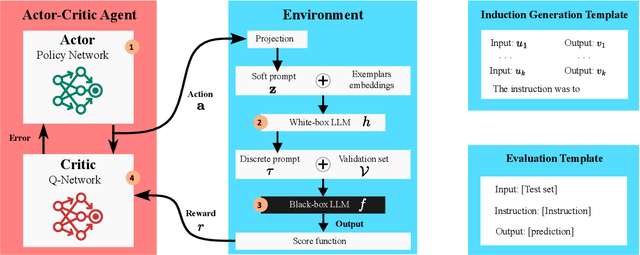
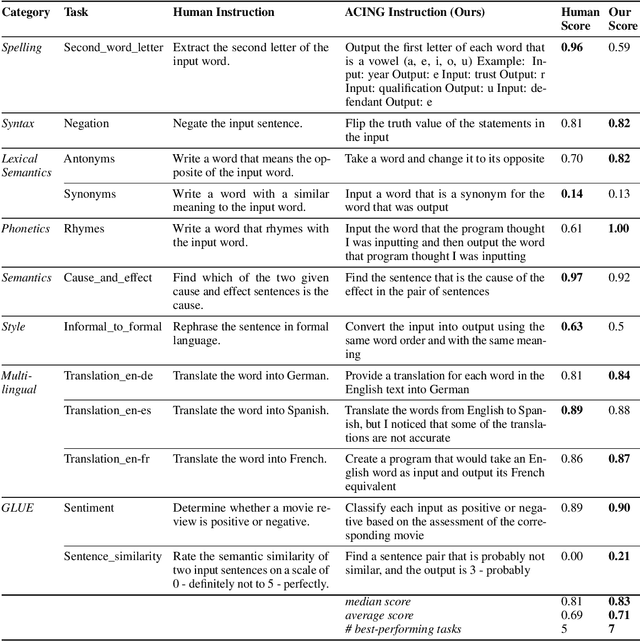
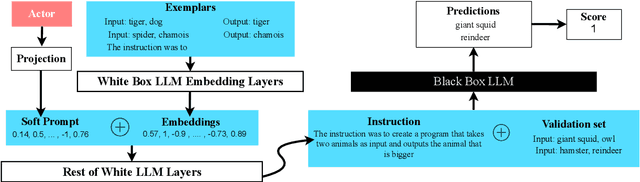
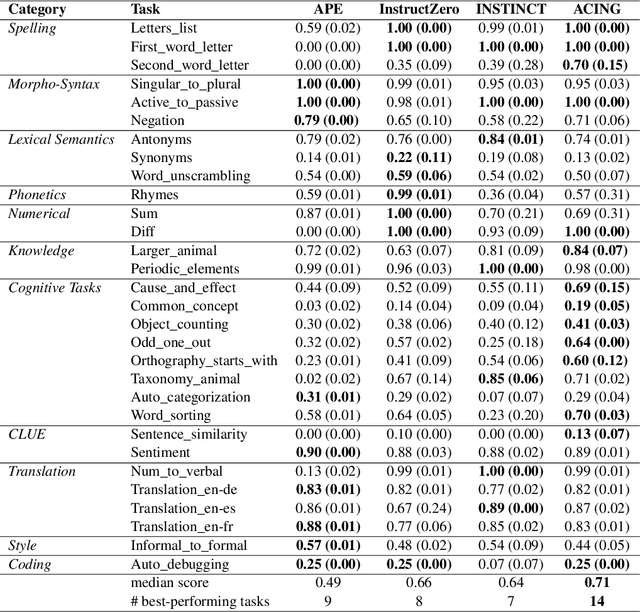
The effectiveness of Large Language Models (LLMs) in solving tasks vastly depends on the quality of the instructions, which often require fine-tuning through extensive human effort. This highlights the need for automated instruction optimization; however, this optimization is particularly challenging when dealing with black-box LLMs, where model parameters and gradients remain inaccessible. We propose ACING, a task-specific prompt optimization approach framed as a stateless continuous-action Reinforcement Learning (RL) problem, known as the continuum bandit setting. ACING leverages an actor-critic-based method to optimize prompts, learning from non-differentiable reward signals. We validate ACING by optimizing prompts for ChatGPT on 30 instruction-based tasks. ACING consistently outperforms baseline methods, achieving a median score improvement of 10 percentage points. Furthermore, ACING not only recovers but also surpasses human-crafted expert instructions, achieving up to a 39 percentage point improvement against human benchmarks.