 Add to Chrome
 Add to Firefox
 Add to Edge
Active Movable-Element RIS Assisted Vehicular Semantic Communications: Modeling and Optimization
Jul 29, 2026
Severe signal blockage and fast-varying channels in vehicular environments pose critical challenges to reliable semantic communication. To address these, this paper proposes a novel Row-Movable Active Reconfigurable Intelligent Surface (RM-A-RIS) assisted vehicular semantic communication system. This architecture uniquely combines active signal amplification with element mobility to compensate for multiplicative fading and reconstruct channel geometry, thereby enhancing spatial diversity. We formulate a joint optimization problem to maximize Semantic Spectral Efficiency (SSE) by coordinating RIS element positions, active reflection coefficients, and semantic symbol length. An efficient Alternating Optimization (AO) algorithm is developed to tackle the coupled non-convexity. Simulation results demonstrate that the proposed scheme substantially outperforms existing benchmarks, achieving up to 132.9%, 9.2%, and 35.2% improvements in Sum-Semantic Spectral Efficiency (Sum-SSE) compared to the passive RIS, fixed-position active RIS, and QPSO baselines, respectively.

Joint Optimization of Trajectory Control, Resource Allocation, and Task Offloading for Multi-UAV-Assisted IoV
May 06, 2026This paper investigates a multi-Unmanned Aerial Vehicle (UAV) joint base station-assisted Internet of Vehicles (IoV) task offloading system in dense urban environments. To minimize system delay and energy consumption under strict coupling constraints, the complex non-convex optimization problem is decoupled into a hierarchical execution framework. First, a sequential distributed optimization algorithm based on Second-Order Cone Programming (SOCP) is proposed to optimize the 3D flight trajectory of each UAV, ensuring adaptive network coverage. Second, a novel hybrid resource scheduling paradigm synergizing Deep Reinforcement Learning (DRL) and Large Language Models (LLMs) is developed. Within this framework, the DRL agent dictates the initial resource allocation, while the LLM acts as a semantic macro-scheduler to rectify long-tail allocation imbalances for failed and surplus tasks. Crucially, a reward decoupling mechanism is introduced to isolate DRL training from external LLM interventions, thereby ensuring policy convergence. Finally, the task offloading ratios are precisely determined via Linear Programming (LP) within an alternating optimization loop. Simulation results demonstrate that the proposed method significantly outperforms traditional multi-agent reinforcement learning baselines in terms of task success rate and system efficiency.
Single-Step Six-Dimensional Movable Antenna Reconfiguration for High-Mobility IoV: Modeling, Analysis, and Optimization
May 05, 2026The Six-Dimensional Movable Antenna (6DMA) system has emerged as a promising technology to enhance wireless capacity by fully exploiting spatial degrees of freedom. However, applying 6DMA to high-mobility Internet of Vehicles (IoV) scenarios faces significant challenges, primarily due to the difficulty of acquiring instantaneous Channel State Information (CSI) and the risk of service interruptions caused by mechanical reconfiguration delays. To address these issues, this paper proposes a low-complexity, CSI-free single-step reconfiguration framework. First, we design a deterministic discrete position generation scheme based on a latitude-longitude grid with inherent topological structures. Leveraging graph theory, we explicitly model and theoretically derive the lower bounds of movement and time costs for antenna reconfiguration. Subsequently, utilizing the directional sparsity of 6DMA channels, we develop an adaptive optimization strategy that fuses offline environmental priors with online historical feedback. Furthermore, a periodic reconfiguration mechanism based on predicted cumulative vehicle distributions is introduced. By strictly restricting antenna adjustments to the first-order spatial neighborhood, the proposed single-step method effectively eliminates service interruptions. Simulation results demonstrate that the proposed scheme significantly outperforms traditional fixed and global-search-based benchmarks in terms of uplink sum rate, while incurring negligible mechanical overhead and latency, thereby validating its feasibility and robustness in highly dynamic vehicular networks.
6D Movable Antenna for Internet of Vehicles: CSI-Free Dynamic Antenna Configuration
Mar 25, 2026Deploying six-dimensional movable antenna (6DMA) systems in Internet-of-Vehicles (IoV) scenarios can greatly enhance spectral efficiency. However, the high mobility of vehicles causes rapid spatio-temporal channel variations, posing a significant challenge to real-time 6DMA optimization. In this work, we pioneer the application of 6DMA in IoV and propose a low-complexity, instantaneous channel state information (CSI)-free dynamic configuration method. By integrating vehicle motion prediction with offline directional response priors, the proposed approach optimizes antenna positions and orientations at each reconfiguration epoch to maximize the average sum rate over a future time window. Simulation results in a typical urban intersection scenario demonstrate that the proposed 6DMA scheme significantly outperforms conventional fixed antenna arrays and simplified 6DMA baseline schemes in terms of total sum rate.
Semantic-Aware Cooperative Communication and Computation Framework in Vehicular Networks
Dec 10, 2025Semantic Communication (SC) combined with Vehicular edge computing (VEC) provides an efficient edge task processing paradigm for Internet of Vehicles (IoV). Focusing on highway scenarios, this paper proposes a Tripartite Cooperative Semantic Communication (TCSC) framework, which enables Vehicle Users (VUs) to perform semantic task offloading via Vehicle-to-Infrastructure (V2I) and Vehicle-to-Vehicle (V2V) communications. Considering task latency and the number of semantic symbols, the framework constructs a Mixed-Integer Nonlinear Programming (MINLP) problem, which is transformed into two subproblems. First, we innovatively propose a multi-agent proximal policy optimization task offloading optimization method based on parametric distribution noise (MAPPO-PDN) to solve the optimization problem of the number of semantic symbols; second, linear programming (LP) is used to solve offloading ratio. Simulations show that performance of this scheme is superior to that of other algorithms.
Graph Neural Networks and Deep Reinforcement Learning Based Resource Allocation for V2X Communications
Jul 09, 2024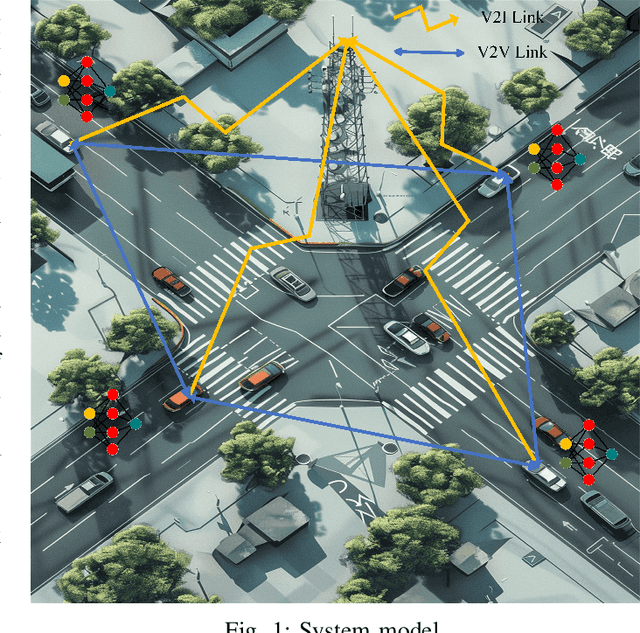
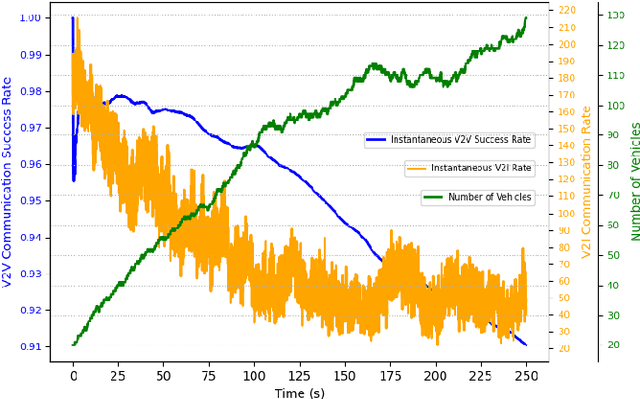
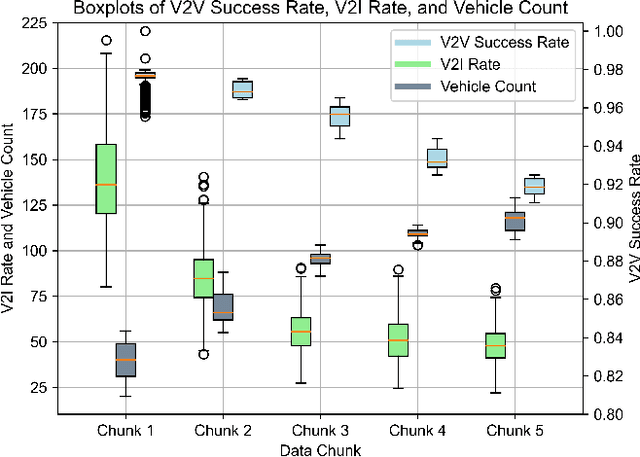
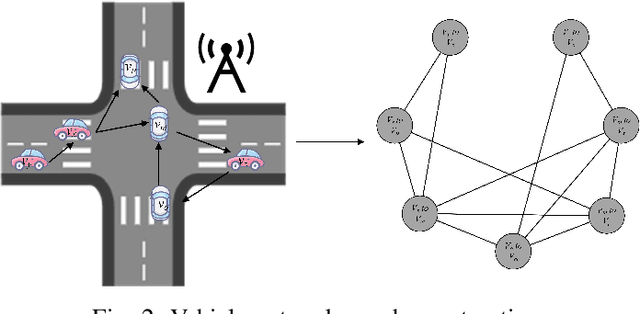
In the rapidly evolving landscape of Internet of Vehicles (IoV) technology, Cellular Vehicle-to-Everything (C-V2X) communication has attracted much attention due to its superior performance in coverage, latency, and throughput. Resource allocation within C-V2X is crucial for ensuring the transmission of safety information and meeting the stringent requirements for ultra-low latency and high reliability in Vehicle-to-Vehicle (V2V) communication. This paper proposes a method that integrates Graph Neural Networks (GNN) with Deep Reinforcement Learning (DRL) to address this challenge. By constructing a dynamic graph with communication links as nodes and employing the Graph Sample and Aggregation (GraphSAGE) model to adapt to changes in graph structure, the model aims to ensure a high success rate for V2V communication while minimizing interference on Vehicle-to-Infrastructure (V2I) links, thereby ensuring the successful transmission of V2V link information and maintaining high transmission rates for V2I links. The proposed method retains the global feature learning capabilities of GNN and supports distributed network deployment, allowing vehicles to extract low-dimensional features that include structural information from the graph network based on local observations and to make independent resource allocation decisions. Simulation results indicate that the introduction of GNN, with a modest increase in computational load, effectively enhances the decision-making quality of agents, demonstrating superiority to other methods. This study not only provides a theoretically efficient resource allocation strategy for V2V and V2I communications but also paves a new technical path for resource management in practical IoV environments.