 Add to Chrome
 Add to Firefox
 Add to Edge
VikingMem: A Memory Base Management System for Stateful LLM-based Applications
May 28, 2026
Large Language Models have revolutionized interactive applications; however, their finite context windows pose a critical data management challenge for maintaining stateful, long-term interactions. Existing memory approaches often rely on simplistic extraction methods that lead to incomplete memories or use rigid, single-purpose memory extraction prompts tailored to a single use case, such as chatbots. Consequently, they lack generalizability and perform poorly across diverse downstream tasks. To bridge this gap, we introduce the Memory Base, a novel data management paradigm for managing the persistent state of long-term interactions. It is characterized by three core principles: selective extraction of high-value memories from raw information streams; inherent statefulness and evolution, where memory content is progressively summarized, corrected, and temporally weighted to prioritize recent interactions; and a generalizable abstraction paradigm designed for robust transferability across diverse applications, including education, recommendation, and agent memory. Building on this foundation, we present VikingMem, an end-to-end Memory Base Management System implemented on the VikingDB vector engine. VikingMem materializes this paradigm through interconnected event and entity abstractions. It features event-centric memory extraction to selectively handle complex information streams, while entities are dynamically updated by events to achieve stateful evolution. Using temporal compression via a topic-wise timeline and time-weighted recall, the system progressively produces high-level summary memories, prioritizes recent items, and compresses and fades older ones. Extensive evaluations on long-term memory benchmarks demonstrate that VikingMem outperformes baselines by up to 30% in memory retrieval effectiveness while maintaining the low latency essential for interactive applications.

Efficient and Effective Retrieval of Dense-Sparse Hybrid Vectors using Graph-based Approximate Nearest Neighbor Search
Oct 27, 2024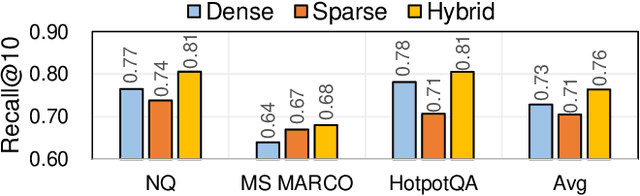
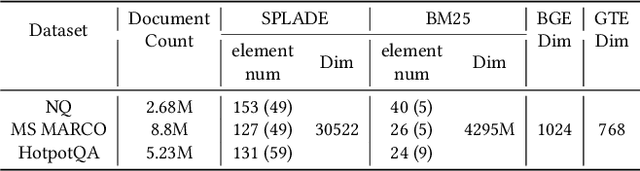
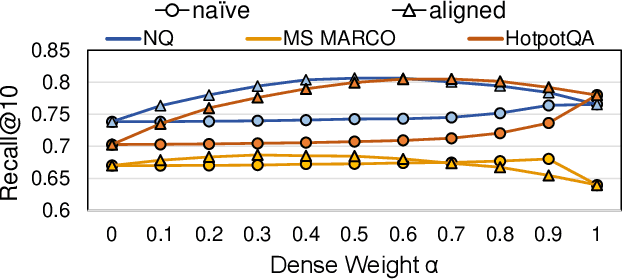
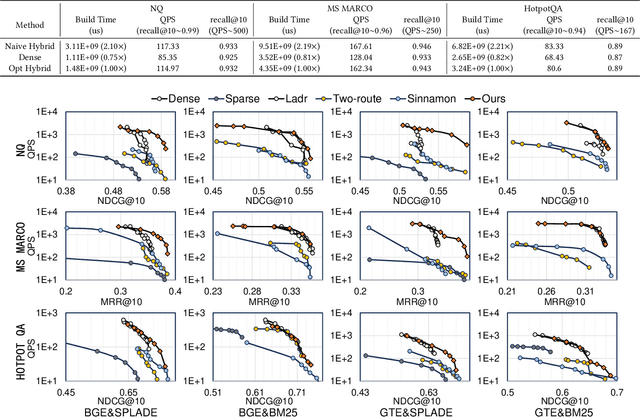
ANNS for embedded vector representations of texts is commonly used in information retrieval, with two important information representations being sparse and dense vectors. While it has been shown that combining these representations improves accuracy, the current method of conducting sparse and dense vector searches separately suffers from low scalability and high system complexity. Alternatively, building a unified index faces challenges with accuracy and efficiency. To address these issues, we propose a graph-based ANNS algorithm for dense-sparse hybrid vectors. Firstly, we propose a distribution alignment method to improve accuracy, which pre-samples dense and sparse vectors to analyze their distance distribution statistic, resulting in a 1%$\sim$9% increase in accuracy. Secondly, to improve efficiency, we design an adaptive two-stage computation strategy that initially computes dense distances only and later computes hybrid distances. Further, we prune the sparse vectors to speed up the calculation. Compared to naive implementation, we achieve $\sim2.1\times$ acceleration. Thorough experiments show that our algorithm achieves 8.9x$\sim$11.7x throughput at equal accuracy compared to existing hybrid vector search algorithms.