 Add to Chrome
 Add to Firefox
 Add to Edge
Causal Attribution via Activation Patching
Mar 13, 2026
Attribution methods for Vision Transformers (ViTs) aim to identify image regions that influence model predictions, but producing faithful and well-localized attributions remains challenging. Existing gradient-based and perturbation-based techniques often fail to isolate the causal contribution of internal representations associated with individual image patches. The key challenge is that class-relevant evidence is formed through interactions between patch tokens across layers, and input-level perturbations can be poor proxies for patch importance, since they may fail to reconstruct the internal evidence actually used by the model. We propose Causal Attribution via Activation Patching (CAAP), which estimates the contribution of individual image patches to the ViT's prediction by directly intervening on internal activations rather than using learned masks or synthetic perturbation patterns. For each patch, CAAP inserts the corresponding source-image activations into a neutral target context over an intermediate range of layers and uses the resulting target-class score as the attribution signal. The resulting attribution map reflects the causal effect of patch-associated internal representations on the model's prediction. The causal intervention serves as a principled measure of patch influence by capturing class-relevant evidence after initial representation formation, while avoiding late-layer global mixing that can reduce spatial specificity. Across multiple ViT backbones and standard metrics, CAAP significantly outperforms existing methods and produces more faithful and localized attributions.

Eye-Q: A Multilingual Benchmark for Visual Word Puzzle Solving and Image-to-Phrase Reasoning
Jan 06, 2026Vision-Language Models (VLMs) have achieved strong performance on standard vision-language benchmarks, yet often rely on surface-level recognition rather than deeper reasoning. We propose visual word puzzles as a challenging alternative, as they require discovering implicit visual cues, generating and revising hypotheses, and mapping perceptual evidence to non-literal concepts in ways that are difficult to solve via literal grounding, OCR-heavy shortcuts, or simple retrieval-style matching. We introduce Eye-Q, a multilingual benchmark designed to assess this form of complex visual understanding. Eye-Q contains 1,343 puzzles in which a model observes a conceptually dense scene with a brief description and must infer a specific target word or phrase. The puzzles are intentionally unstructured and cue-implicit, with distractors and contextual relationships that demand selective attention, abstraction, and associative inference. The benchmark spans English, Persian, Arabic, and cross-lingual puzzles. We evaluate state-of-the-art VLMs using an open-ended, human-aligned protocol that probes hypothesis formation and revision under lightweight assistance. Results reveal substantial performance gaps, especially on abstract and cross-lingual puzzles, highlighting limitations in current models' ability to construct and search over appropriate conceptual representations for flexible image-to-phrase inference; maximum accuracy reaches only 60.27%.
Generative AI for Character Animation: A Comprehensive Survey of Techniques, Applications, and Future Directions
Apr 27, 2025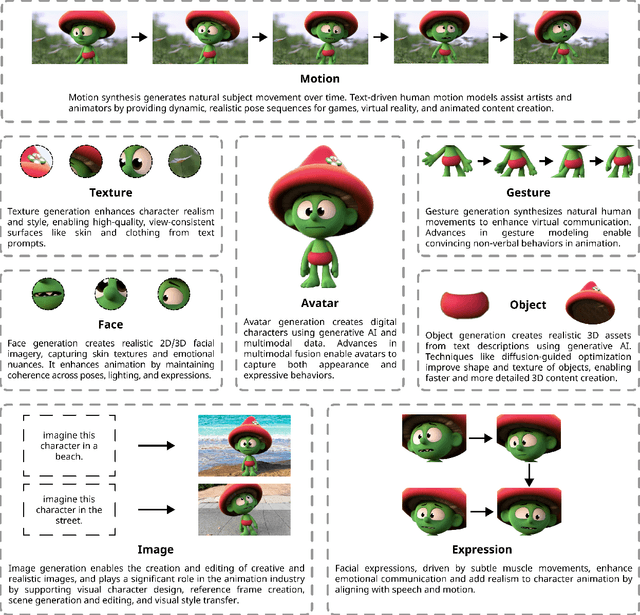
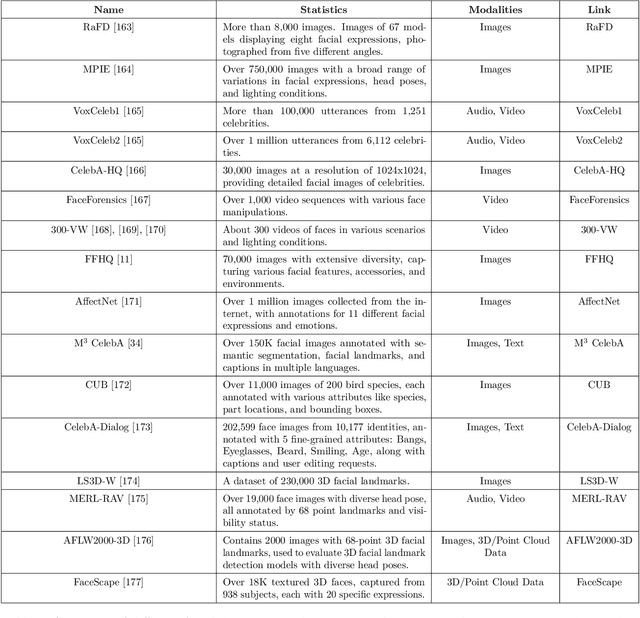
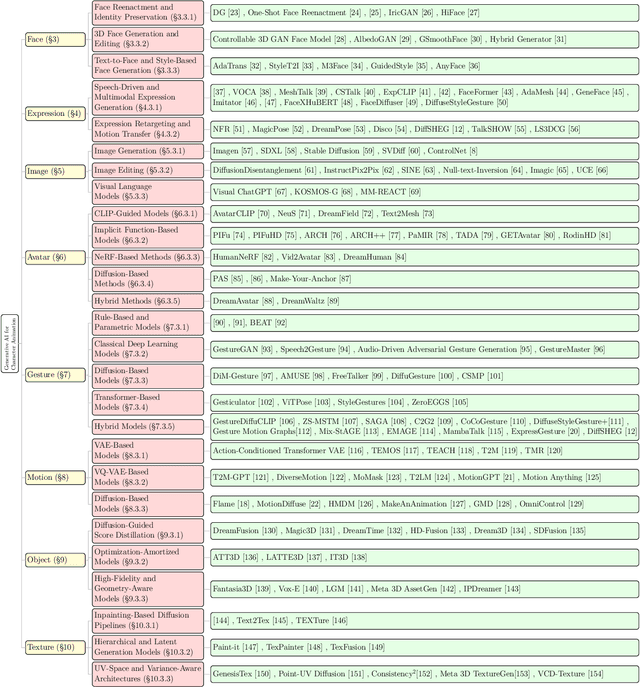
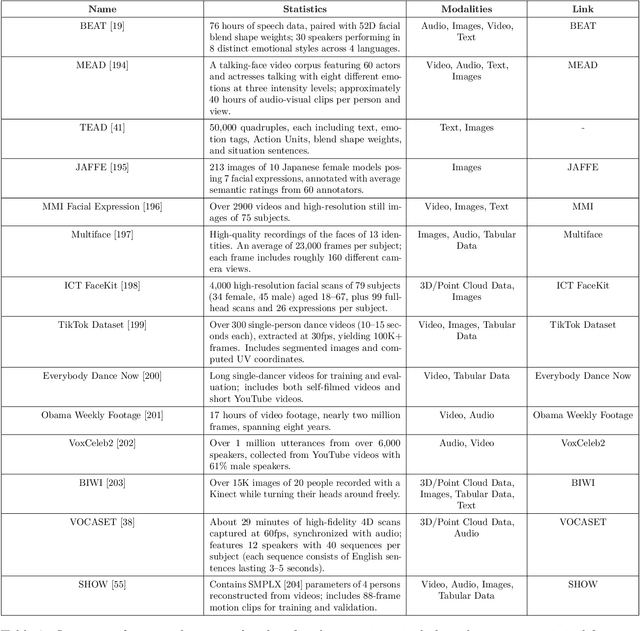
Generative AI is reshaping art, gaming, and most notably animation. Recent breakthroughs in foundation and diffusion models have reduced the time and cost of producing animated content. Characters are central animation components, involving motion, emotions, gestures, and facial expressions. The pace and breadth of advances in recent months make it difficult to maintain a coherent view of the field, motivating the need for an integrative review. Unlike earlier overviews that treat avatars, gestures, or facial animation in isolation, this survey offers a single, comprehensive perspective on all the main generative AI applications for character animation. We begin by examining the state-of-the-art in facial animation, expression rendering, image synthesis, avatar creation, gesture modeling, motion synthesis, object generation, and texture synthesis. We highlight leading research, practical deployments, commonly used datasets, and emerging trends for each area. To support newcomers, we also provide a comprehensive background section that introduces foundational models and evaluation metrics, equipping readers with the knowledge needed to enter the field. We discuss open challenges and map future research directions, providing a roadmap to advance AI-driven character-animation technologies. This survey is intended as a resource for researchers and developers entering the field of generative AI animation or adjacent fields. Resources are available at: https://github.com/llm-lab-org/Generative-AI-for-Character-Animation-Survey.