 Add to Chrome
 Add to Firefox
 Add to Edge
DRIVE: Data Curation Best Practices for Reinforcement Learning with Verifiable Reward in Competitive Code Generation
Nov 09, 2025
Recent reasoning-first models (e.g., OpenAI o1, DeepSeek R1) have spurred a resurgence of interest in RLVR. Nevertheless, advances are dominated by mathematics (e.g., AIME), with competitive-programming code generation underexplored and data curation receiving less attention than RL algorithm design. We investigate how to construct RLVR datasets (i.e., RL prompts) and present practical training techniques that yield strong performance on competitive-programming code generation. Our pipeline begins with supervised fine-tuning (SFT) distilled from strong open-source models, augmented with general-purpose and reasoning-intensive data. RL then follows a two-stage process with executable, testcase-driven rewards: first, training on a large, uniformly distributed set of competitive-programming problems using Group Relative Policy Optimization (GRPO) with 8 rollouts per prompt and a relatively short response-generation window (e.g., 32k during SFT and 24k in this stage) to expand entropy and mitigate repetition and truncation; second, we perform \textbf{Pre-GRPO}: updating on a small, high-quality set of challenging problems with a large rollout budget (64 rollouts per prompt) under a hard-focus curriculum that continuously retains the most difficult instances throughout training. We implement our method on Qwen2.5-32B and evaluate on LeetCode and Codeforces weekly contests to avoid data leakage. The resulting model achieves state-of-the-art performance among models of similar scale and is comparable to leading systems such as DeepSeek v3.1 and Doubao-1.5-Thinking. We also examine scaling trends and observe strong RL scaling on an internal large-scale MoE model. Our study distills concise best practices for data curation, entropy expansion, and curriculum design in RLVR for competitive-programming code generation.

Hunyuan-TurboS: Advancing Large Language Models through Mamba-Transformer Synergy and Adaptive Chain-of-Thought
May 21, 2025As Large Language Models (LLMs) rapidly advance, we introduce Hunyuan-TurboS, a novel large hybrid Transformer-Mamba Mixture of Experts (MoE) model. It synergistically combines Mamba's long-sequence processing efficiency with Transformer's superior contextual understanding. Hunyuan-TurboS features an adaptive long-short chain-of-thought (CoT) mechanism, dynamically switching between rapid responses for simple queries and deep "thinking" modes for complex problems, optimizing computational resources. Architecturally, this 56B activated (560B total) parameter model employs 128 layers (Mamba2, Attention, FFN) with an innovative AMF/MF block pattern. Faster Mamba2 ensures linear complexity, Grouped-Query Attention minimizes KV cache, and FFNs use an MoE structure. Pre-trained on 16T high-quality tokens, it supports a 256K context length and is the first industry-deployed large-scale Mamba model. Our comprehensive post-training strategy enhances capabilities via Supervised Fine-Tuning (3M instructions), a novel Adaptive Long-short CoT Fusion method, Multi-round Deliberation Learning for iterative improvement, and a two-stage Large-scale Reinforcement Learning process targeting STEM and general instruction-following. Evaluations show strong performance: overall top 7 rank on LMSYS Chatbot Arena with a score of 1356, outperforming leading models like Gemini-2.0-Flash-001 (1352) and o4-mini-2025-04-16 (1345). TurboS also achieves an average of 77.9% across 23 automated benchmarks. Hunyuan-TurboS balances high performance and efficiency, offering substantial capabilities at lower inference costs than many reasoning models, establishing a new paradigm for efficient large-scale pre-trained models.
Hunyuan-Large: An Open-Source MoE Model with 52 Billion Activated Parameters by Tencent
Nov 05, 2024


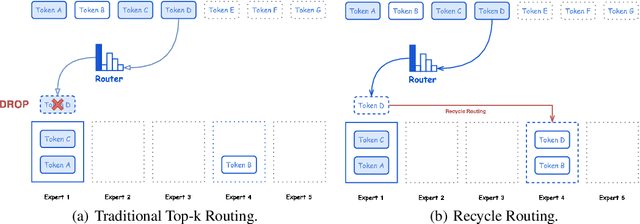
In this paper, we introduce Hunyuan-Large, which is currently the largest open-source Transformer-based mixture of experts model, with a total of 389 billion parameters and 52 billion activation parameters, capable of handling up to 256K tokens. We conduct a thorough evaluation of Hunyuan-Large's superior performance across various benchmarks including language understanding and generation, logical reasoning, mathematical problem-solving, coding, long-context, and aggregated tasks, where it outperforms LLama3.1-70B and exhibits comparable performance when compared to the significantly larger LLama3.1-405B model. Key practice of Hunyuan-Large include large-scale synthetic data that is orders larger than in previous literature, a mixed expert routing strategy, a key-value cache compression technique, and an expert-specific learning rate strategy. Additionally, we also investigate the scaling laws and learning rate schedule of mixture of experts models, providing valuable insights and guidances for future model development and optimization. The code and checkpoints of Hunyuan-Large are released to facilitate future innovations and applications. Codes: https://github.com/Tencent/Hunyuan-Large Models: https://huggingface.co/tencent/Tencent-Hunyuan-Large