 Add to Chrome
 Add to Firefox
 Add to Edge
MXNorm: Reusing MXFP block scales for efficient tensor normalisation
Mar 13, 2026
Matrix multiplication performance has long been the major bottleneck to scaling deep learning workloads, which has stimulated the design of new accelerators that use increasingly low-precision number formats. However, improvements in matrix multiplication performance have far outstripped improvements in performance on reductions and elementwise computations, which are still being performed in higher precision. In this work, we propose MXNorm, a drop-in replacement for RMSNorm that estimates the RMS using only the block scales calculated as part of the MXFP8 cast and enables a 32x decrease in the size of reduction needed for normalization. We validate our approximation method on pre-training of Llama 3 models of 125M, 1B and 8B parameters, finding minimal loss of training accuracy compared to a baseline using RMSNorm with MXFP8 matmuls. We also show practical kernel speedups using only torch.compile of up to 2.4x for MXNorm over RMSNorm, corresponding to a 1.3% speedup in Llama 3 8B transformer layers in MXFP8 and a 2.6% speedup in NVFP4.

u-$μ$P: The Unit-Scaled Maximal Update Parametrization
Jul 24, 2024The Maximal Update Parametrization ($\mu$P) aims to make the optimal hyperparameters (HPs) of a model independent of its size, allowing them to be swept using a cheap proxy model rather than the full-size target model. We present a new scheme, u-$\mu$P, which improves upon $\mu$P by combining it with Unit Scaling, a method for designing models that makes them easy to train in low-precision. The two techniques have a natural affinity: $\mu$P ensures that the scale of activations is independent of model size, and Unit Scaling ensures that activations, weights and gradients begin training with a scale of one. This synthesis opens the door to a simpler scheme, whose default values are near-optimal. This in turn facilitates a more efficient sweeping strategy, with u-$\mu$P models reaching a lower loss than comparable $\mu$P models and working out-of-the-box in FP8.
CCN GAC Workshop: Issues with learning in biological recurrent neural networks
May 12, 2021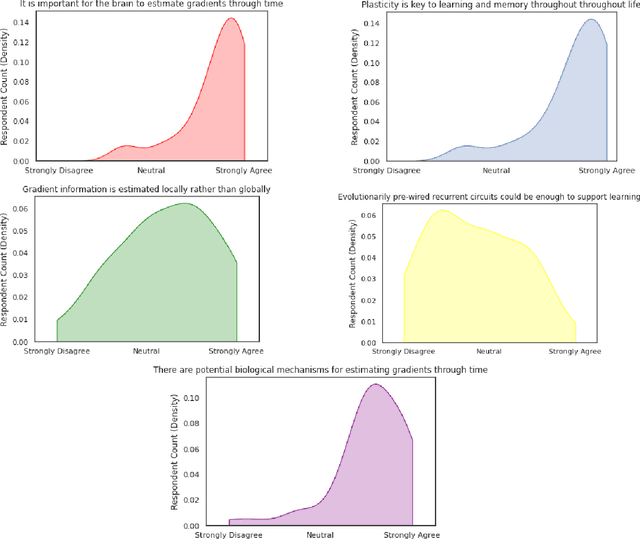
This perspective piece came about through the Generative Adversarial Collaboration (GAC) series of workshops organized by the Computational Cognitive Neuroscience (CCN) conference in 2020. We brought together a number of experts from the field of theoretical neuroscience to debate emerging issues in our understanding of how learning is implemented in biological recurrent neural networks. Here, we will give a brief review of the common assumptions about biological learning and the corresponding findings from experimental neuroscience and contrast them with the efficiency of gradient-based learning in recurrent neural networks commonly used in artificial intelligence. We will then outline the key issues discussed in the workshop: synaptic plasticity, neural circuits, theory-experiment divide, and objective functions. Finally, we conclude with recommendations for both theoretical and experimental neuroscientists when designing new studies that could help to bring clarity to these issues.