 Add to Chrome
 Add to Firefox
 Add to Edge
MXNorm: Reusing MXFP block scales for efficient tensor normalisation
Mar 13, 2026
Matrix multiplication performance has long been the major bottleneck to scaling deep learning workloads, which has stimulated the design of new accelerators that use increasingly low-precision number formats. However, improvements in matrix multiplication performance have far outstripped improvements in performance on reductions and elementwise computations, which are still being performed in higher precision. In this work, we propose MXNorm, a drop-in replacement for RMSNorm that estimates the RMS using only the block scales calculated as part of the MXFP8 cast and enables a 32x decrease in the size of reduction needed for normalization. We validate our approximation method on pre-training of Llama 3 models of 125M, 1B and 8B parameters, finding minimal loss of training accuracy compared to a baseline using RMSNorm with MXFP8 matmuls. We also show practical kernel speedups using only torch.compile of up to 2.4x for MXNorm over RMSNorm, corresponding to a 1.3% speedup in Llama 3 8B transformer layers in MXFP8 and a 2.6% speedup in NVFP4.

Scalify: scale propagation for efficient low-precision LLM training
Jul 24, 2024
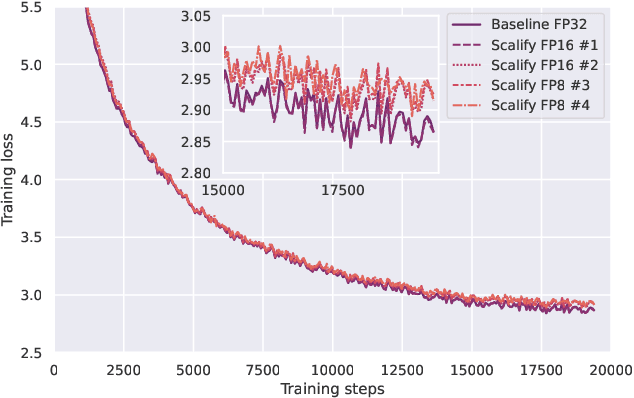
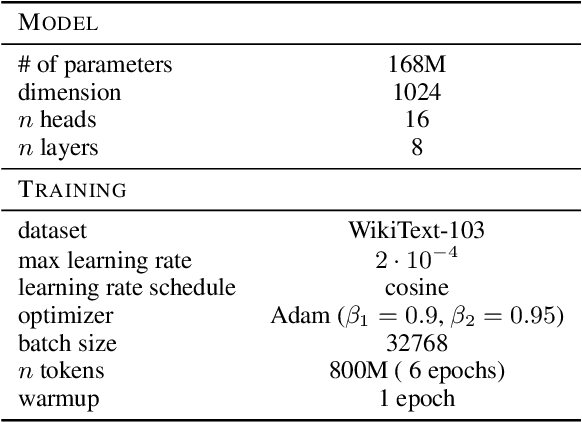
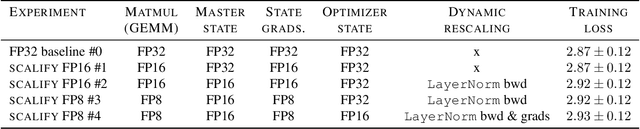
Low-precision formats such as float8 have been introduced in machine learning accelerated hardware to improve computational efficiency for large language models training and inference. Nevertheless, adoption by the ML community has been slowed down by the complex, and sometimes brittle, techniques required to match higher precision training accuracy. In this work, we present Scalify, a end-to-end scale propagation paradigm for computational graphs, generalizing and formalizing existing tensor scaling methods. Experiment results show that Scalify supports out-of-the-box float8 matrix multiplication and gradients representation, as well as float16 optimizer state storage. Our JAX implementation of Scalify is open-sourced at https://github.com/graphcore-research/jax-scalify