 Add to Chrome
 Add to Firefox
 Add to Edge
MXNorm: Reusing MXFP block scales for efficient tensor normalisation
Mar 13, 2026
Matrix multiplication performance has long been the major bottleneck to scaling deep learning workloads, which has stimulated the design of new accelerators that use increasingly low-precision number formats. However, improvements in matrix multiplication performance have far outstripped improvements in performance on reductions and elementwise computations, which are still being performed in higher precision. In this work, we propose MXNorm, a drop-in replacement for RMSNorm that estimates the RMS using only the block scales calculated as part of the MXFP8 cast and enables a 32x decrease in the size of reduction needed for normalization. We validate our approximation method on pre-training of Llama 3 models of 125M, 1B and 8B parameters, finding minimal loss of training accuracy compared to a baseline using RMSNorm with MXFP8 matmuls. We also show practical kernel speedups using only torch.compile of up to 2.4x for MXNorm over RMSNorm, corresponding to a 1.3% speedup in Llama 3 8B transformer layers in MXFP8 and a 2.6% speedup in NVFP4.

$\texttt{MiniMol}$: A Parameter-Efficient Foundation Model for Molecular Learning
Apr 23, 2024In biological tasks, data is rarely plentiful as it is generated from hard-to-gather measurements. Therefore, pre-training foundation models on large quantities of available data and then transfer to low-data downstream tasks is a promising direction. However, how to design effective foundation models for molecular learning remains an open question, with existing approaches typically focusing on models with large parameter capacities. In this work, we propose $\texttt{MiniMol}$, a foundational model for molecular learning with 10 million parameters. $\texttt{MiniMol}$ is pre-trained on a mix of roughly 3300 sparsely defined graph- and node-level tasks of both quantum and biological nature. The pre-training dataset includes approximately 6 million molecules and 500 million labels. To demonstrate the generalizability of $\texttt{MiniMol}$ across tasks, we evaluate it on downstream tasks from the Therapeutic Data Commons (TDC) ADMET group showing significant improvements over the prior state-of-the-art foundation model across 17 tasks. $\texttt{MiniMol}$ will be a public and open-sourced model for future research.
Towards Foundational Models for Molecular Learning on Large-Scale Multi-Task Datasets
Oct 18, 2023

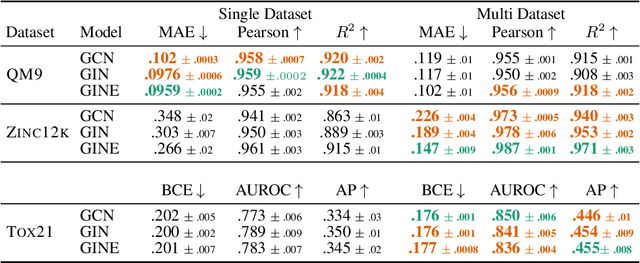

Recently, pre-trained foundation models have enabled significant advancements in multiple fields. In molecular machine learning, however, where datasets are often hand-curated, and hence typically small, the lack of datasets with labeled features, and codebases to manage those datasets, has hindered the development of foundation models. In this work, we present seven novel datasets categorized by size into three distinct categories: ToyMix, LargeMix and UltraLarge. These datasets push the boundaries in both the scale and the diversity of supervised labels for molecular learning. They cover nearly 100 million molecules and over 3000 sparsely defined tasks, totaling more than 13 billion individual labels of both quantum and biological nature. In comparison, our datasets contain 300 times more data points than the widely used OGB-LSC PCQM4Mv2 dataset, and 13 times more than the quantum-only QM1B dataset. In addition, to support the development of foundational models based on our proposed datasets, we present the Graphium graph machine learning library which simplifies the process of building and training molecular machine learning models for multi-task and multi-level molecular datasets. Finally, we present a range of baseline results as a starting point of multi-task and multi-level training on these datasets. Empirically, we observe that performance on low-resource biological datasets show improvement by also training on large amounts of quantum data. This indicates that there may be potential in multi-task and multi-level training of a foundation model and fine-tuning it to resource-constrained downstream tasks.