 Add to Chrome
 Add to Firefox
 Add to Edge
Stochastic Emulation of a Fully Coupled Preindustrial E3SMv3 Simulation
Aug 10, 2026
We present a stochastic coupled emulator of E3SM version 3, built on the SamudrACE framework, which couples an atmosphere emulator (ACE2) with a full-depth ocean emulator (Samudra). We replace the deterministic atmosphere emulator with its stochastic counterpart, ACE2S, and fine-tune the coupled system with a probabilistic objective, so that the atmosphere acts as a source of internal variability for the ocean. Trained on 105 years of a pre-industrial control simulation and evaluated on an independent 400 years, the emulator reproduces E3SMv3's mean climate state with biases much smaller than existing model-to-observation differences. Relative to a deterministic baseline, stochastic training maintains internal variability across timescales, most notably in the ENSO power spectrum, eddy-rich SST anomalies, and sea ice variability in the marginal ice zone. The emulator captures daily precipitation accurately up to the 99.99th percentile, but underestimates the rarest tropical extremes. These results show that stochastic coupled emulators can reproduce long-timescale variability with high fidelity, while extrapolation to unseen extremes remains a key challenge.

Streamlining Ocean Dynamics Modeling with Fourier Neural Operators: A Multiobjective Hyperparameter and Architecture Optimization Approach
Apr 10, 2024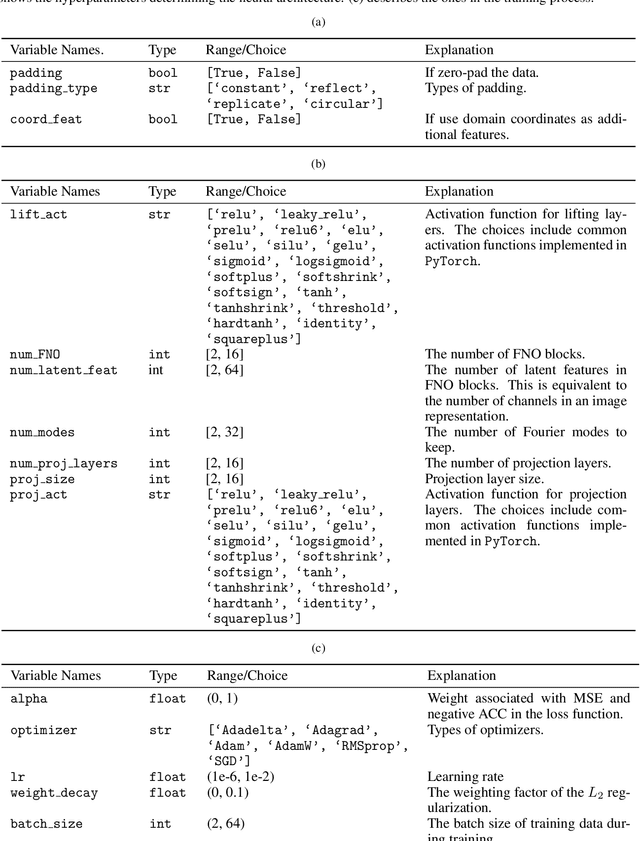
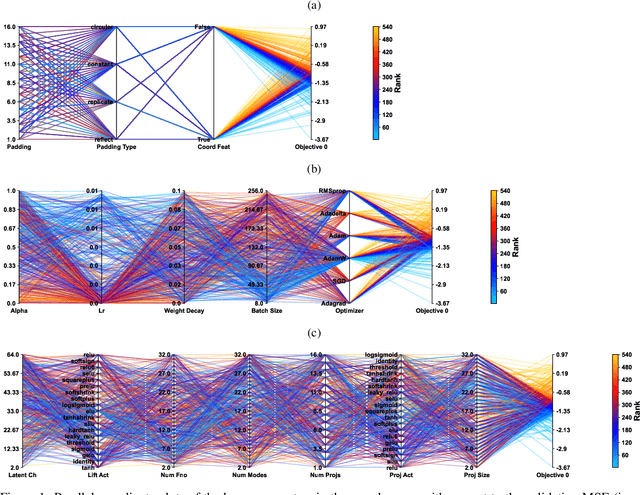
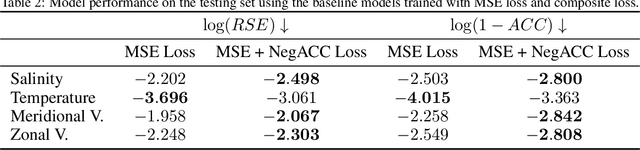
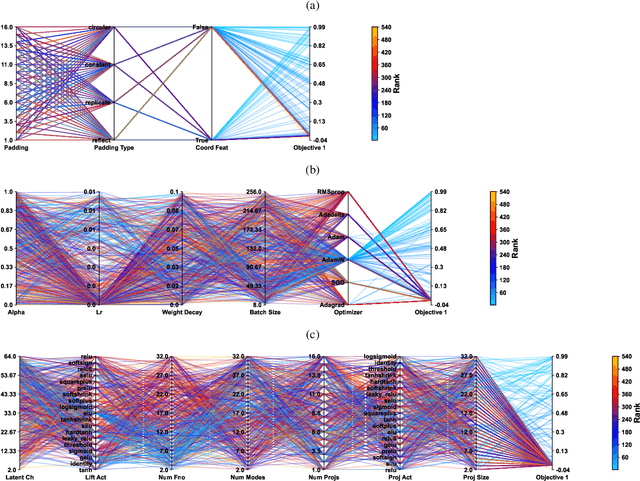
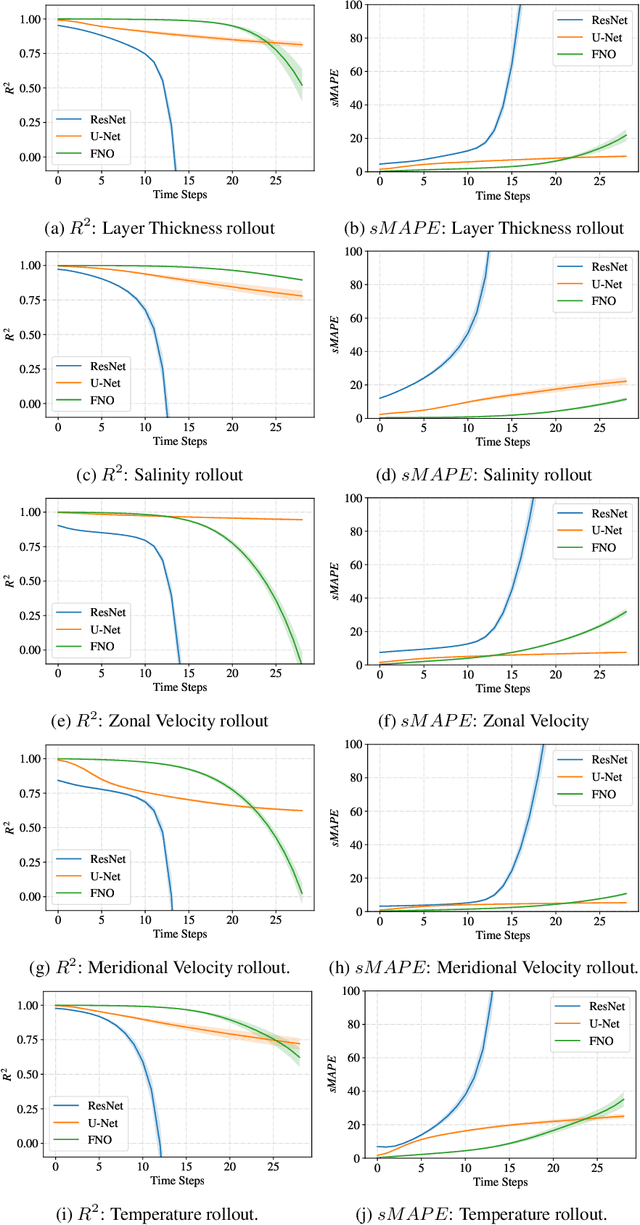
Training an effective deep learning model to learn ocean processes involves careful choices of various hyperparameters. We leverage the advanced search algorithms for multiobjective optimization in DeepHyper, a scalable hyperparameter optimization software, to streamline the development of neural networks tailored for ocean modeling. The focus is on optimizing Fourier neural operators (FNOs), a data-driven model capable of simulating complex ocean behaviors. Selecting the correct model and tuning the hyperparameters are challenging tasks, requiring much effort to ensure model accuracy. DeepHyper allows efficient exploration of hyperparameters associated with data preprocessing, FNO architecture-related hyperparameters, and various model training strategies. We aim to obtain an optimal set of hyperparameters leading to the most performant model. Moreover, on top of the commonly used mean squared error for model training, we propose adopting the negative anomaly correlation coefficient as the additional loss term to improve model performance and investigate the potential trade-off between the two terms. The experimental results show that the optimal set of hyperparameters enhanced model performance in single timestepping forecasting and greatly exceeded the baseline configuration in the autoregressive rollout for long-horizon forecasting up to 30 days. Utilizing DeepHyper, we demonstrate an approach to enhance the use of FNOs in ocean dynamics forecasting, offering a scalable solution with improved precision.
Surrogate Neural Networks to Estimate Parametric Sensitivity of Ocean Models
Nov 10, 2023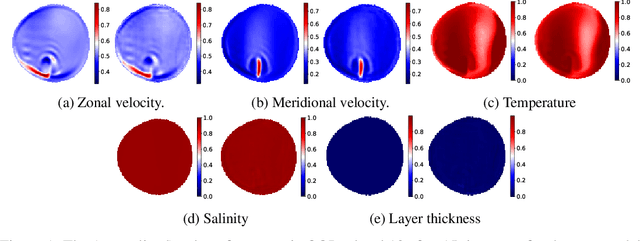
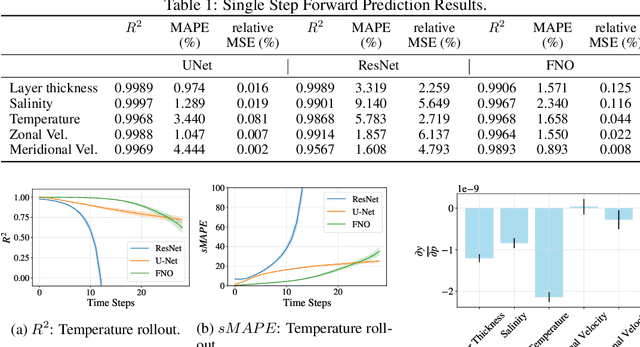
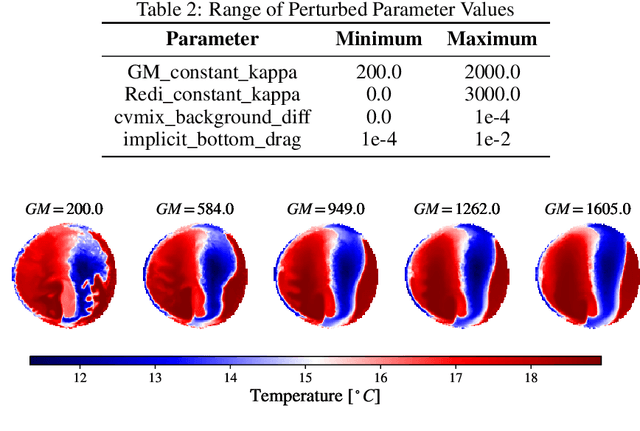
Modeling is crucial to understanding the effect of greenhouse gases, warming, and ice sheet melting on the ocean. At the same time, ocean processes affect phenomena such as hurricanes and droughts. Parameters in the models that cannot be physically measured have a significant effect on the model output. For an idealized ocean model, we generated perturbed parameter ensemble data and trained surrogate neural network models. The neural surrogates accurately predicted the one-step forward dynamics, of which we then computed the parametric sensitivity.