 Add to Chrome
 Add to Firefox
 Add to Edge
BRICKS: Compositional Neural Markov Kernels for Zero-Shot Radiation-Matter Simulation
May 07, 2026
We introduce a new strategy for compositional neural surrogates for radiation-matter interactions, a key task spanning domains from particle physics through nuclear and space engineering to medical physics. Exploiting the locality and the Markov nature of particle interactions, we create a \emph{next-particle prediction} kernel using hybrid discrete-continuous transformer models based on Riemannian Flow Matching on product manifolds. The model generates variable-sized typed sets of particles and radiation side effects that are the result of the interaction of an incident particle with a material volume. The resulting kernel can be composed to simulate unseen large-scale material distributions in a zero-shot manner. Unlike mechanistic simulators, our model is designed to be differentiable, provides tractable likelihoods for future downstream applications. A significant computational speed-up on GPU compared to CPU-bound mechanistic simulation is observed for single-kernel execution. We evaluate the model at the kernel level and demonstrate predictive stability over multi-round autoregressive rollouts. We additionally release a novel 20M-event radiation-matter interaction dataset for further research.

Gradient estimators for parameter inference in discrete stochastic kinetic models
Apr 02, 2026Stochastic kinetic models are ubiquitous in physics, yet inferring their parameters from experimental data remains challenging. In deterministic models, parameter inference often relies on gradients, as they can be obtained efficiently through automatic differentiation. However, these tools cannot be directly applied to stochastic simulation algorithms (SSA) such as the Gillespie algorithm, since sampling from a discrete set of reactions introduces non-differentiable operations. In this work, we adopt three gradient estimators from machine learning for the Gillespie SSA: the Gumbel-Softmax Straight-Through (GS-ST) estimator, the Score Function estimator, and the Alternative Path estimator. We compare the properties of all estimators in two representative systems exhibiting relaxation or oscillatory dynamics, where the latter requires gradient estimation of time-dependent objective functions. We find that the GS-ST estimator mostly yields well-behaved gradient estimates, but exhibits diverging variance in challenging parameter regimes, resulting in unsuccessful parameter inference. In these cases, the other estimators provide more robust, lower variance gradients. Our results demonstrate that gradient-based parameter inference can be integrated effectively with the Gillespie SSA, with different estimators offering complementary advantages.
Neural Scaling Laws for Boosted Jet Tagging
Feb 17, 2026The success of Large Language Models (LLMs) has established that scaling compute, through joint increases in model capacity and dataset size, is the primary driver of performance in modern machine learning. While machine learning has long been an integral component of High Energy Physics (HEP) data analysis workflows, the compute used to train state-of-the-art HEP models remains orders of magnitude below that of industry foundation models. With scaling laws only beginning to be studied in the field, we investigate neural scaling laws for boosted jet classification using the public JetClass dataset. We derive compute optimal scaling laws and identify an effective performance limit that can be consistently approached through increased compute. We study how data repetition, common in HEP where simulation is expensive, modifies the scaling yielding a quantifiable effective dataset size gain. We then study how the scaling coefficients and asymptotic performance limits vary with the choice of input features and particle multiplicity, demonstrating that increased compute reliably drives performance toward an asymptotic limit, and that more expressive, lower-level features can raise the performance limit and improve results at fixed dataset size.
Strategic White Paper on AI Infrastructure for Particle, Nuclear, and Astroparticle Physics: Insights from JENA and EuCAIF
Mar 18, 2025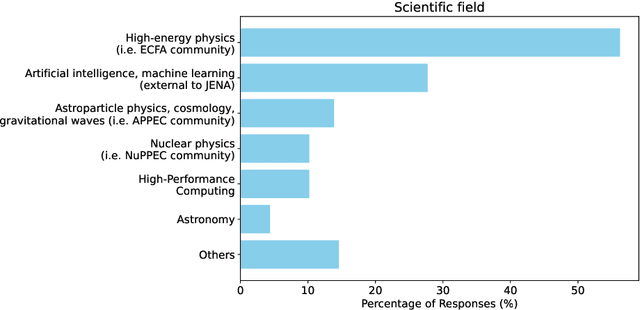
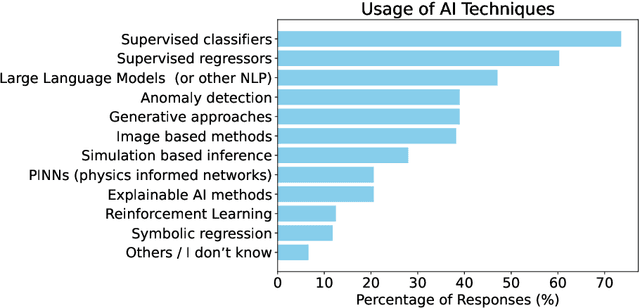
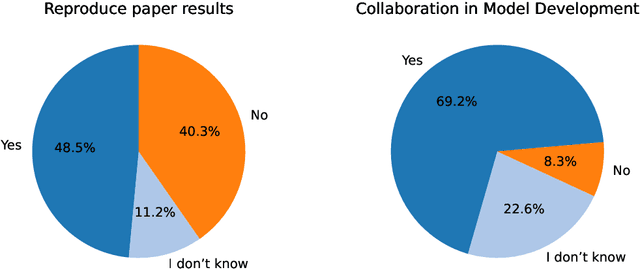
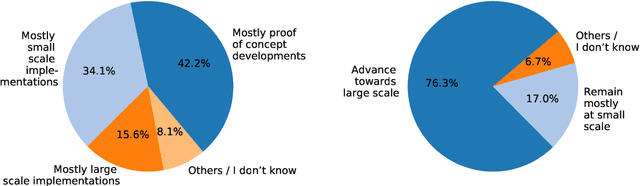
Artificial intelligence (AI) is transforming scientific research, with deep learning methods playing a central role in data analysis, simulations, and signal detection across particle, nuclear, and astroparticle physics. Within the JENA communities-ECFA, NuPECC, and APPEC-and as part of the EuCAIF initiative, AI integration is advancing steadily. However, broader adoption remains constrained by challenges such as limited computational resources, a lack of expertise, and difficulties in transitioning from research and development (R&D) to production. This white paper provides a strategic roadmap, informed by a community survey, to address these barriers. It outlines critical infrastructure requirements, prioritizes training initiatives, and proposes funding strategies to scale AI capabilities across fundamental physics over the next five years.
Combined track finding with GNN & CKF
Jan 29, 2024The application of Graph Neural Networks (GNN) in track reconstruction is a promising approach to cope with the challenges arising at the High-Luminosity upgrade of the Large Hadron Collider (HL-LHC). GNNs show good track-finding performance in high-multiplicity scenarios and are naturally parallelizable on heterogeneous compute architectures. Typical high-energy-physics detectors have high resolution in the innermost layers to support vertex reconstruction but lower resolution in the outer parts. GNNs mainly rely on 3D space-point information, which can cause reduced track-finding performance in the outer regions. In this contribution, we present a novel combination of GNN-based track finding with the classical Combinatorial Kalman Filter (CKF) algorithm to circumvent this issue: The GNN resolves the track candidates in the inner pixel region, where 3D space points can represent measurements very well. These candidates are then picked up by the CKF in the outer regions, where the CKF performs well even for 1D measurements. Using the ACTS infrastructure, we present a proof of concept based on truth tracking in the pixels as well as a dedicated GNN pipeline trained on $t\bar{t}$ events with pile-up 200 in the OpenDataDetector.
Masked Particle Modeling on Sets: Towards Self-Supervised High Energy Physics Foundation Models
Jan 25, 2024


We propose masked particle modeling (MPM) as a self-supervised method for learning generic, transferable, and reusable representations on unordered sets of inputs for use in high energy physics (HEP) scientific data. This work provides a novel scheme to perform masked modeling based pre-training to learn permutation invariant functions on sets. More generally, this work provides a step towards building large foundation models for HEP that can be generically pre-trained with self-supervised learning and later fine-tuned for a variety of down-stream tasks. In MPM, particles in a set are masked and the training objective is to recover their identity, as defined by a discretized token representation of a pre-trained vector quantized variational autoencoder. We study the efficacy of the method in samples of high energy jets at collider physics experiments, including studies on the impact of discretization, permutation invariance, and ordering. We also study the fine-tuning capability of the model, showing that it can be adapted to tasks such as supervised and weakly supervised jet classification, and that the model can transfer efficiently with small fine-tuning data sets to new classes and new data domains.
Finetuning Foundation Models for Joint Analysis Optimization
Jan 25, 2024In this work we demonstrate that significant gains in performance and data efficiency can be achieved in High Energy Physics (HEP) by moving beyond the standard paradigm of sequential optimization or reconstruction and analysis components. We conceptually connect HEP reconstruction and analysis to modern machine learning workflows such as pretraining, finetuning, domain adaptation and high-dimensional embedding spaces and quantify the gains in the example usecase of searches of heavy resonances decaying via an intermediate di-Higgs system to four $b$-jets.
Branches of a Tree: Taking Derivatives of Programs with Discrete and Branching Randomness in High Energy Physics
Aug 31, 2023
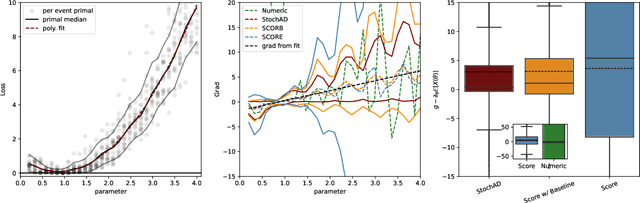
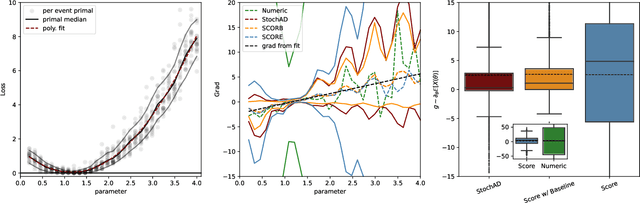

We propose to apply several gradient estimation techniques to enable the differentiation of programs with discrete randomness in High Energy Physics. Such programs are common in High Energy Physics due to the presence of branching processes and clustering-based analysis. Thus differentiating such programs can open the way for gradient based optimization in the context of detector design optimization, simulator tuning, or data analysis and reconstruction optimization. We discuss several possible gradient estimation strategies, including the recent Stochastic AD method, and compare them in simplified detector design experiments. In doing so we develop, to the best of our knowledge, the first fully differentiable branching program.
Hierarchical Neural Simulation-Based Inference Over Event Ensembles
Jun 21, 2023When analyzing real-world data it is common to work with event ensembles, which comprise sets of observations that collectively constrain the parameters of an underlying model of interest. Such models often have a hierarchical structure, where "local" parameters impact individual events and "global" parameters influence the entire dataset. We introduce practical approaches for optimal dataset-wide probabilistic inference in cases where the likelihood is intractable, but simulations can be realized via forward modeling. We construct neural estimators for the likelihood(-ratio) or posterior and show that explicitly accounting for the model's hierarchical structure can lead to tighter parameter constraints. We ground our discussion using case studies from the physical sciences, focusing on examples from particle physics (particle collider data) and astrophysics (strong gravitational lensing observations).
Configurable calorimeter simulation for AI applications
Mar 08, 2023A configurable calorimeter simulation for AI (COCOA) applications is presented, based on the Geant4 toolkit and interfaced with the Pythia event generator. This open-source project is aimed to support the development of machine learning algorithms in high energy physics that rely on realistic particle shower descriptions, such as reconstruction, fast simulation, and low-level analysis. Specifications such as the granularity and material of its nearly hermetic geometry are user-configurable. The tool is supplemented with simple event processing including topological clustering, jet algorithms, and a nearest-neighbors graph construction. Formatting is also provided to visualise events using the Phoenix event display software.