 Add to Chrome
 Add to Firefox
 Add to Edge
BRICKS: Compositional Neural Markov Kernels for Zero-Shot Radiation-Matter Simulation
May 07, 2026
We introduce a new strategy for compositional neural surrogates for radiation-matter interactions, a key task spanning domains from particle physics through nuclear and space engineering to medical physics. Exploiting the locality and the Markov nature of particle interactions, we create a \emph{next-particle prediction} kernel using hybrid discrete-continuous transformer models based on Riemannian Flow Matching on product manifolds. The model generates variable-sized typed sets of particles and radiation side effects that are the result of the interaction of an incident particle with a material volume. The resulting kernel can be composed to simulate unseen large-scale material distributions in a zero-shot manner. Unlike mechanistic simulators, our model is designed to be differentiable, provides tractable likelihoods for future downstream applications. A significant computational speed-up on GPU compared to CPU-bound mechanistic simulation is observed for single-kernel execution. We evaluate the model at the kernel level and demonstrate predictive stability over multi-round autoregressive rollouts. We additionally release a novel 20M-event radiation-matter interaction dataset for further research.

New directions for surrogate models and differentiable programming for High Energy Physics detector simulation
Mar 15, 2022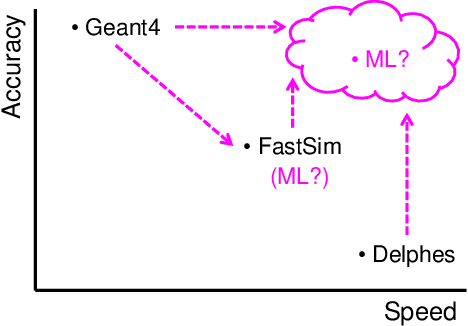
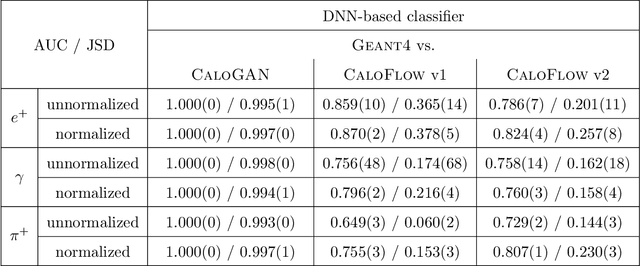
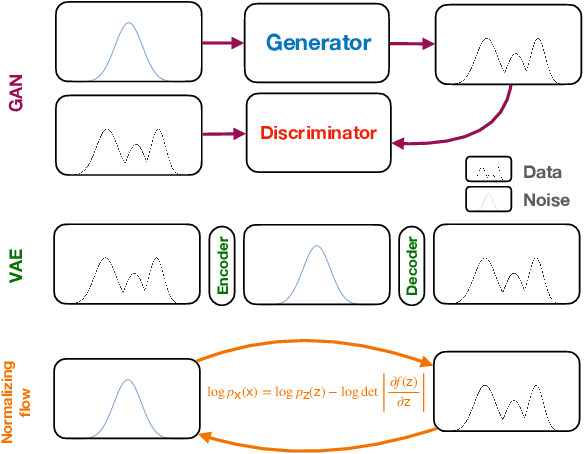
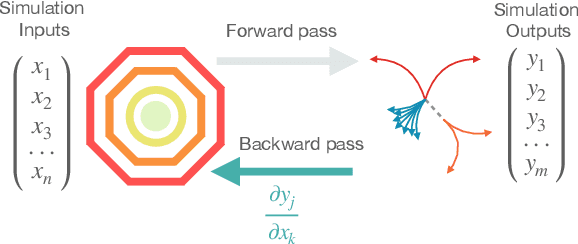
The computational cost for high energy physics detector simulation in future experimental facilities is going to exceed the current available resources. To overcome this challenge, new ideas on surrogate models using machine learning methods are being explored to replace computationally expensive components. Additionally, differentiable programming has been proposed as a complementary approach, providing controllable and scalable simulation routines. In this document, new and ongoing efforts for surrogate models and differential programming applied to detector simulation are discussed in the context of the 2021 Particle Physics Community Planning Exercise (`Snowmass').