 Add to Chrome
 Add to Firefox
 Add to Edge
Gradient estimators for parameter inference in discrete stochastic kinetic models
Apr 02, 2026
Stochastic kinetic models are ubiquitous in physics, yet inferring their parameters from experimental data remains challenging. In deterministic models, parameter inference often relies on gradients, as they can be obtained efficiently through automatic differentiation. However, these tools cannot be directly applied to stochastic simulation algorithms (SSA) such as the Gillespie algorithm, since sampling from a discrete set of reactions introduces non-differentiable operations. In this work, we adopt three gradient estimators from machine learning for the Gillespie SSA: the Gumbel-Softmax Straight-Through (GS-ST) estimator, the Score Function estimator, and the Alternative Path estimator. We compare the properties of all estimators in two representative systems exhibiting relaxation or oscillatory dynamics, where the latter requires gradient estimation of time-dependent objective functions. We find that the GS-ST estimator mostly yields well-behaved gradient estimates, but exhibits diverging variance in challenging parameter regimes, resulting in unsuccessful parameter inference. In these cases, the other estimators provide more robust, lower variance gradients. Our results demonstrate that gradient-based parameter inference can be integrated effectively with the Gillespie SSA, with different estimators offering complementary advantages.

Flow Matching for Atmospheric Retrieval of Exoplanets: Where Reliability meets Adaptive Noise Levels
Oct 28, 2024
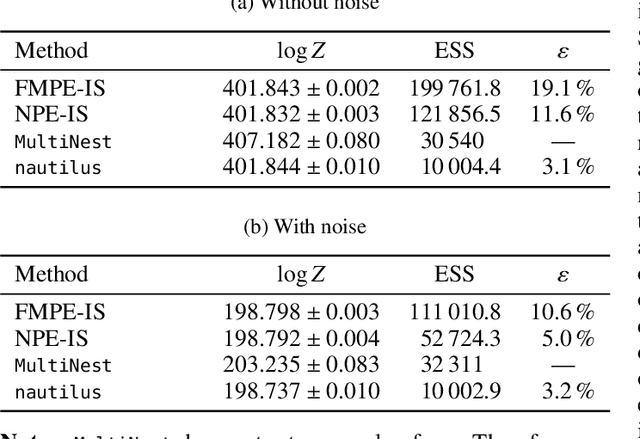


Inferring atmospheric properties of exoplanets from observed spectra is key to understanding their formation, evolution, and habitability. Since traditional Bayesian approaches to atmospheric retrieval (e.g., nested sampling) are computationally expensive, a growing number of machine learning (ML) methods such as neural posterior estimation (NPE) have been proposed. We seek to make ML-based atmospheric retrieval (1) more reliable and accurate with verified results, and (2) more flexible with respect to the underlying neural networks and the choice of the assumed noise models. First, we adopt flow matching posterior estimation (FMPE) as a new ML approach to atmospheric retrieval. FMPE maintains many advantages of NPE, but provides greater architectural flexibility and scalability. Second, we use importance sampling (IS) to verify and correct ML results, and to compute an estimate of the Bayesian evidence. Third, we condition our ML models on the assumed noise level of a spectrum (i.e., error bars), thus making them adaptable to different noise models. Both our noise level-conditional FMPE and NPE models perform on par with nested sampling across a range of noise levels when tested on simulated data. FMPE trains about 3 times faster than NPE and yields higher IS efficiencies. IS successfully corrects inaccurate ML results, identifies model failures via low efficiencies, and provides accurate estimates of the Bayesian evidence. FMPE is a powerful alternative to NPE for fast, amortized, and parallelizable atmospheric retrieval. IS can verify results, thus helping to build confidence in ML-based approaches, while also facilitating model comparison via the evidence ratio. Noise level conditioning allows design studies for future instruments to be scaled up, for example, in terms of the range of signal-to-noise ratios.