 Add to Chrome
 Add to Firefox
 Add to Edge
A Bilateral Teleoperation Framework for Dexterous Manipulation
Jun 13, 2026
Dexterous teleoperation requires precise arm-hand coordination, low-latency feedback, and robust interaction in real-world contact-rich environments. This paper presents a modular bilateral teleoperation framework that integrates operator-side input interfaces with a robot-side dexterous hand and compliant robotic arm in a unified control architecture. The system supports position-based hand retargeting, differential arm control, multi-scale haptic feedback, and shared control for stable manipulation. We validate the framework through a real-world dexterous manipulation task, highlighting coordinated arm-hand control and contact-aware interaction. Beyond feasibility, we identify key design insights related to cross-embodiment mismatch, haptic feedback granularity, and shared control. The proposed platform provides a practical teleoperation system and a foundation for collecting high-quality demonstrations for future learning-from-demonstration research.

Knowledge-Based Zero-Replay Debugging of Multi-Agent LLM Traces
Jun 11, 2026Reliable operation of multi-agent large language model (LLM) systems depends on debugging long execution traces, where the few causally decisive events are buried in unstructured logs of messages, routes, memory writes, and tool calls. The standard tool is counterfactual replay (rewind, edit, and re-run the trajectory to measure each event's effect), but its cost grows linearly with the number of candidate events, making exhaustive replay infeasible at scale. We frame trace debugging as a knowledge-based decision-support problem. Each trace is compiled into a structured event knowledge graph over routing, memory, tool-use, uncertainty, and latent evidence, and a calibrated predictor decides where a scarce replay budget should be spent. We do not propose a new replay oracle; we propose a method to predict its results without paying the replay cost. We formulate zero-replay counterfactual-effect prediction: given a trace under a fixed budget, predict which events the oracle would mark high-effect before any replay is performed. BranchPoint-Latent is a lightweight predictor over observable, structural, uncertainty, and latent features of the knowledge graph. Calibrated against a deterministic replay oracle across 37 trace families, a single learning-to-rank gradient-boosted predictor raises per-trace localization (Branch Recall@5) from 0.73 to 0.93 on held-out families at zero oracle-replay cost. Rather than claiming universal dominance, we characterize when cheap graph centrality suffices and when learned evidence is necessary. The result is an auditable, cost-efficient decision-support system for AI-reliability debugging, positioned explicitly on the cost-accuracy frontier with reproducible artifacts.
ARISTO Hand: Sensing-Driven Distal Hyperextension for Fine-Grained Manipulation
May 28, 2026Manipulating thin objects requires precise contact geometry and reliable force perception, yet many anthropomorphic robotic hands lack the mechanical and sensing capabilities needed for such interactions. We present the ARISTO Hand, a tendon-driven robotic hand that integrates active distal hyperextension with a hybrid fingertip-sensing architecture that combines a rigid, nail-mounted force-torque sensor and a soft capacitive tactile array. Active hyperextension enables controlled fingertip engagement beyond the kinematic limits of standard flexion, increasing pull-out force by 2.76x for object thicknesses of 1-20 mm while preserving the nominal grasp capability. The rigid nail-mounted sensor provides reliable force measurements during edge contacts, where the sensitivity of proprioceptive force estimation degrades as the contact geometry approaches kinematic singularities. We validate the proposed architecture through quantitative force characterization and a multi-stage SD card extraction and insertion task. Video and supplementary materials are available at: https://aristohand.github.io
PLATO Hand: Shaping Contact Behavior with Fingernails for Precise Manipulation
Feb 05, 2026We present the PLATO Hand, a dexterous robotic hand with a hybrid fingertip that embeds a rigid fingernail within a compliant pulp. This design shapes contact behavior to enable diverse interaction modes across a range of object geometries. We develop a strain-energy-based bending-indentation model to guide the fingertip design and to explain how guided contact preserves local indentation while suppressing global bending. Experimental results show that the proposed robotic hand design demonstrates improved pinching stability, enhanced force observability, and successful execution of edge-sensitive manipulation tasks, including paper singulation, card picking, and orange peeling. Together, these results show that coupling structured contact geometry with a force-motion transparent mechanism provides a principled, physically embodied approach to precise manipulation.
RPC: A Modular Framework for Robot Planning, Control, and Deployment
Sep 16, 2024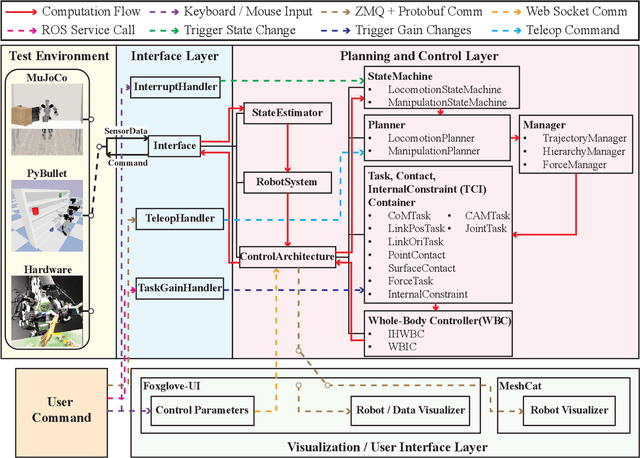
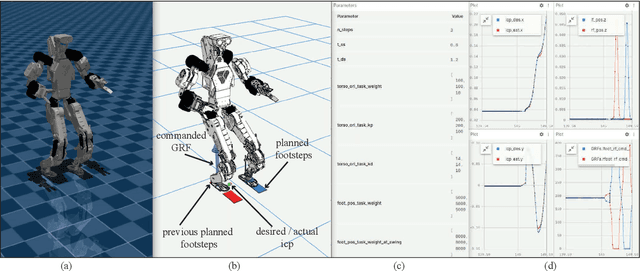
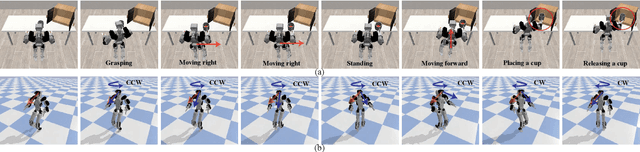
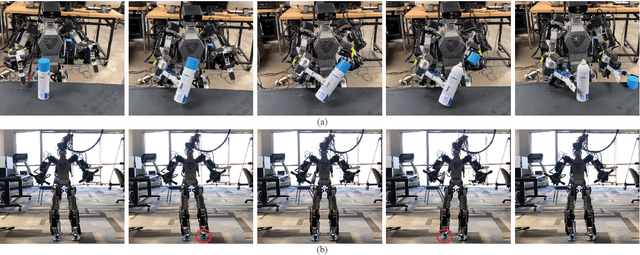
This paper presents an open-source, lightweight, yet comprehensive software framework, named RPC, which integrates physics-based simulators, planning and control libraries, debugging tools, and a user-friendly operator interface. RPC enables users to thoroughly evaluate and develop control algorithms for robotic systems. While existing software frameworks provide some of these capabilities, integrating them into a cohesive system can be challenging and cumbersome. To overcome this challenge, we have modularized each component in RPC to ensure easy and seamless integration or replacement with new modules. Additionally, our framework currently supports a variety of model-based planning and control algorithms for robotic manipulators and legged robots, alongside essential debugging tools, making it easier for users to design and execute complex robotics tasks. The code and usage instructions of RPC are available at https://github.com/shbang91/rpc.