 Add to Chrome
 Add to Firefox
 Add to Edge
sLTN: Structural Logic Tensor Networks
Aug 11, 2026
Logic Tensor Networks (LTN) provide a neurosymbolic framework in which first-order logic is interpreted through tensor operations, enabling logical constraints to be integrated with differentiable learning. However, the original formulation of LTN is primarily suited to data represented as flat collections of individuals, and does not explicitly capture structural organization such as temporal order, sequential position, or graph connectivity. We introduce sLTN, an extension of LTN that makes structural dimensions first-class elements of the language. Structural dimensions represent named tensor axes associated with domain-specific organization, such as time steps, sequence positions, or graph nodes. They can be quantified explicitly, related through structural relations, and used to express temporal, sequential, and relational constraints directly at the logical level. We formalize the syntax and fuzzy tensor semantics of sLTN and show that, in the absence of structural dimensions, the framework recovers the original LTN semantics as a special case. We further describe a PyTorch implementation based on a declarative signature, formula parsing, and tensorial interpretation. The framework is illustrated on representative temporal and sequential reasoning examples. This paper serves as a companion to the sltn library, available at https://github.com/logictensornetworks/sltn.

IMPRINT: Image-Conditioned Query Enrichment for Long-Tail Object Goal Navigation
Jul 27, 2026Embodied AI increasingly relies on queryable semantic maps built from pre-trained vision-language models to enable zero-shot Object Goal Navigation (ObjectNav). However, existing approaches typically depend on text-only queries, which become less reliable as semantic specificity increases toward fine-grained object categories. We introduce IMPRINT, a zero-shot plug-and-play framework that enriches textual object queries with web-sourced images to improve grounding in queryable maps. Retrieved images are encoded using a vision-language model, matched against the semantic map to produce similarity maps, and aggregated to yield context-aware localization. Notably, this requires no training or modification of the underlying navigation policy. To explicitly evaluate long-tail behavior, we present HSSD-rare, a new ObjectNav benchmark built on Habitat Synthetic Scenes and featuring semantically specific subcategories. Across both OVON and HSSD-rare, image-conditioned queries consistently improve object grounding and yield end-to-end navigation gains. Further analysis reveals that translating localization gains to navigation performance depends critically on downstream detection quality, highlighting a key systems bottleneck in long-tail embodied navigation.
What VGGT Knows About Overlap: Probing Geometric Foundation Models for Co-Visibility
Jul 10, 2026A fundamental challenge in 3D reconstruction and robotic localization is co-visibility: determining which image pairs share overlapping visible surfaces, particularly in scenarios with minimal overlap. We demonstrate that VGGT implicitly encodes co-visibility as an emergent behavior: without any supervision for this task, its internal representations exhibit a clear hierarchical structure mirroring that of large language models, i.e. early layers build a 3D-aware scene representation, while late layers act as dedicated co-visibility reasoners. In particular, we identify layer L17 as a negative anchor that consistently routes non-co-visible pairs for this backbone, regardless of the evaluation setting, providing task-grounded evidence of layer specialization in a geometry-grounded foundation model. Building on this, we introduce Co-VGGT, which freezes VGGT and trains only a lightweight layer-wise mixture-of-experts head (less than 7.5M parameters) to classify co-visibility from RGB alone, treating each layer as a specialized expert whose geometric abstraction is adaptively weighted per input pair. On the Co-VisiON benchmark, Co-VGGT surpasses the human annotation baseline and improves over prior work by more than 25% pairwise and 10% multiview. Pairwise predictions are well-calibrated (ECE=0.030), enabling direct use as edge weights in visibility graphs for downstream SfM and SLAM pipelines without post-hoc correction. Code and data are available.
FLAGG: Flexible Autoregressive Graph Generation
Jun 03, 2026The Deep Graph Generation's panorama spans two extremes: one-shot and sequential models. The former generates nodes and edges jointly, while the latter samples them autoregressively. Each method performs better in different graph domains depending on size and topology, but neither is applicable to all graph categories. For instance, one-shot methods struggle with generating large graphs, while sequential methods underperform on smaller graphs. A possible way to overcome these limitations is to flexibly combine the two methods in a unique system. In this work, we propose the FLAGG (Flexible Autoregressive Graph Generation) framework, which sequentially generates portions of graphs with one-shot models. FLAGG can apply any one-shot model to make it autoregressive, allowing flexibility in choosing the sequential policy. This policy is specified through a stochastic node removal process, which an Insertion Model learns to reverse. We evaluate FLAGG with the DiGress one-shot model on several data sets of different graph sizes and domains. We show that the approach outperforms both one-shot and autoregressive baselines in terms of sampling quality.
Discrete World Models via Regularization
Mar 02, 2026World models aim to capture the states and dynamics of an environment in a compact latent space. Moreover, using Boolean state representations is particularly useful for search heuristics and symbolic reasoning and planning. Existing approaches keep latents informative via decoder-based reconstruction, or instead via contrastive or reward signals. In this work, we introduce Discrete World Models via Regularization (DWMR): a reconstruction-free and contrastive-free method for unsupervised Boolean world-model learning. In particular, we introduce a novel world-modeling loss that couples latent prediction with specialized regularizers. Such regularizers maximize the entropy and independence of the representation bits through variance, correlation, and coskewness penalties, while simultaneously enforcing a locality prior for sparse action changes. To enable effective optimization, we also introduce a novel training scheme improving robustness to discrete roll-outs. Experiments on two benchmarks with underlying combinatorial structure show that DWMR learns more accurate representations and transitions than reconstruction-based alternatives. Finally, DWMR can also be paired with an auxiliary reconstruction decoder, and this combination yields additional gains.
Aligning Generalisation Between Humans and Machines
Nov 23, 2024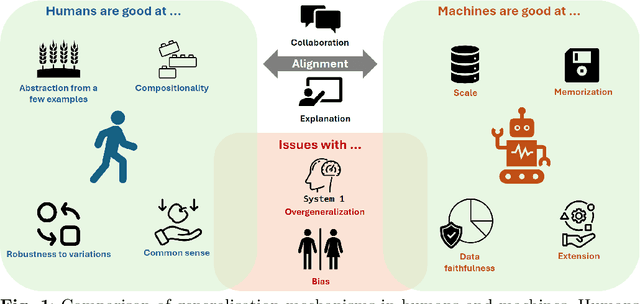
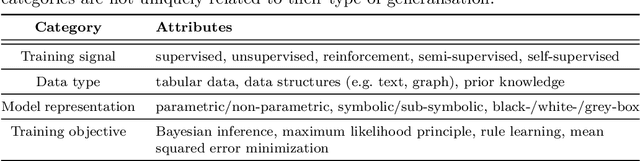
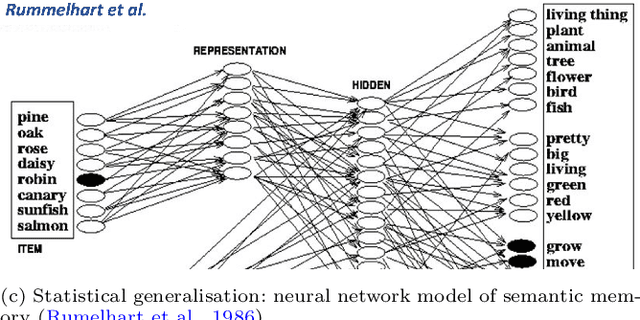
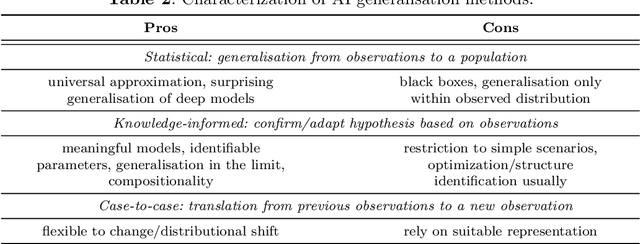
Recent advances in AI -- including generative approaches -- have resulted in technology that can support humans in scientific discovery and decision support but may also disrupt democracies and target individuals. The responsible use of AI increasingly shows the need for human-AI teaming, necessitating effective interaction between humans and machines. A crucial yet often overlooked aspect of these interactions is the different ways in which humans and machines generalise. In cognitive science, human generalisation commonly involves abstraction and concept learning. In contrast, AI generalisation encompasses out-of-domain generalisation in machine learning, rule-based reasoning in symbolic AI, and abstraction in neuro-symbolic AI. In this perspective paper, we combine insights from AI and cognitive science to identify key commonalities and differences across three dimensions: notions of generalisation, methods for generalisation, and evaluation of generalisation. We map the different conceptualisations of generalisation in AI and cognitive science along these three dimensions and consider their role in human-AI teaming. This results in interdisciplinary challenges across AI and cognitive science that must be tackled to provide a foundation for effective and cognitively supported alignment in human-AI teaming scenarios.
LTNtorch: PyTorch Implementation of Logic Tensor Networks
Sep 24, 2024Logic Tensor Networks (LTN) is a Neuro-Symbolic framework that effectively incorporates deep learning and logical reasoning. In particular, LTN allows defining a logical knowledge base and using it as the objective of a neural model. This makes learning by logical reasoning possible as the parameters of the model are optimized by minimizing a loss function composed of a set of logical formulas expressing facts about the learning task. The framework learns via gradient-descent optimization. Fuzzy logic, a relaxation of classical logic permitting continuous truth values in the interval [0,1], makes this learning possible. Specifically, the training of an LTN consists of three steps. Firstly, (1) the training data is used to ground the formulas. Then, (2) the formulas are evaluated, and the loss function is computed. Lastly, (3) the gradients are back-propagated through the logical computational graph, and the weights of the neural model are changed so the knowledge base is maximally satisfied. LTNtorch is the fully documented and tested PyTorch implementation of Logic Tensor Networks. This paper presents the formalization of LTN and how LTNtorch implements it. Moreover, it provides a basic binary classification example.
IFH: a Diffusion Framework for Flexible Design of Graph Generative Models
Aug 23, 2024Graph generative models can be classified into two prominent families: one-shot models, which generate a graph in one go, and sequential models, which generate a graph by successive additions of nodes and edges. Ideally, between these two extreme models lies a continuous range of models that adopt different levels of sequentiality. This paper proposes a graph generative model, called Insert-Fill-Halt (IFH), that supports the specification of a sequentiality degree. IFH is based upon the theory of Denoising Diffusion Probabilistic Models (DDPM), designing a node removal process that gradually destroys a graph. An insertion process learns to reverse this removal process by inserting arcs and nodes according to the specified sequentiality degree. We evaluate the performance of IFH in terms of quality, run time, and memory, depending on different sequentiality degrees. We also show that using DiGress, a diffusion-based one-shot model, as a generative step in IFH leads to improvement to the model itself, and is competitive with the current state-of-the-art.
Simple and Effective Transfer Learning for Neuro-Symbolic Integration
Feb 21, 2024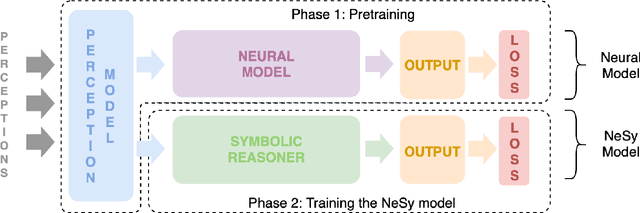
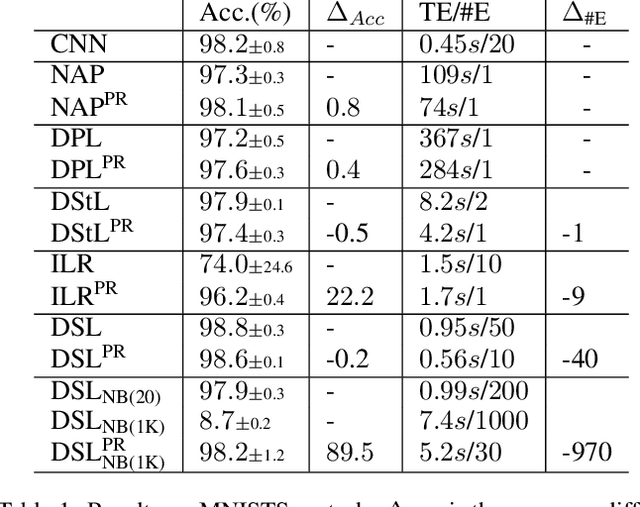
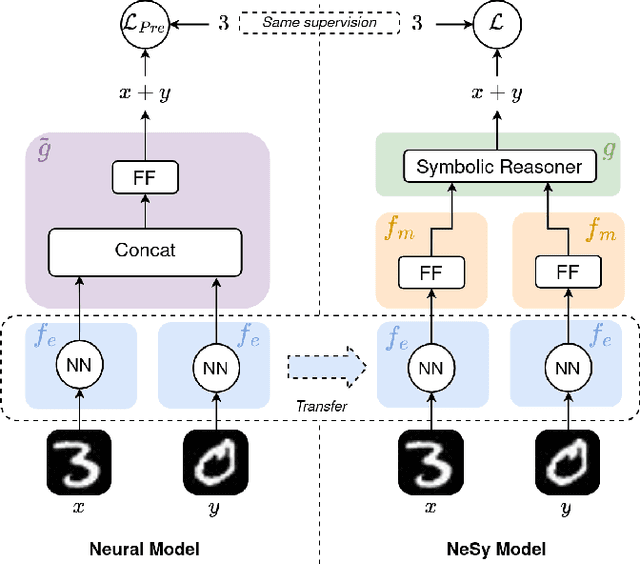
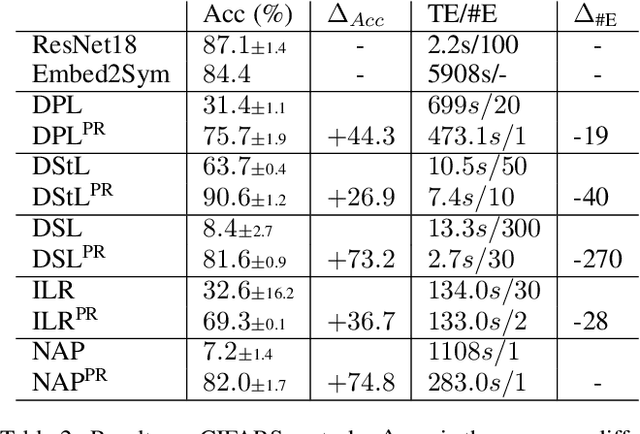
Deep Learning (DL) techniques have achieved remarkable successes in recent years. However, their ability to generalize and execute reasoning tasks remains a challenge. A potential solution to this issue is Neuro-Symbolic Integration (NeSy), where neural approaches are combined with symbolic reasoning. Most of these methods exploit a neural network to map perceptions to symbols and a logical reasoner to predict the output of the downstream task. These methods exhibit superior generalization capacity compared to fully neural architectures. However, they suffer from several issues, including slow convergence, learning difficulties with complex perception tasks, and convergence to local minima. This paper proposes a simple yet effective method to ameliorate these problems. The key idea involves pretraining a neural model on the downstream task. Then, a NeSy model is trained on the same task via transfer learning, where the weights of the perceptual part are injected from the pretrained network. The key observation of our work is that the neural network fails to generalize only at the level of the symbolic part while being perfectly capable of learning the mapping from perceptions to symbols. We have tested our training strategy on various SOTA NeSy methods and datasets, demonstrating consistent improvements in the aforementioned problems.
Lifted Inference beyond First-Order Logic
Aug 22, 2023Weighted First Order Model Counting (WFOMC) is fundamental to probabilistic inference in statistical relational learning models. As WFOMC is known to be intractable in general ($\#$P-complete), logical fragments that admit polynomial time WFOMC are of significant interest. Such fragments are called domain liftable. Recent works have shown that the two-variable fragment of first order logic extended with counting quantifiers ($\mathrm{C^2}$) is domain-liftable. However, many properties of real-world data, like acyclicity in citation networks and connectivity in social networks, cannot be modeled in $\mathrm{C^2}$, or first order logic in general. In this work, we expand the domain liftability of $\mathrm{C^2}$ with multiple such properties. We show that any $\mathrm{C^2}$ sentence remains domain liftable when one of its relations is restricted to represent a directed acyclic graph, a connected graph, a tree (resp. a directed tree) or a forest (resp. a directed forest). All our results rely on a novel and general methodology of "counting by splitting". Besides their application to probabilistic inference, our results provide a general framework for counting combinatorial structures. We expand a vast array of previous results in discrete mathematics literature on directed acyclic graphs, phylogenetic networks, etc.