 Add to Chrome
 Add to Firefox
 Add to Edge
The Lift Spectrum: How Measurement-to-Space Adaptivity Shapes Robustness in Image-Free Single-Pixel Sensing
Jul 24, 2026
Single-pixel sensing encodes a scene as a short sequence of coded measurements, and image-free methods infer the task directly from that sequence. Removing reconstruction does not remove the difficulty: it relocates it to the lift, the map from 1D measurements to a 2D representation, which prior work treats as a trivial reshape. We recast the lift as the central design axis of image-free sensing and order methods by how strongly it adapts to its input: a fixed-physics inverse (reconstruct-then-segment), a learned static projection, or a content-adaptive retrieval; position on this lift spectrum predicts behavior as acquisition degrades. The spatiotemporal soft-fusion (STSF) network pairs a probe-selected recurrent encoder with a cross-attention lift chosen by a parameter-matched ablation, ahead of its U-Net++ decoder, and trains under task-prioritized loss scheduling (TPLS), a scheduled reconstruction prior. In simulation, STSF+TPLS surpasses the prior image-free baseline on three datasets at 3.13% sampling (+3.2 to +9.9 pp foreground mIoU) and plateaus down to 0.39%. The strongest clean-trained reconstruct-then-segment baseline wins the noiseless limit, but under calibrated measurement noise image-free inference overtakes it, for a measured reason: the reconstruction pipeline amplifies the identical measurement noise before its segmenter reads it. Each region fails in its own signature: collapse, imprinting, or coarsening. STSF+TPLS transfers without fine-tuning to a real single-pixel bench as a proof of concept, at about 14 ms per mask. Charting the lift turns a scattered design space into a map of which lift to deploy at each operating point. Code and pretrained weights: https://github.com/Hanyuyuan6/STSF-TPLS

A Multi-task Learning Approach for Improving Product Title Compression with User Search Log Data
Jan 05, 2018
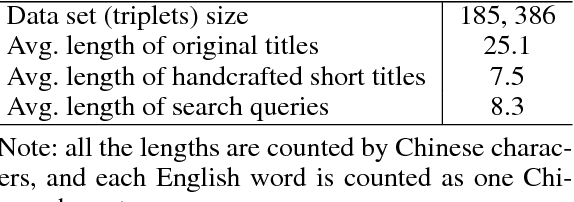
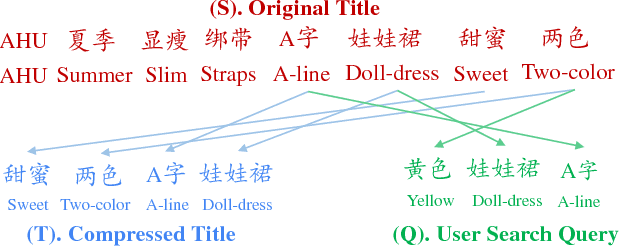
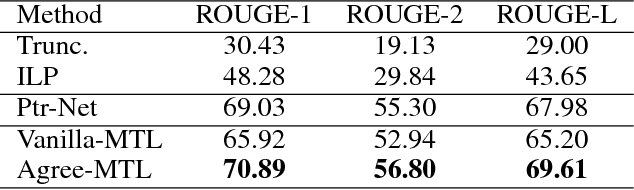
It is a challenging and practical research problem to obtain effective compression of lengthy product titles for E-commerce. This is particularly important as more and more users browse mobile E-commerce apps and more merchants make the original product titles redundant and lengthy for Search Engine Optimization. Traditional text summarization approaches often require a large amount of preprocessing costs and do not capture the important issue of conversion rate in E-commerce. This paper proposes a novel multi-task learning approach for improving product title compression with user search log data. In particular, a pointer network-based sequence-to-sequence approach is utilized for title compression with an attentive mechanism as an extractive method and an attentive encoder-decoder approach is utilized for generating user search queries. The encoding parameters (i.e., semantic embedding of original titles) are shared among the two tasks and the attention distributions are jointly optimized. An extensive set of experiments with both human annotated data and online deployment demonstrate the advantage of the proposed research for both compression qualities and online business values.
A Public Reference Implementation of the RAP Anaphora Resolution Algorithm
Jun 17, 2004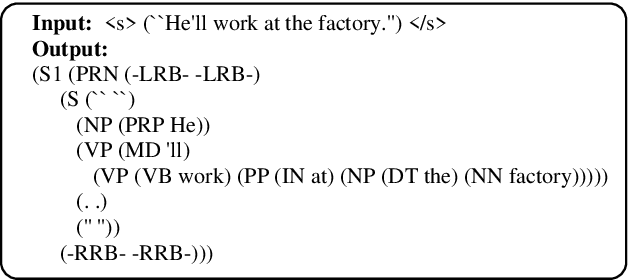
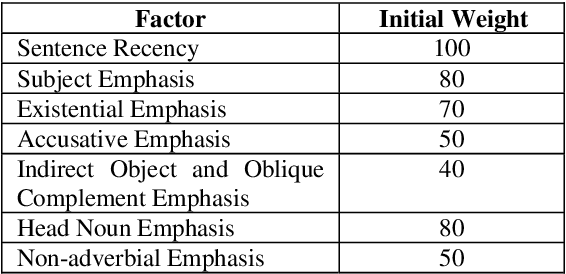
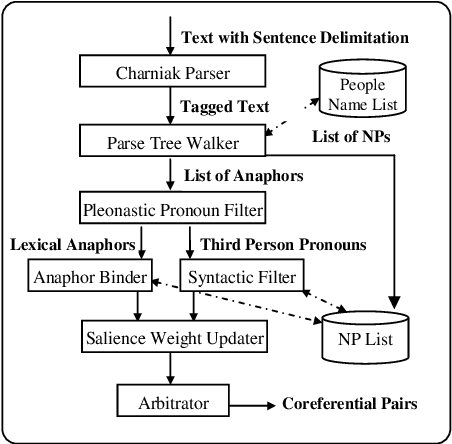

This paper describes a standalone, publicly-available implementation of the Resolution of Anaphora Procedure (RAP) given by Lappin and Leass (1994). The RAP algorithm resolves third person pronouns, lexical anaphors, and identifies pleonastic pronouns. Our implementation, JavaRAP, fills a current need in anaphora resolution research by providing a reference implementation that can be benchmarked against current algorithms. The implementation uses the standard, publicly available Charniak (2000) parser as input, and generates a list of anaphora-antecedent pairs as output. Alternately, an in-place annotation or substitution of the anaphors with their antecedents can be produced. Evaluation on the MUC-6 co-reference task shows that JavaRAP has an accuracy of 57.9%, similar to the performance given previously in the literature (e.g., Preiss 2002).