 Add to Chrome
 Add to Firefox
 Add to Edge
Semi-Dense Matching Uncertainty Is Not Just Local Confidence
Aug 09, 2026
Reliable semi-dense matching is essential for modern geometric vision systems. Designed under a coarse-to-fine paradigm, it achieves an optimal balance between performance and computational cost. However, existing methods often struggle to provide well-quantified uncertainties, where catastrophic coarse-assignment failures are ignored, leading to truncated error distributions and severely misjudged geometric estimations. In this paper, we propose a lightweight, post-hoc overall uncertainty estimation framework that introduces a two-component calibrated Laplace mixture model with only 9 learnable parameters. The objective is to explicitly capture both the sharp local refinement noise and the broader tail of coarse-assignment failures. We introduce the Coarse-success posterior Refit (CoRe) method, a geometric refitting module that utilizes the posterior probability of coarse-assignment success as soft correspondence weights. Extensive experiments show that our method consistently improves downstream geometric accuracy across various pretrained-only matchers and robust estimators with minimal computational overhead. Our code is available at https://github.com/khoavpt/Probabilistic-matching.

A Continuous-time Mutually-Exciting Point Process Framework for Prioritizing Events in Social Media
Nov 13, 2015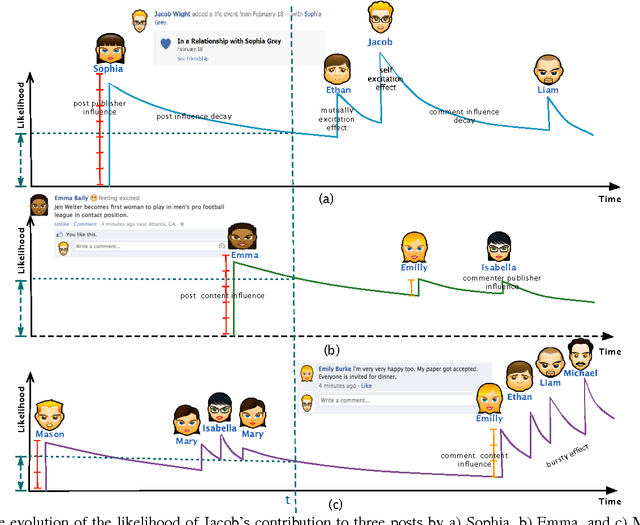
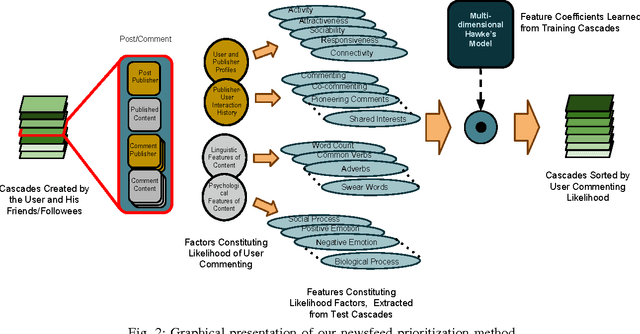
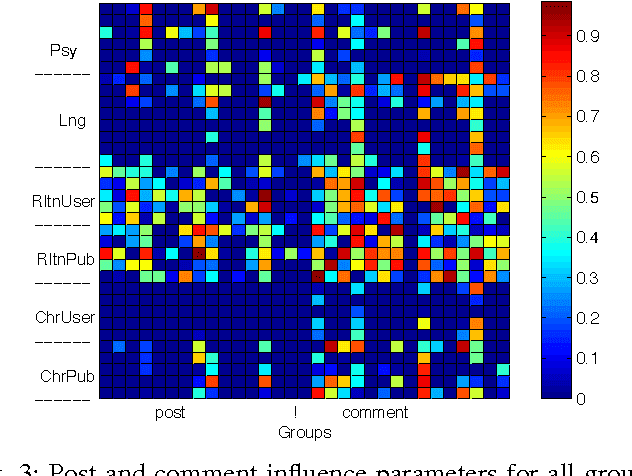
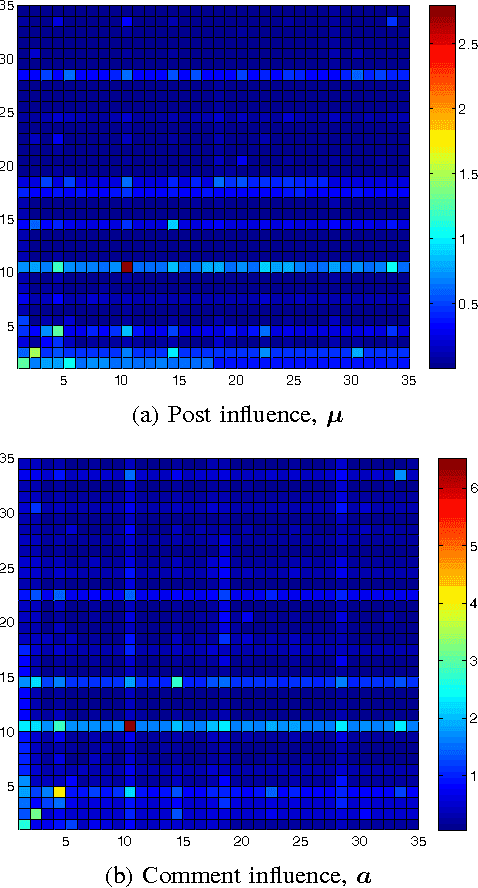
The overwhelming amount and rate of information update in online social media is making it increasingly difficult for users to allocate their attention to their topics of interest, thus there is a strong need for prioritizing news feeds. The attractiveness of a post to a user depends on many complex contextual and temporal features of the post. For instance, the contents of the post, the responsiveness of a third user, and the age of the post may all have impact. So far, these static and dynamic features has not been incorporated in a unified framework to tackle the post prioritization problem. In this paper, we propose a novel approach for prioritizing posts based on a feature modulated multi-dimensional point process. Our model is able to simultaneously capture textual and sentiment features, and temporal features such as self-excitation, mutual-excitation and bursty nature of social interaction. As an evaluation, we also curated a real-world conversational benchmark dataset crawled from Facebook. In our experiments, we demonstrate that our algorithm is able to achieve the-state-of-the-art performance in terms of analyzing, predicting, and prioritizing events. In terms of interpretability of our method, we observe that features indicating individual user profile and linguistic characteristics of the events work best for prediction and prioritization of new events.