 Add to Chrome
 Add to Firefox
 Add to Edge
Semi-Dense Matching Uncertainty Is Not Just Local Confidence
Aug 09, 2026
Reliable semi-dense matching is essential for modern geometric vision systems. Designed under a coarse-to-fine paradigm, it achieves an optimal balance between performance and computational cost. However, existing methods often struggle to provide well-quantified uncertainties, where catastrophic coarse-assignment failures are ignored, leading to truncated error distributions and severely misjudged geometric estimations. In this paper, we propose a lightweight, post-hoc overall uncertainty estimation framework that introduces a two-component calibrated Laplace mixture model with only 9 learnable parameters. The objective is to explicitly capture both the sharp local refinement noise and the broader tail of coarse-assignment failures. We introduce the Coarse-success posterior Refit (CoRe) method, a geometric refitting module that utilizes the posterior probability of coarse-assignment success as soft correspondence weights. Extensive experiments show that our method consistently improves downstream geometric accuracy across various pretrained-only matchers and robust estimators with minimal computational overhead. Our code is available at https://github.com/khoavpt/Probabilistic-matching.

Design and Implementation of a Human-Robot Joint Action Framework using Augmented Reality and Eye Gaze
Aug 25, 2022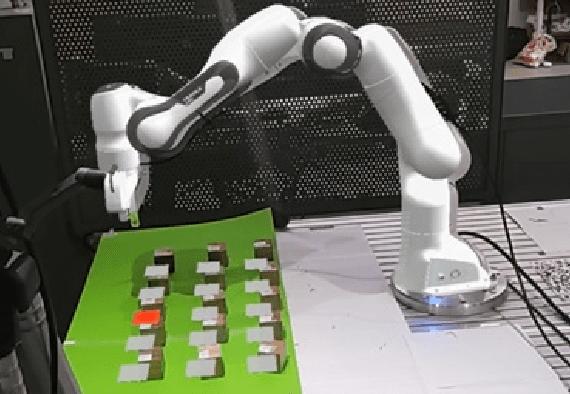
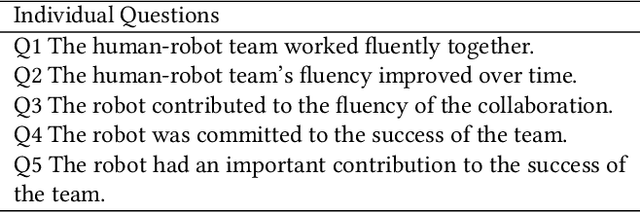
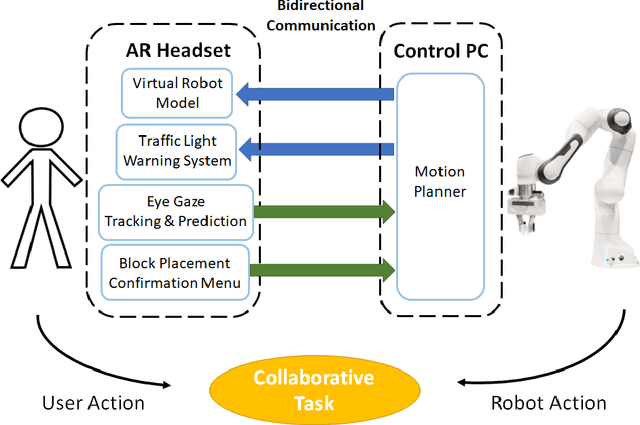
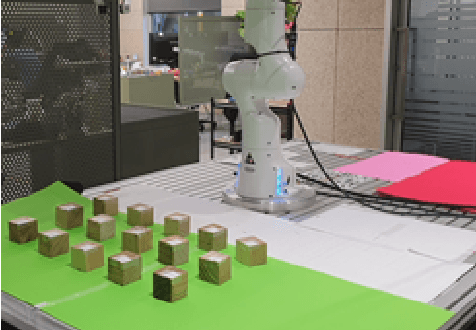
When humans work together to complete a joint task, each person builds an internal model of the situation and how it will evolve. Efficient collaboration is dependent on how these individual models overlap to form a shared mental model among team members, which is important for collaborative processes in human-robot teams. The development and maintenance of an accurate shared mental model requires bidirectional communication of individual intent and the ability to interpret the intent of other team members. To enable effective human-robot collaboration, this paper presents a design and implementation of a novel joint action framework in human-robot team collaboration, utilizing augmented reality (AR) technology and user eye gaze to enable bidirectional communication of intent. We tested our new framework through a user study with 37 participants, and found that our system improves task efficiency, trust, as well as task fluency. Therefore, using AR and eye gaze to enable bidirectional communication is a promising mean to improve core components that influence collaboration between humans and robots.