 Add to Chrome
 Add to Firefox
 Add to Edge
Semi-Dense Matching Uncertainty Is Not Just Local Confidence
Aug 09, 2026
Reliable semi-dense matching is essential for modern geometric vision systems. Designed under a coarse-to-fine paradigm, it achieves an optimal balance between performance and computational cost. However, existing methods often struggle to provide well-quantified uncertainties, where catastrophic coarse-assignment failures are ignored, leading to truncated error distributions and severely misjudged geometric estimations. In this paper, we propose a lightweight, post-hoc overall uncertainty estimation framework that introduces a two-component calibrated Laplace mixture model with only 9 learnable parameters. The objective is to explicitly capture both the sharp local refinement noise and the broader tail of coarse-assignment failures. We introduce the Coarse-success posterior Refit (CoRe) method, a geometric refitting module that utilizes the posterior probability of coarse-assignment success as soft correspondence weights. Extensive experiments show that our method consistently improves downstream geometric accuracy across various pretrained-only matchers and robust estimators with minimal computational overhead. Our code is available at https://github.com/khoavpt/Probabilistic-matching.

An Effective Deep Network for Head Pose Estimation without Keypoints
Oct 25, 2022
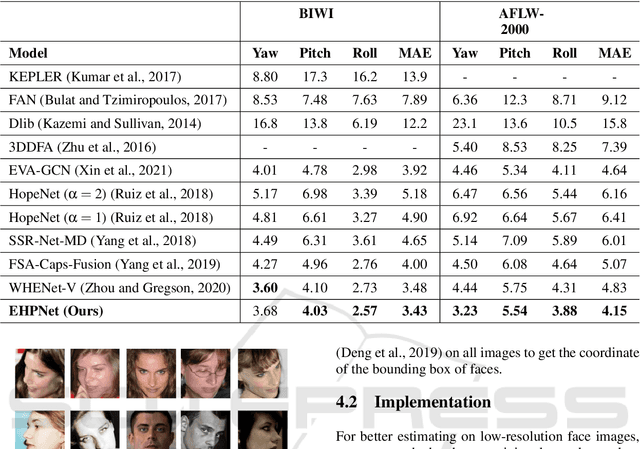
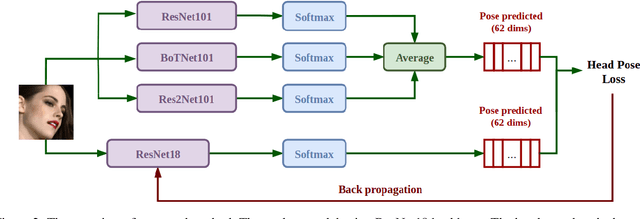
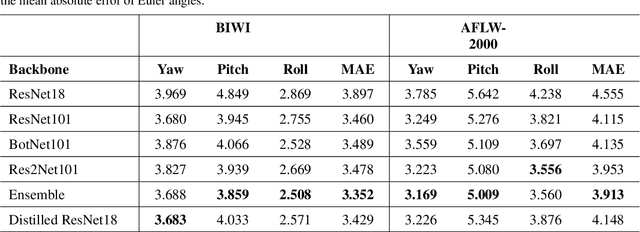
Human head pose estimation is an essential problem in facial analysis in recent years that has a lot of computer vision applications such as gaze estimation, virtual reality, and driver assistance. Because of the importance of the head pose estimation problem, it is necessary to design a compact model to resolve this task in order to reduce the computational cost when deploying on facial analysis-based applications such as large camera surveillance systems, AI cameras while maintaining accuracy. In this work, we propose a lightweight model that effectively addresses the head pose estimation problem. Our approach has two main steps. 1) We first train many teacher models on the synthesis dataset - 300W-LPA to get the head pose pseudo labels. 2) We design an architecture with the ResNet18 backbone and train our proposed model with the ensemble of these pseudo labels via the knowledge distillation process. To evaluate the effectiveness of our model, we use AFLW-2000 and BIWI - two real-world head pose datasets. Experimental results show that our proposed model significantly improves the accuracy in comparison with the state-of-the-art head pose estimation methods. Furthermore, our model has the real-time speed of $\sim$300 FPS when inferring on Tesla V100.
Facial Expression Classification Based on Multi Artificial Neural Network and Two Dimensional Principal Component Analysis
Jul 16, 2011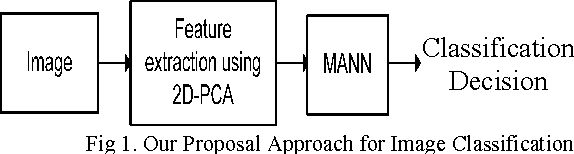
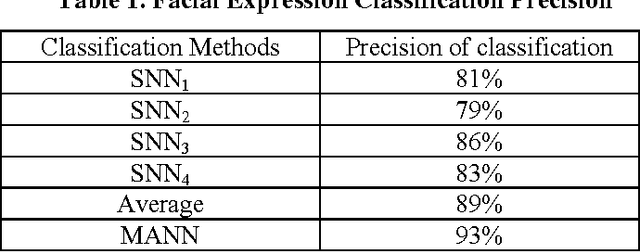
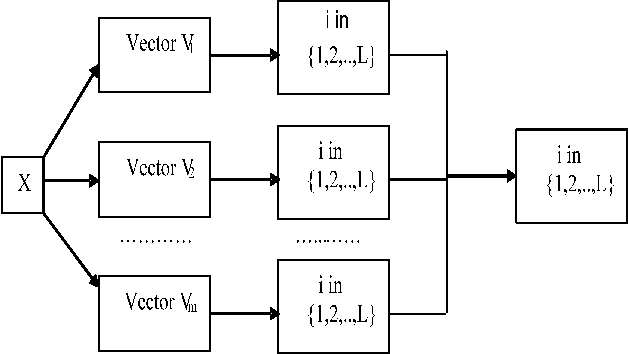
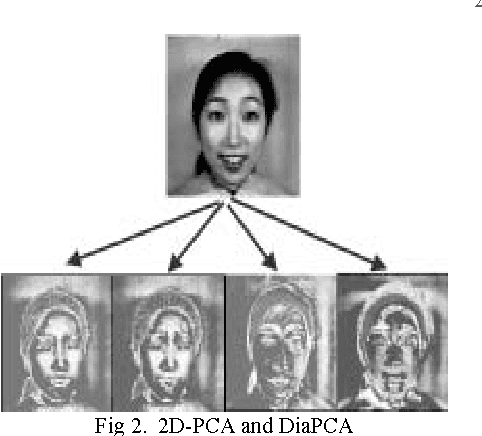
Facial expression classification is a kind of image classification and it has received much attention, in recent years. There are many approaches to solve these problems with aiming to increase efficient classification. One of famous suggestions is described as first step, project image to different spaces; second step, in each of these spaces, images are classified into responsive class and the last step, combine the above classified results into the final result. The advantages of this approach are to reflect fulfill and multiform of image classified. In this paper, we use 2D-PCA and its variants to project the pattern or image into different spaces with different grouping strategies. Then we develop a model which combines many Neural Networks applied for the last step. This model evaluates the reliability of each space and gives the final classification conclusion. Our model links many Neural Networks together, so we call it Multi Artificial Neural Network (MANN). We apply our proposal model for 6 basic facial expressions on JAFFE database consisting 213 images posed by 10 Japanese female models.
* 8 pages, 16 figures, IJCSI International Journal of Computer Science Issues, Vol. 8, Issue 3, No. 1, May 2011