 Add to Chrome
 Add to Firefox
 Add to Edge
Semi-Dense Matching Uncertainty Is Not Just Local Confidence
Aug 09, 2026
Reliable semi-dense matching is essential for modern geometric vision systems. Designed under a coarse-to-fine paradigm, it achieves an optimal balance between performance and computational cost. However, existing methods often struggle to provide well-quantified uncertainties, where catastrophic coarse-assignment failures are ignored, leading to truncated error distributions and severely misjudged geometric estimations. In this paper, we propose a lightweight, post-hoc overall uncertainty estimation framework that introduces a two-component calibrated Laplace mixture model with only 9 learnable parameters. The objective is to explicitly capture both the sharp local refinement noise and the broader tail of coarse-assignment failures. We introduce the Coarse-success posterior Refit (CoRe) method, a geometric refitting module that utilizes the posterior probability of coarse-assignment success as soft correspondence weights. Extensive experiments show that our method consistently improves downstream geometric accuracy across various pretrained-only matchers and robust estimators with minimal computational overhead. Our code is available at https://github.com/khoavpt/Probabilistic-matching.

SwinAD: Multi-stage feature reconstruction for unsupervised industrial anomaly detection
Jul 16, 2026Industrial anomaly detection aims to identify and localize defective regions without relying on exhaustive annotations of all possible defect types. Although recent unsupervised methods have achieved strong performance, most are primarily designed for single-class settings and often struggle in multi-class scenarios, where diverse normal patterns may lead to over-generalization and reduce the discriminative capability between normal and anomalous regions. In this paper, we propose SwinAD, a reconstruction-based framework for multi-class unsupervised anomaly detection that leverages a frozen pretrained Swin Transformer V2 encoder and a feature diversity-preserving reconstruction decoder. The hierarchical encoder provides semantically rich multi-scale features, while stage-wise bottleneck modules with dropout prevent trivial identity mapping and encourage robust reconstruction of normal patterns. To further improve localization, we introduce a feature diversity-preserving reconstruction framework that maintains complementary reconstruction hypotheses instead of relying on a single decoding branch. The discrepancies between encoder features and the two reconstructed features are then aggregated across multiple scales to produce the final anomaly map. Experiments conducted on three industrial anomaly detection benchmarks, including MVTec AD, VisA, and Real-IAD, demonstrate that SwinAD achieves competitive image-level performance and strong pixel-level localization accuracy, with particularly notable improvements in pixel-level AP and 1 on MVTec AD. These results indicate that combining hierarchical Swin features with diverse multi-scale reconstruction substantially improve pixel-level localization in multi-class unsupervised anomaly setting.
An Effective Deep Network for Head Pose Estimation without Keypoints
Oct 25, 2022
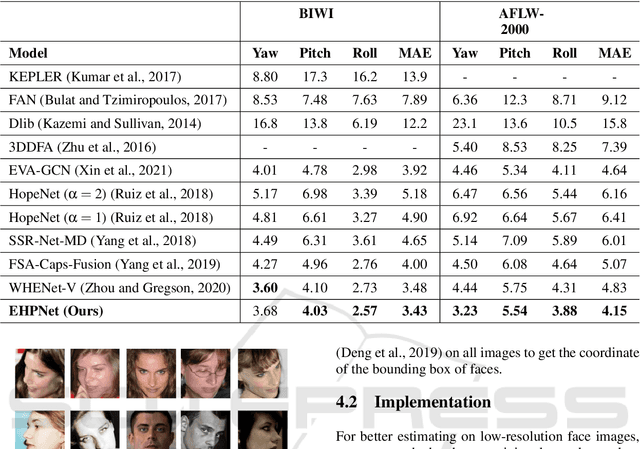
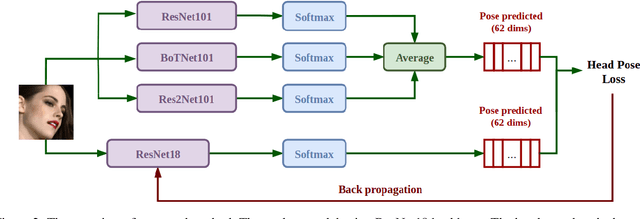
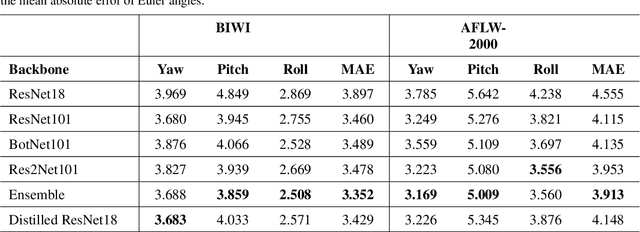
Human head pose estimation is an essential problem in facial analysis in recent years that has a lot of computer vision applications such as gaze estimation, virtual reality, and driver assistance. Because of the importance of the head pose estimation problem, it is necessary to design a compact model to resolve this task in order to reduce the computational cost when deploying on facial analysis-based applications such as large camera surveillance systems, AI cameras while maintaining accuracy. In this work, we propose a lightweight model that effectively addresses the head pose estimation problem. Our approach has two main steps. 1) We first train many teacher models on the synthesis dataset - 300W-LPA to get the head pose pseudo labels. 2) We design an architecture with the ResNet18 backbone and train our proposed model with the ensemble of these pseudo labels via the knowledge distillation process. To evaluate the effectiveness of our model, we use AFLW-2000 and BIWI - two real-world head pose datasets. Experimental results show that our proposed model significantly improves the accuracy in comparison with the state-of-the-art head pose estimation methods. Furthermore, our model has the real-time speed of $\sim$300 FPS when inferring on Tesla V100.