 Add to Chrome
 Add to Firefox
 Add to Edge
LinTree: Improving LLM Reasoning with Explicitly Structured Search Histories
May 29, 2026
Large language models (LLMs) often solve reasoning problems by generating intermediate traces that explore and revise partial solutions. From a search perspective, these traces can be viewed as linearized search trees, where the model extends a partial solution, abandons it when it fails, and backtracks to try alternatives. Compared with traditional heuristic-guided search, such a policy has a potential advantage: it conditions on the whole search trace rather than only on the current local state. We first test whether LLMs utilize this advantage by comparing trace-conditioned reasoning policies against best-first search equipped with an LLM heuristic that only observes the current local state. Across three controlled reasoning environments, Blocks World, grid Navigation, and Sokoban, we find that raw access to search history alone is not enough to reliably outperform heuristic search. We then study one possible reason: in LLM reasoning traces, the underlying search tree is only implicitly represented, and when the model backtracks or switches branches, the trace does not explicitly identify which earlier search state is being revisited. We show that adding simple parent pointers to explicitly represent the linearized tree (LinTree) structure improves both task performance and search efficiency relative to implicit reasoning models and LLM-heuristic-guided search. These results suggest that search history becomes most useful when its tree structure is made explicit, motivating more structure-aware representations for LLM reasoning.

DeepResearchEval: An Automated Framework for Deep Research Task Construction and Agentic Evaluation
Jan 14, 2026Deep research systems are widely used for multi-step web research, analysis, and cross-source synthesis, yet their evaluation remains challenging. Existing benchmarks often require annotation-intensive task construction, rely on static evaluation dimensions, or fail to reliably verify facts when citations are missing. To bridge these gaps, we introduce DeepResearchEval, an automated framework for deep research task construction and agentic evaluation. For task construction, we propose a persona-driven pipeline generating realistic, complex research tasks anchored in diverse user profiles, applying a two-stage filter Task Qualification and Search Necessity to retain only tasks requiring multi-source evidence integration and external retrieval. For evaluation, we propose an agentic pipeline with two components: an Adaptive Point-wise Quality Evaluation that dynamically derives task-specific evaluation dimensions, criteria, and weights conditioned on each generated task, and an Active Fact-Checking that autonomously extracts and verifies report statements via web search, even when citations are missing.
On the Empirical Complexity of Reasoning and Planning in LLMs
Apr 17, 2024Large Language Models (LLMs) work surprisingly well for some complex reasoning problems via chain-of-thought (CoT) or tree-of-thought (ToT), but the underlying reasons remain unclear. We seek to understand the performance of these methods by conducting experimental case studies and linking the outcomes to sample and computational complexity in machine learning. We found that if problems can be decomposed into a sequence of reasoning steps and learning to predict the next step has a low sample and computational complexity, explicitly outlining the reasoning chain with all necessary information for predicting the next step may improve performance. Conversely, for problems where predicting the next step is computationally hard, adopting ToT may yield better reasoning outcomes than attempting to formulate a short reasoning chain.
Continual Learning of Numerous Tasks from Long-tail Distributions
Apr 03, 2024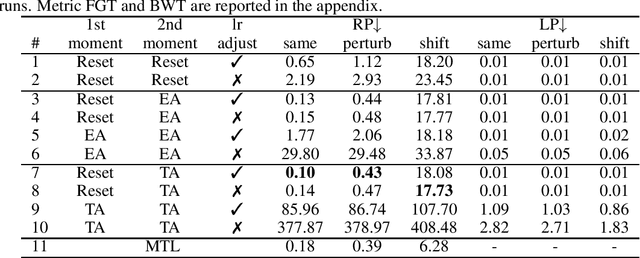
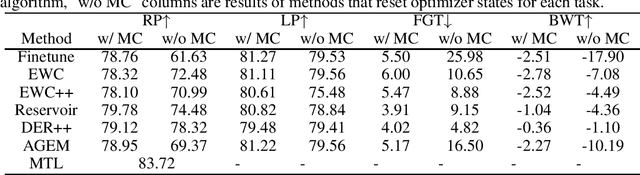
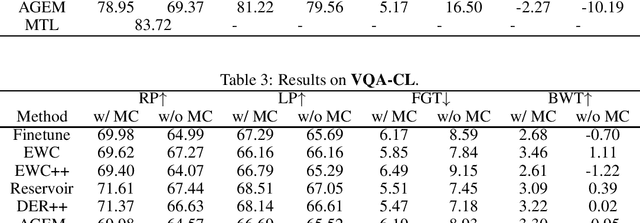
Continual learning, an important aspect of artificial intelligence and machine learning research, focuses on developing models that learn and adapt to new tasks while retaining previously acquired knowledge. Existing continual learning algorithms usually involve a small number of tasks with uniform sizes and may not accurately represent real-world learning scenarios. In this paper, we investigate the performance of continual learning algorithms with a large number of tasks drawn from a task distribution that is long-tail in terms of task sizes. We design one synthetic dataset and two real-world continual learning datasets to evaluate the performance of existing algorithms in such a setting. Moreover, we study an overlooked factor in continual learning, the optimizer states, e.g. first and second moments in the Adam optimizer, and investigate how it can be used to improve continual learning performance. We propose a method that reuses the optimizer states in Adam by maintaining a weighted average of the second moments from previous tasks. We demonstrate that our method, compatible with most existing continual learning algorithms, effectively reduces forgetting with only a small amount of additional computational or memory costs, and provides further improvements on existing continual learning algorithms, particularly in a long-tail task sequence.