 Add to Chrome
 Add to Firefox
 Add to Edge
Where to Look: Can Foundation Models Reach a Target Viewpoint Through Active Exploration?
May 31, 2026
Humans can reproduce the viewpoint specified by a target image through active head and body motion, yet spatial intelligence in foundation models has largely been studied as passive understanding of pre-collected observations. We introduce Target Viewpoint Reproduction (TVR) -- an active task where an agent adjusts its viewpoint in a 3D environment until its observation matches a given target image -- and TVRBench, an indoor-simulation benchmark spanning scene scale and target-view visual richness. TVR is far from solved: on the evaluation split, the strongest open-source and closed-source models reach only 7.8% and 12.0% success. Fine-grained analysis identifies two consistent bottlenecks: off-the-shelf models struggle with multi-turn visual history, and performance drops sharply when viewpoint reproduction requires body translation rather than in-place rotation, exposing a gap in mapping spatial discrepancies to embodied movement. To study reducing this gap, we build a unified TVR post-training framework covering expert-trajectory SFT, rationale-supervised CoT-SFT, offline Single-turn GRPO, and on-policy Multi-turn GRPO from live simulator rollouts. Visual-action SFT supplies the main gain, raising a 9B open-source model to 50.8% success; Multi-turn GRPO provides targeted multi-room refinement and reaches 51.4% overall, while CoT supervision and Single-turn GRPO degrade closed-loop performance. These results establish TVRBench as a testbed for measuring and training foundation models that actively perceive and act in 3D environments. Our code, data, and models are available at https://github.com/aim-uofa/TVRBench.

Efficient Self-Evaluation for Diffusion Language Models via Sequence Regeneration
Mar 03, 2026Diffusion large language models (dLLMs) have recently attracted significant attention for their ability to enhance diversity, controllability, and parallelism. However, their non-sequential, bidirectionally masked generation makes quality assessment difficult, underscoring the need for effective self-evaluation. In this work, we propose DiSE, a simple yet effective self-evaluation confidence quantification method for dLLMs. DiSE quantifies confidence by computing the probability of regenerating the tokens in the entire generated sequence, given the full context. This method enables more efficient and reliable quality assessment by leveraging token regeneration probabilities, facilitating both likelihood estimation and robust uncertainty quantification. Building upon DiSE, we further introduce a flexible-length generation framework, which adaptively controls the sequence length based on the model's self-assessment of its own output. We analyze and validate the feasibility of DiSE from the perspective of dLLM generalization, and empirically demonstrate that DiSE is positively correlated with both semantic coherence and answer accuracy. Extensive experiments on likelihood evaluation, uncertainty quantification, and flexible-length generation further confirm the effectiveness of the proposed DiSE.
Beyond Hard Masks: Progressive Token Evolution for Diffusion Language Models
Jan 12, 2026Diffusion Language Models (DLMs) offer a promising alternative for language modeling by enabling parallel decoding through iterative refinement. However, most DLMs rely on hard binary masking and discrete token assignments, which hinder the revision of early decisions and underutilize intermediate probabilistic representations. In this paper, we propose EvoToken-DLM, a novel diffusion-based language modeling approach that replaces hard binary masks with evolving soft token distributions. EvoToken-DLM enables a progressive transition from masked states to discrete outputs, supporting revisable decoding. To effectively support this evolution, we introduce continuous trajectory supervision, which aligns training objectives with iterative probabilistic updates. Extensive experiments across multiple benchmarks show that EvoToken-DLM consistently achieves superior performance, outperforming strong diffusion-based and masked DLM baselines. Project webpage: https://aim-uofa.github.io/EvoTokenDLM.
User-Friendly Customized Generation with Multi-Modal Prompts
May 26, 2024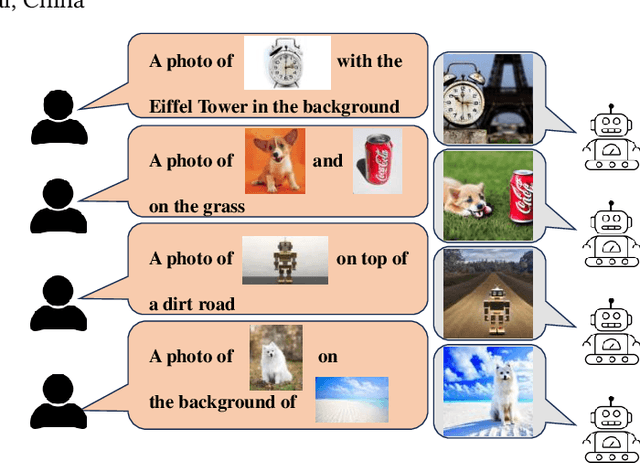
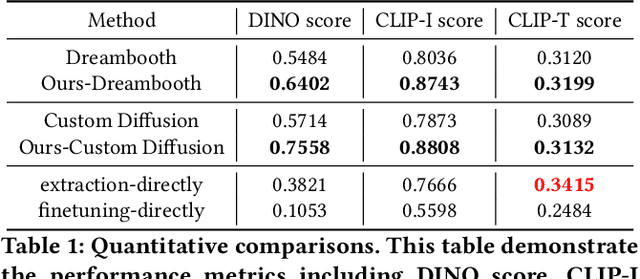
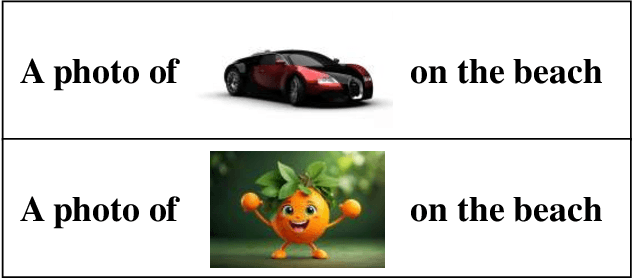

Text-to-image generation models have seen considerable advancement, catering to the increasing interest in personalized image creation. Current customization techniques often necessitate users to provide multiple images (typically 3-5) for each customized object, along with the classification of these objects and descriptive textual prompts for scenes. This paper questions whether the process can be made more user-friendly and the customization more intricate. We propose a method where users need only provide images along with text for each customization topic, and necessitates only a single image per visual concept. We introduce the concept of a ``multi-modal prompt'', a novel integration of text and images tailored to each customization concept, which simplifies user interaction and facilitates precise customization of both objects and scenes. Our proposed paradigm for customized text-to-image generation surpasses existing finetune-based methods in user-friendliness and the ability to customize complex objects with user-friendly inputs. Our code is available at $\href{https://github.com/zhongzero/Multi-Modal-Prompt}{https://github.com/zhongzero/Multi-Modal-Prompt}$.
Improve Cross-Architecture Generalization on Dataset Distillation
Feb 20, 2024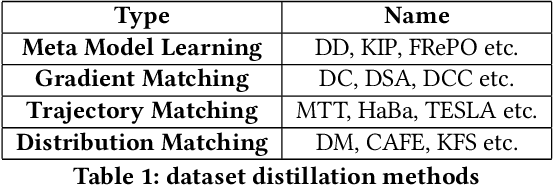

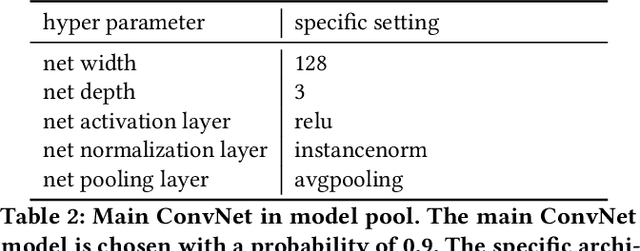
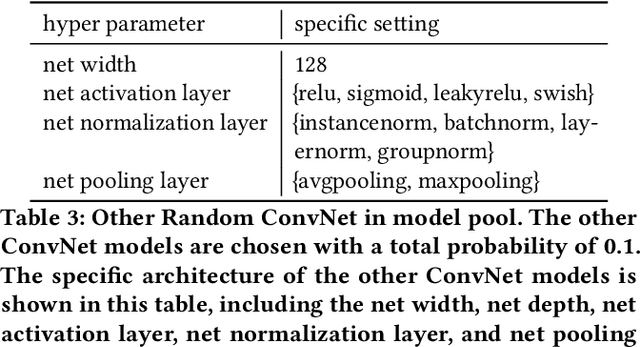
Dataset distillation, a pragmatic approach in machine learning, aims to create a smaller synthetic dataset from a larger existing dataset. However, existing distillation methods primarily adopt a model-based paradigm, where the synthetic dataset inherits model-specific biases, limiting its generalizability to alternative models. In response to this constraint, we propose a novel methodology termed "model pool". This approach involves selecting models from a diverse model pool based on a specific probability distribution during the data distillation process. Additionally, we integrate our model pool with the established knowledge distillation approach and apply knowledge distillation to the test process of the distilled dataset. Our experimental results validate the effectiveness of the model pool approach across a range of existing models while testing, demonstrating superior performance compared to existing methodologies.