 Add to Chrome
 Add to Firefox
 Add to Edge
Physics-Driven Zero-Shot MRI Reconstruction with Non-local Image Priors
Jun 13, 2026
Zero-Shot Self-Supervised Learning (ZS-SSL) has emerged as a promising paradigm for accelerated Magnetic Resonance Imaging (MRI) reconstruction, eliminating the reliance on fully-sampled external datasets. However, learning solely from a single under-sampled scan suffers from supervision scarcity and optimization instability, often leading to overfitting or artifacts. To address these challenges, we propose a robust physics-driven ZS-SSL framework that synergizes physical consistency with image-domain non-local priors. Our method introduces three core innovations: (1) a Coil Sensitivity Map (CSM)-Guided Dynamic Repository, which stabilizes the training trajectory by filtering physically inconsistent artifacts based on coil sensitivity constraints; (2) a SPIRiT-based regularization, which enforces k-space self-consistency via a learned correlation kernel and stochastic masking; (3) a Non-Local Self-Similarity (NSS) Pixel Bank, which leverages the high-fidelity reference established by the former modules to explicitly mine non-local anatomical similarities, thereby augmenting supervision in the image domain. Extensive experiments on the FastMRI dataset demonstrate that our approach achieves state-of-the-art performance, particularly under high acceleration factors, effectively bridging the gap between zero-shot learning and supervised methods. The code is available at https://github.com/Zolento/NS-SSL.

Evolving Testing Scenario Generation Method and Intelligence Evaluation Framework for Automated Vehicles
Jun 12, 2023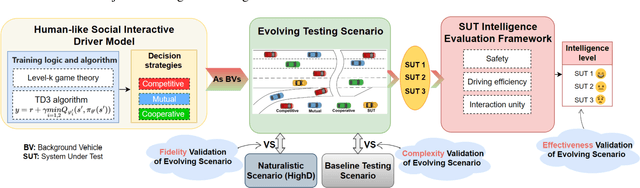
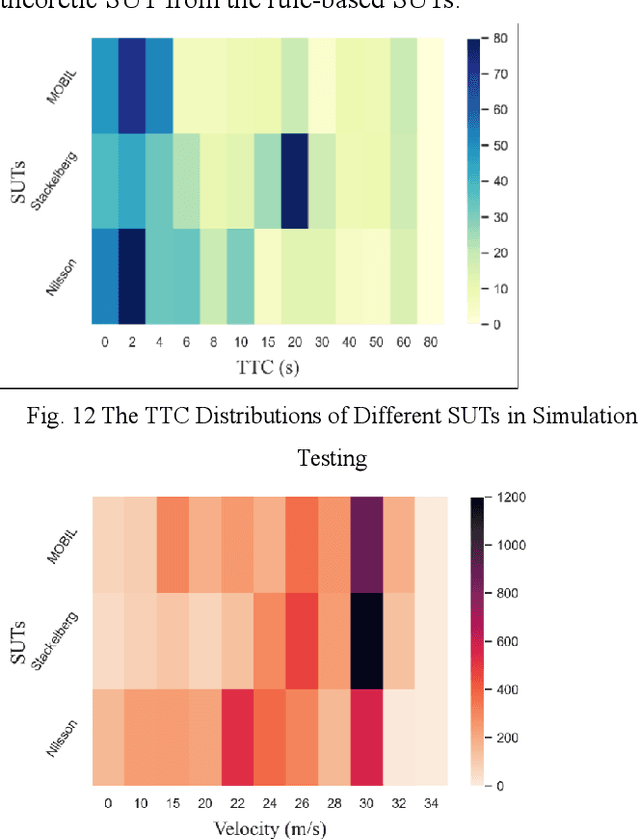
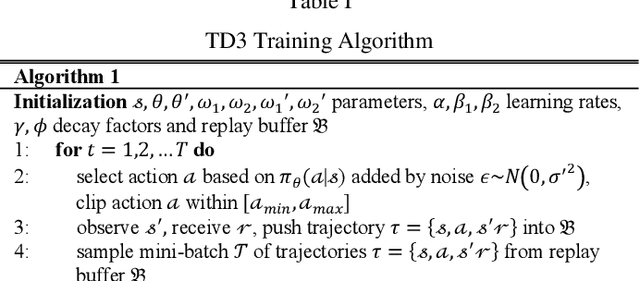
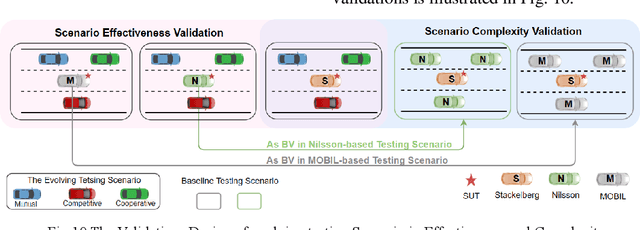
Interaction between the background vehicles (BVs) and automated vehicles (AVs) in scenario-based testing plays a critical role in evaluating the intelligence of the AVs. Current testing scenarios typically employ predefined or scripted BVs, which inadequately reflect the complexity of human-like social behaviors in real-world driving scenarios, and also lack a systematic metric for evaluating the comprehensive intelligence of AVs. Therefore, this paper proposes an evolving scenario generation method that utilizes deep reinforcement learning (DRL) to create human-like BVs for testing and intelligence evaluation of AVs. Firstly, a class of driver models with human-like competitive, cooperative, and mutual driving motivations is designed. Then, utilizing an improved "level-k" training procedure, the three distinct driver models acquire game-based interactive driving policies. And these models are assigned to BVs for generating evolving scenarios in which all BVs can interact continuously and evolve diverse contents. Next, a framework including safety, driving efficiency, and interaction utility are presented to evaluate and quantify the intelligence performance of 3 systems under test (SUTs), indicating the effectiveness of the evolving scenario for intelligence testing. Finally, the complexity and fidelity of the proposed evolving testing scenario are validated. The results demonstrate that the proposed evolving scenario exhibits the highest level of complexity compared to other baseline scenarios and has more than 85% similarity to naturalistic driving data. This highlights the potential of the proposed method to facilitate the development and evaluation of high-level AVs in a realistic and challenging environment.