 Add to Chrome
 Add to Firefox
 Add to Edge
GenPage: Towards End-to-End Generative Homepage Construction at Netflix
Jun 30, 2026
We present GenPage, an end-to-end generative approach to Netflix homepage construction that replaces the traditional multi-stage recommender stack with a single transformer. GenPage treats the user and request context as a prompt, and autoregressively generates the entire structured, multi-row homepage as the response. We adapt the LLM training recipe: pretraining on production pages, followed by post-training via weighted binary classification (WBC) or reinforcement learning (RL). For industry-scale deployment, we introduce techniques addressing cold start, model freshness, business-rule enforcement, and serving efficiency. In online A/B tests against a mature, highly optimized production homepage recommender, the WBC variant of GenPage delivered a +0.24% lift on the core user engagement metric we use for launch decisions (p < 0.001), while reducing end-to-end serving latency by 20%. Offline, two findings stand out: enriching the prompt yields a larger improvement than scaling model capacity in our current regime, and RL post-training increases homepage diversity even though diversity is not part of the objective.

From Logs to Language: Learning Optimal Verbalization for LLM-Based Recommendation in Production
Feb 24, 2026Large language models (LLMs) are promising backbones for generative recommender systems, yet a key challenge remains underexplored: verbalization, i.e., converting structured user interaction logs into effective natural language inputs. Existing methods rely on rigid templates that simply concatenate fields, yielding suboptimal representations for recommendation. We propose a data-centric framework that learns verbalization for LLM-based recommendation. Using reinforcement learning, a verbalization agent transforms raw interaction histories into optimized textual contexts, with recommendation accuracy as the training signal. This agent learns to filter noise, incorporate relevant metadata, and reorganize information to improve downstream predictions. Experiments on a large-scale industrial streaming dataset show that learned verbalization delivers up to 93% relative improvement in discovery item recommendation accuracy over template-based baselines. Further analysis reveals emergent strategies such as user interest summarization, noise removal, and syntax normalization, offering insights into effective context construction for LLM-based recommender systems.
Session-based Recommendations with Recurrent Neural Networks
Mar 29, 2016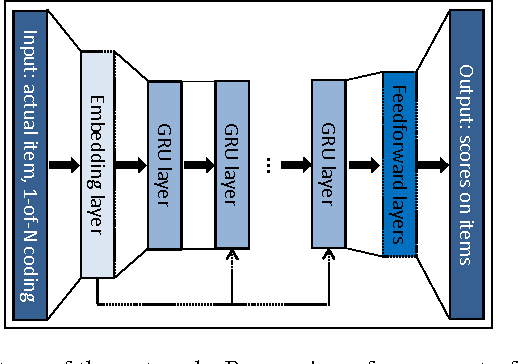
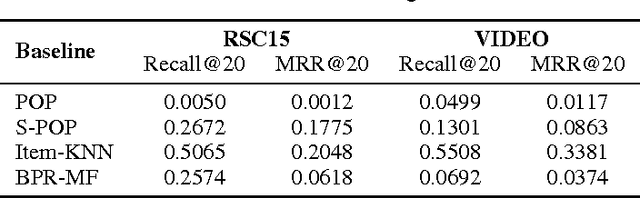
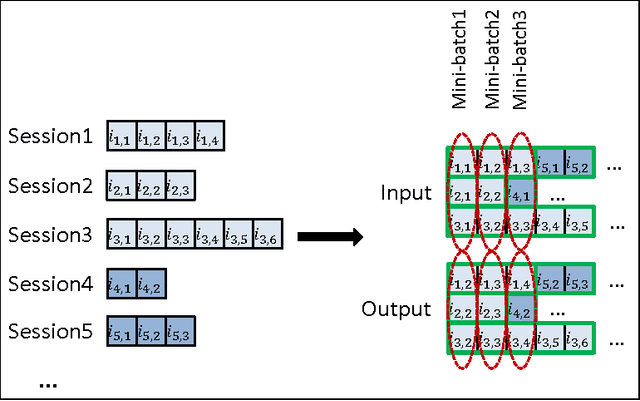
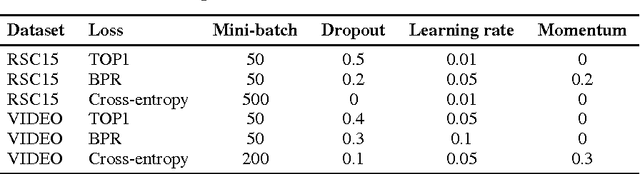
We apply recurrent neural networks (RNN) on a new domain, namely recommender systems. Real-life recommender systems often face the problem of having to base recommendations only on short session-based data (e.g. a small sportsware website) instead of long user histories (as in the case of Netflix). In this situation the frequently praised matrix factorization approaches are not accurate. This problem is usually overcome in practice by resorting to item-to-item recommendations, i.e. recommending similar items. We argue that by modeling the whole session, more accurate recommendations can be provided. We therefore propose an RNN-based approach for session-based recommendations. Our approach also considers practical aspects of the task and introduces several modifications to classic RNNs such as a ranking loss function that make it more viable for this specific problem. Experimental results on two data-sets show marked improvements over widely used approaches.