 Add to Chrome
 Add to Firefox
 Add to Edge
Minute-Scale Training for Microrobot Navigation
Aug 01, 2026
Microrobots hold significant potential for various applications, where targeted navigation is a basic requirement. Deep reinforcement learning (DRL) has recently emerged as a powerful paradigm for fully autonomous microrobot navigation. Yet, current DRL-based approaches pay limited attention to learning efficiency and effectiveness, requiring hours to days for model training. Consequently, this impedes both rapid practical deployment and parameter optimization. To address these challenges, we present a learning framework that enables effective microrobot navigation policies to be trained within minutes. In the proposed framework, we develop a fully vectorized simulator with more than 10,000 artificial vascular environments, parallelizing dynamics, LiDAR-inspired perception, and feasibility checks across thousands of environments to achieve roughly 190,000 transitions per second. To achieve effectiveness in the fast training, we propose a task-shaping-regularization (TSR) reward framework. The TSR framework accelerates convergence, improves final performance, reduces action variation by at least 33.7%, and increases obstacle clearance by at least 2.1% across all evaluated scenarios. Results show that the proposed learning framework reduces training time to under 10 minutes, while supporting zero-shot deployment across distinct microrobot types and navigation scenarios. Collectively, this framework can substantially shorten the design loop and accelerate the deployment of autonomous microrobots.

A Separable Temporal Convolution Neural Network with Attention for Small-Footprint Keyword Spotting
Sep 01, 2021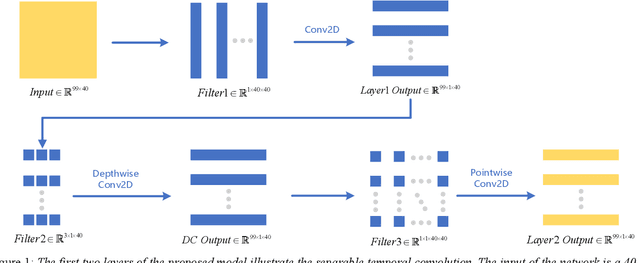
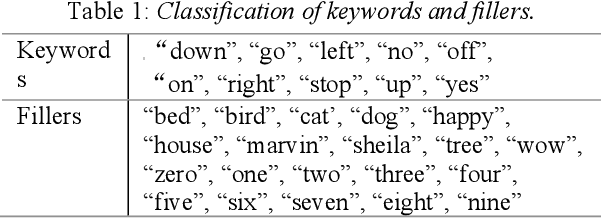
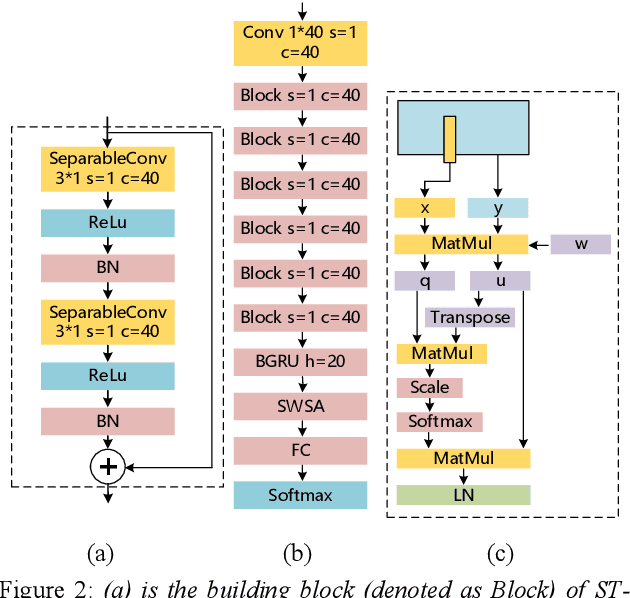
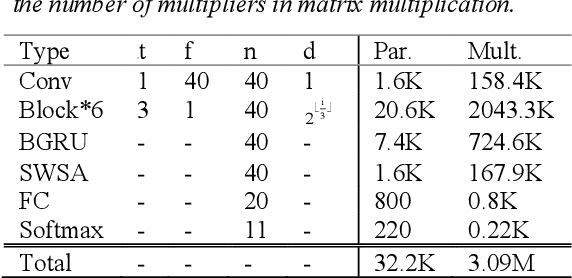
Keyword spotting (KWS) on mobile devices generally requires a small memory footprint. However, most current models still maintain a large number of parameters in order to ensure good performance. To solve this problem, this paper proposes a separable temporal convolution neural network with attention, it has a small number of parameters. Through the time convolution combined with attention mechanism, a small number of parameters model (32.2K) is implemented while maintaining high performance. The proposed model achieves 95.7% accuracy on the Google Speech Commands dataset, which is close to the performance of Res15(239K), the state-of-the-art model in KWS at present.
Magnetic Navigation of a Rotating Colloidal Swarm Using Ultrasound Images
Sep 18, 2018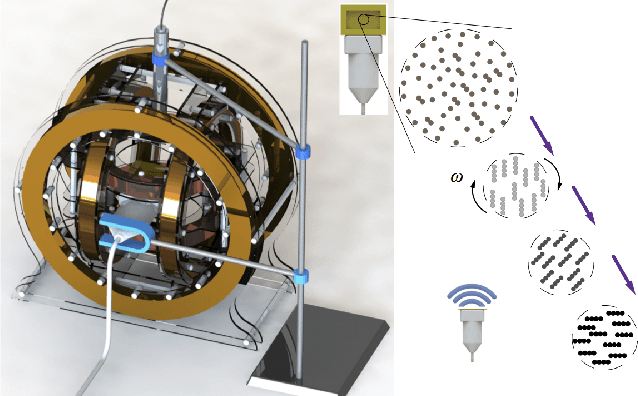
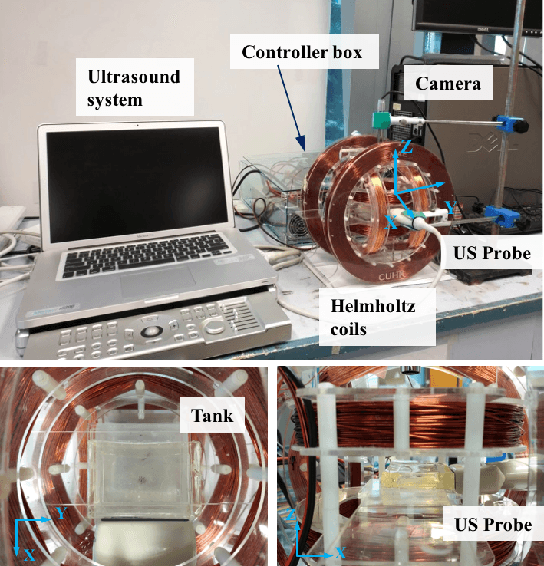

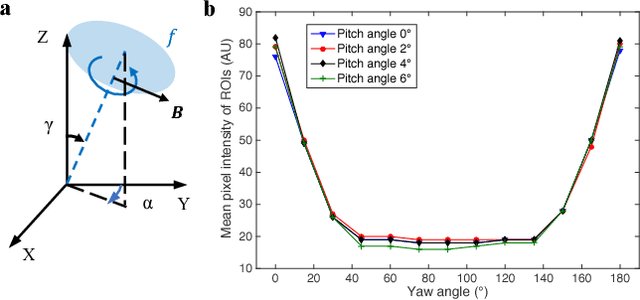
Microrobots are considered as promising tools for biomedical applications. However, the imaging of them becomes challenges in order to be further applied on in vivo environments. Here we report the magnetic navigation of a paramagnetic nanoparticle based swarm using ultrasound images. The swarm can be generated using simple rotating magnetic fields, resulting in a region containing particles with a high area density. Ultrasound images of the swarm shows a periodic changing of imaging contrast. The reason for such dynamic contrast has been analyzed and experimental results are presented. Moreover, this swarm exhibits enhanced ultrasound imaging in comparison to that formed by individual nanoparticles with a low area density, and the relationship between imaging contrast and area density is testified. Furthermore, the microrobotic swarm can be navigated near a solid surface at different velocities, and the imaging contrast show negligible changes. This method allows us to localize and navigate a microrobotic swarm with enhanced ultrasound imaging indicating a promising approach for imaging of microrobots.