 Add to Chrome
 Add to Firefox
 Add to Edge
Self-Evolving Visual Questioner
Jun 11, 2026
Vision-language models (VLMs) are typically trained as passive answerers, while their ability to actively ask diverse, non-trivial, visual-centric and grounded questions remains underexplored. Existing visual questioners' performance is bottlenecked by the availability of high-quality training data or the cost of curating them. We show that a VLM can continuously improve itself as a visual questioner without any external supervision. We propose a self-evolving framework that uses a VLM itself as both a proposer and a filter to produce harder, more informative, and visual-centric questions, while maintaining their exploration diversity to avoid training collapse. These questions are then used to train the VLM in both questioner and answerer modes. To evaluate the questioner, we introduce an agentic protocol that assesses questions along perception, reasoning, and diversity dimensions. Experiments across various backbone VLMs show that our method substantially enhances the quality and substantially expands the difficulty boundary of autonomous question generation. Under the same budget, our self-supervision is more effective than training on the static source data. Moreover, the self-evolving questioner remains a competitive or even better answerer.

Do Synthetic Trajectories Reflect Real Reward Hacking? A Systematic Study on Monitoring In-the-Wild Hacking in Code Generation
Apr 26, 2026Reward hacking in code generation, where models exploit evaluation loopholes to obtain full reward without correctly solving the tasks, poses a critical challenge for Reinforcement Learning (RL) and the deployment of reasoning models. Existing studies have been conducted primarily on synthetic hacking trajectories. However, whether these synthetic behaviors faithfully represent naturally emerging hacking in the wild remains unclear. In this work, we present a systematic analysis of the synthetic vs. in-the-wild discrepancy in reward hacking. We examine to what extent hacking behaviors induced by prompting resemble those emerging during RL training, and whether monitors trained on synthetic trajectories generalize to naturally arising but previously unseen hacking. To scale up the curation of in-the-wild reward hacking trajectories, we modified Group Relative Policy Optimization (GRPO) by injecting conflicting unit tests as tracers and applying a "resampling-until-hack" mechanism. Through controlled comparisons between monitors trained on synthetic versus in-the-wild data, we find that (1) synthetic-data-trained monitors fail to generalize to "in-the-wild" hacking, and (2) monitors trained on our "in-the-wild" trajectories demonstrate stronger generalizability to unseen hacking types. Our results indicate that synthetic reward hacking data may not fully reflect natural reward hacking behaviors, and that relying solely on synthetic data can lead to misleading conclusions. The codebase is available at https://github.com/LichenLillc/CoTMonitoring.git
Beyond Attention or Similarity: Maximizing Conditional Diversity for Token Pruning in MLLMs
Jun 12, 2025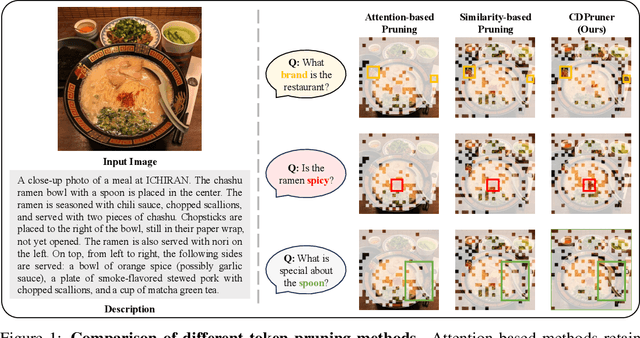
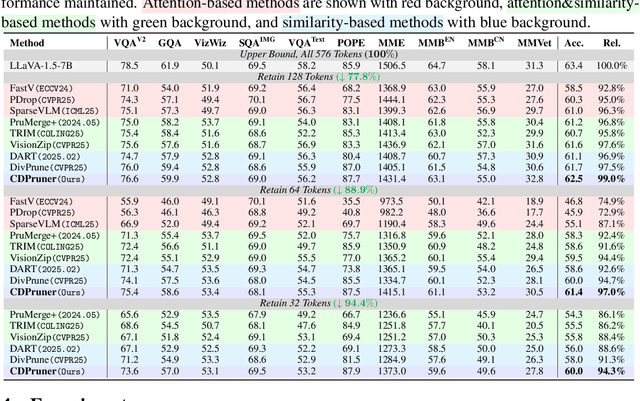
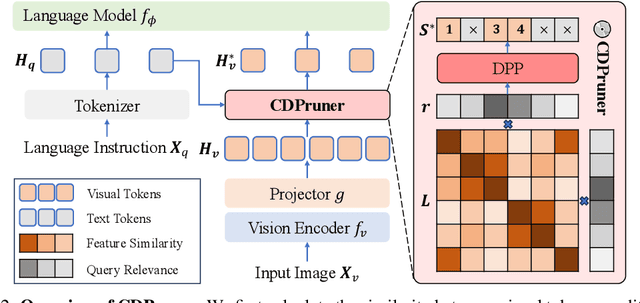
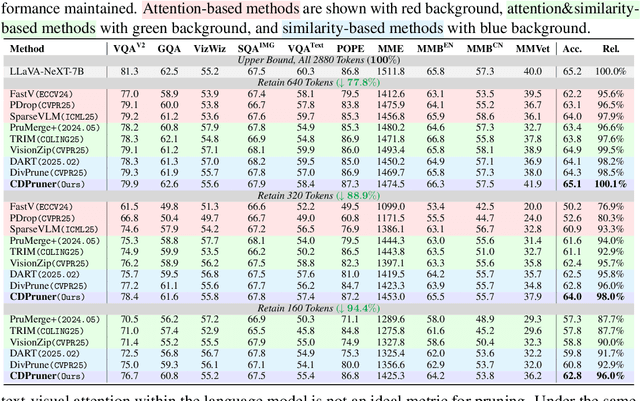
In multimodal large language models (MLLMs), the length of input visual tokens is often significantly greater than that of their textual counterparts, leading to a high inference cost. Many works aim to address this issue by removing redundant visual tokens. However, current approaches either rely on attention-based pruning, which retains numerous duplicate tokens, or use similarity-based pruning, overlooking the instruction relevance, consequently causing suboptimal performance. In this paper, we go beyond attention or similarity by proposing a novel visual token pruning method named CDPruner, which maximizes the conditional diversity of retained tokens. We first define the conditional similarity between visual tokens conditioned on the instruction, and then reformulate the token pruning problem with determinantal point process (DPP) to maximize the conditional diversity of the selected subset. The proposed CDPruner is training-free and model-agnostic, allowing easy application to various MLLMs. Extensive experiments across diverse MLLMs show that CDPruner establishes new state-of-the-art on various vision-language benchmarks. By maximizing conditional diversity through DPP, the selected subset better represents the input images while closely adhering to user instructions, thereby preserving strong performance even with high reduction ratios. When applied to LLaVA, CDPruner reduces FLOPs by 95\% and CUDA latency by 78\%, while maintaining 94\% of the original accuracy. Our code is available at https://github.com/Theia-4869/CDPruner.