 Add to Chrome
 Add to Firefox
 Add to Edge
A Robust Semantic Segmentation Pipeline for the CVPR 2026 8th UG2+ Challenge Track 2
May 21, 2026
This report presents our solution for the WeatherProof Dataset Challenge, namely CVPR 2026 8th UG2+ Challenge Track 2: Semantic Segmentation in Adverse Weather. For the semantic segmentation task under adverse weather conditions, we propose a semi-supervised segmentation pipeline. Our method is trained exclusively on the WeatherProof dataset, without using any additional external data. Specifically, we adopt UniMatch V2 as the baseline model and treat all degraded-weather images as unlabeled data for semi-supervised training, thereby fully exploiting the data distribution provided by the challenge. During inference, we further apply test-time augmentation to improve the robustness and segmentation accuracy of the final predictions. The code is publicly available at: https://github.com/ylb888/weatherproof-challenge-unimatchv2.

Technique Report of CVPR 2024 PBDL Challenges
Jun 15, 2024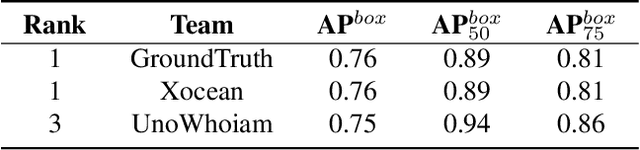
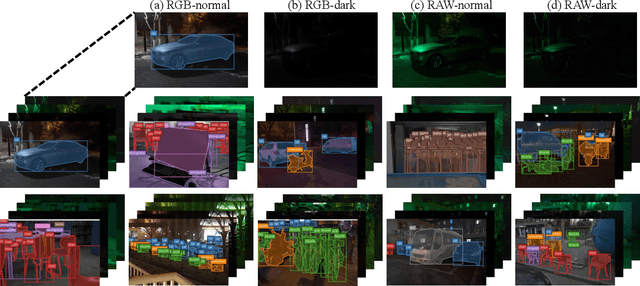
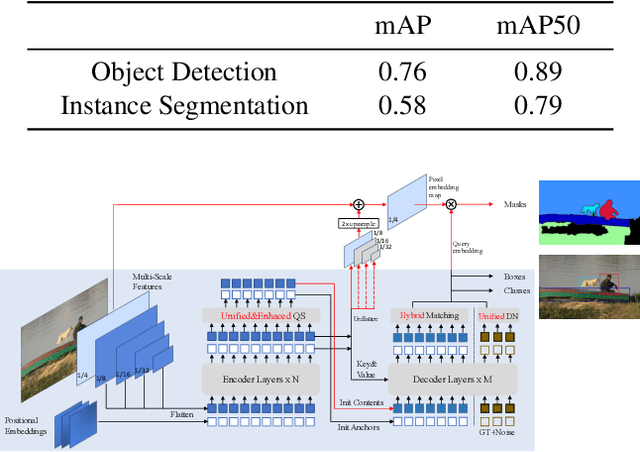

The intersection of physics-based vision and deep learning presents an exciting frontier for advancing computer vision technologies. By leveraging the principles of physics to inform and enhance deep learning models, we can develop more robust and accurate vision systems. Physics-based vision aims to invert the processes to recover scene properties such as shape, reflectance, light distribution, and medium properties from images. In recent years, deep learning has shown promising improvements for various vision tasks, and when combined with physics-based vision, these approaches can enhance the robustness and accuracy of vision systems. This technical report summarizes the outcomes of the Physics-Based Vision Meets Deep Learning (PBDL) 2024 challenge, held in CVPR 2024 workshop. The challenge consisted of eight tracks, focusing on Low-Light Enhancement and Detection as well as High Dynamic Range (HDR) Imaging. This report details the objectives, methodologies, and results of each track, highlighting the top-performing solutions and their innovative approaches.