 Add to Chrome
 Add to Firefox
 Add to Edge
Evolving Interdependent Operators with Large Language Models for Multi-Objective Combinatorial Optimization
Jan 25, 2026
Neighborhood search operators are critical to the performance of Multi-Objective Evolutionary Algorithms (MOEAs) and rely heavily on expert design. Although recent LLM-based Automated Heuristic Design (AHD) methods have made notable progress, they primarily optimize individual heuristics or components independently, lacking explicit exploration and exploitation of dynamic coupling relationships between multiple operators. In this paper, multi-operator optimization in MOEAs is formulated as a Markov decision process, enabling the improvement of interdependent operators through sequential decision-making. To address this, we propose the Evolution of Operator Combination (E2OC) framework for MOEAs, which achieves the co-evolution of design strategies and executable codes. E2OC employs Monte Carlo Tree Search to progressively search combinations of operator design strategies and adopts an operator rotation mechanism to identify effective operator configurations while supporting the integration of mainstream AHD methods as the underlying designer. Experimental results across AHD tasks with varying objectives and problem scales show that E2OC consistently outperforms state-of-the-art AHD and other multi-heuristic co-design frameworks, demonstrating strong generalization and sustained optimization capability.

StarWhisper Telescope: Agent-Based Observation Assistant System to Approach AI Astrophysicist
Dec 09, 2024
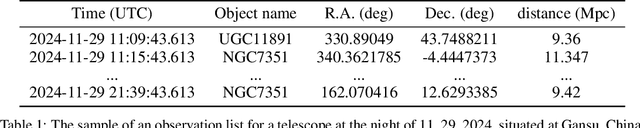


With the rapid advancements in Large Language Models (LLMs), LLM-based agents have introduced convenient and user-friendly methods for leveraging tools across various domains. In the field of astronomical observation, the construction of new telescopes has significantly increased astronomers' workload. Deploying LLM-powered agents can effectively alleviate this burden and reduce the costs associated with training personnel. Within the Nearby Galaxy Supernovae Survey (NGSS) project, which encompasses eight telescopes across three observation sites, aiming to find the transients from the galaxies in 50 mpc, we have developed the \textbf{StarWhisper Telescope System} to manage the entire observation process. This system automates tasks such as generating observation lists, conducting observations, analyzing data, and providing feedback to the observer. Observation lists are customized for different sites and strategies to ensure comprehensive coverage of celestial objects. After manual verification, these lists are uploaded to the telescopes via the agents in the system, which initiates observations upon neutral language. The observed images are analyzed in real-time, and the transients are promptly communicated to the observer. The agent modifies them into a real-time follow-up observation proposal and send to the Xinglong observatory group chat, then add them to the next-day observation lists. Additionally, the integration of AI agents within the system provides online accessibility, saving astronomers' time and encouraging greater participation from amateur astronomers in the NGSS project.