 Add to Chrome
 Add to Firefox
 Add to Edge
PragReST: Self-Reinforcing Counterfactual Reasoning for Pragmatic Language Understanding
Jun 17, 2026
Natural language understanding often depends on meanings that are implied rather than explicitly stated, requiring pragmatic reasoning. Despite strong performance on math and logical reasoning, large language models (LLMs) still struggle with making pragmatic inferences, often choosing literal interpretations. To improve LLM pragmatic reasoning, we introduce PragReST, a self-supervised framework that constructs pragmatic QA data, generates counterfactual reasoning traces, and trains models to internalize them through supervised fine-tuning and reinforcement learning, without human-labeled training data or distillation from a stronger teacher. Across four pragmatic benchmarks (PragMega, Ludwig, MetoQA, and AltPrag), PragReST improves over backbone models, task-specific pragmatic tuning baselines, and non-counterfactual variants of the same pipeline. On accuracy-based benchmarks, PragReST improves over the instruct backbone by 5.37 and 5.50% (absolute) for Qwen3-8B and Qwen3-14B, respectively. Our error analysis and ablations underscore the importance of counterfactual reasoning: PragReST primarily reduces errors caused by failures to contrast observed utterances with plausible alternatives, and removing counterfactual reasoning substantially reduces performance. Moreover, our training preserves out-of-domain performance on general-knowledge and mathematical reasoning benchmarks.

Bridging the Skill Gap in Clinical CBCT Interpretation with CBCTRepD
Mar 11, 2026Generative AI has advanced rapidly in medical report generation; however, its application to oral and maxillofacial CBCT reporting remains limited, largely because of the scarcity of high-quality paired CBCT-report data and the intrinsic complexity of volumetric CBCT interpretation. To address this, we introduce CBCTRepD, a bilingual oral and maxillofacial CBCT report-generation system designed for integration into routine radiologist-AI co-authoring workflows. We curated a large-scale, high-quality paired CBCT-report dataset comprising approximately 7,408 studies, covering 55 oral disease entities across diverse acquisition settings, and used it to develop the system. We further established a clinically grounded, multi-level evaluation framework that assesses both direct AI-generated drafts and radiologist-edited collaboration reports using automatic metrics together with radiologist- and clinician-centered evaluation. Using this framework, we show that CBCTRepD achieves superior report-generation performance and produces drafts with writing quality and standardization comparable to those of intermediate radiologists. More importantly, in radiologist-AI collaboration, CBCTRepD provides consistent and clinically meaningful benefits across experience levels: it helps novice radiologists improve toward intermediate-level reporting, enables intermediate radiologists to approach senior-level performance, and even assists senior radiologists by reducing omission-related errors, including clinically important missed lesions. By improving report structure, reducing omissions, and promoting attention to co-existing lesions across anatomical regions, CBCTRepD shows strong and reliable potential as a practical assistant for real-world CBCT reporting across multi-level care settings.
A Learnable Wavelet Transformer for Long-Short Equity Trading and Risk-Adjusted Return Optimization
Jan 19, 2026Learning profitable intraday trading policies from financial time series is challenging due to heavy noise, non-stationarity, and strong cross-sectional dependence among related assets. We propose \emph{WaveLSFormer}, a learnable wavelet-based long-short Transformer that jointly performs multi-scale decomposition and return-oriented decision learning. Specifically, a learnable wavelet front-end generates low-/high-frequency components via an end-to-end trained filter bank, guided by spectral regularizers that encourage stable and well-separated frequency bands. To fuse multi-scale information, we introduce a low-guided high-frequency injection (LGHI) module that refines low-frequency representations with high-frequency cues while controlling training stability. The model outputs a portfolio of long/short positions that is rescaled to satisfy a fixed risk budget, and is optimized directly with a trading objective and risk-aware regularization. Extensive experiments on five years of hourly data across six industry groups, evaluated over ten random seeds, demonstrate that WaveLSFormer consistently outperforms MLP, LSTM and Transformer backbones, with and without fixed discrete wavelet front-ends. On average in all industries, WaveLSFormer achieves a cumulative overall strategy return of $0.607 \pm 0.045$ and a Sharpe ratio of $2.157 \pm 0.166$, substantially improving both profitability and risk-adjusted returns over the strongest baselines.
Using deep reinforcement learning to promote sustainable human behaviour on a common pool resource problem
Apr 23, 2024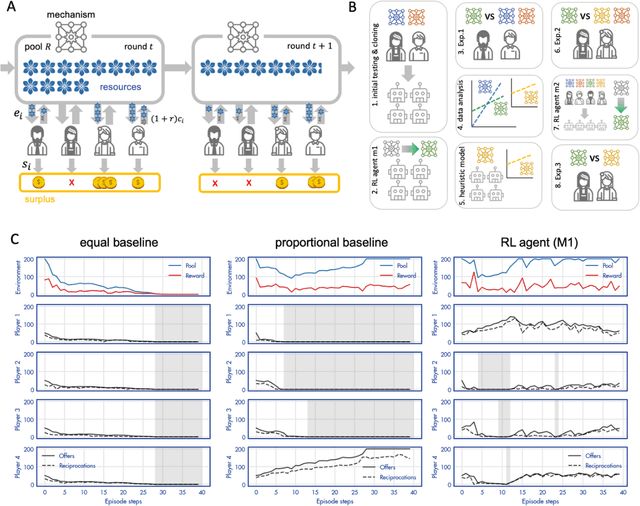


A canonical social dilemma arises when finite resources are allocated to a group of people, who can choose to either reciprocate with interest, or keep the proceeds for themselves. What resource allocation mechanisms will encourage levels of reciprocation that sustain the commons? Here, in an iterated multiplayer trust game, we use deep reinforcement learning (RL) to design an allocation mechanism that endogenously promotes sustainable contributions from human participants to a common pool resource. We first trained neural networks to behave like human players, creating a stimulated economy that allowed us to study how different mechanisms influenced the dynamics of receipt and reciprocation. We then used RL to train a social planner to maximise aggregate return to players. The social planner discovered a redistributive policy that led to a large surplus and an inclusive economy, in which players made roughly equal gains. The RL agent increased human surplus over baseline mechanisms based on unrestricted welfare or conditional cooperation, by conditioning its generosity on available resources and temporarily sanctioning defectors by allocating fewer resources to them. Examining the AI policy allowed us to develop an explainable mechanism that performed similarly and was more popular among players. Deep reinforcement learning can be used to discover mechanisms that promote sustainable human behaviour.