 Add to Chrome
 Add to Firefox
 Add to Edge
Personalization Meets Safety:Mechanisms,Risks,and Mitigations in Personalized LLMs
Jun 08, 2026
Large Language Models (LLMs) have enabled increasingly personalized interactions by adapting to users' preferences, contexts, and long-term histories. However, the mechanisms that enable personalization also expand the safety landscape in ways not systematically addressed by existing literature. Existing reviews typically focus either on personalization or safety, leaving their intersection largely unexplored. We present the first comprehensive, safety-aware review of personalized LLMs. We organize personalization along three dimensions-user representation, personalization paradigm, and evaluation-and introduce a unified taxonomy of safety risks. At the representation level, we analyze risks arising from diverse user representations. Across mainstream personalization paradigms, we delineate vulnerabilities inherent to prompting, retrieval augmentation, parameter fine-tuning, reinforcement learning, Mixture-of-Experts (MoE), pruning, agent frameworks, and multimodal personalization, and synthesize mitigation strategies across the model lifecycle. Beyond these fine-grained risks, we characterize paradigm-agnostic safety risks arising from personalized adaptation. We further summarize personalized datasets and evaluation methodologies. Through a case study of OpenClaw, we analyze deployment trends in personalized agent ecosystems. Our analysis reveals three structural inadequacies in existing research: safety is evaluated as user-invariant rather than relational, personalization techniques are analyzed in isolation rather than in composition, and evaluation frameworks cannot capture emergent long-term risks. By jointly examining personalized representations, personalization paradigms, safety risks, defenses, and evaluation methods, we provide a unified framework for developing safe personalized LLMs and highlight key directions for future research.

Learning to Compose Diversified Prompts for Image Emotion Classification
Jan 26, 2022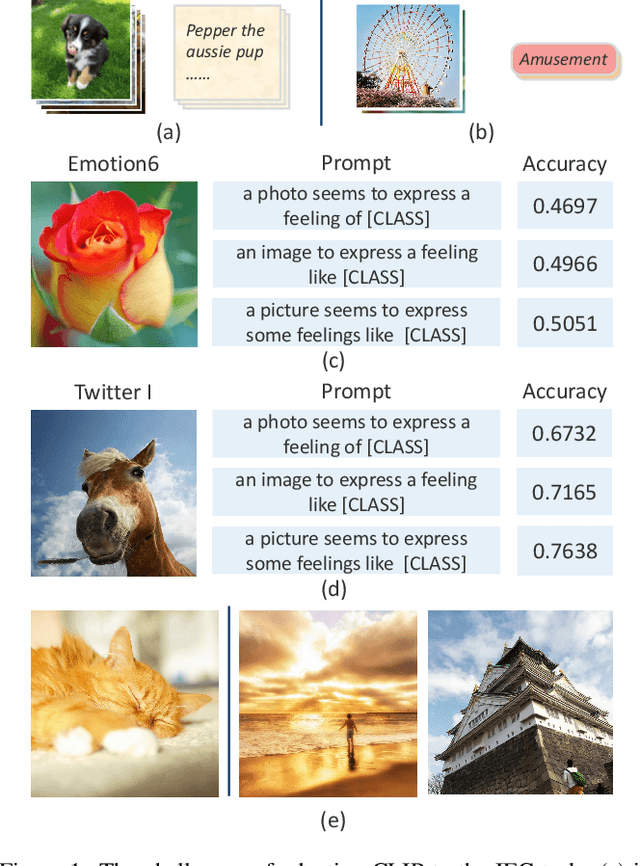
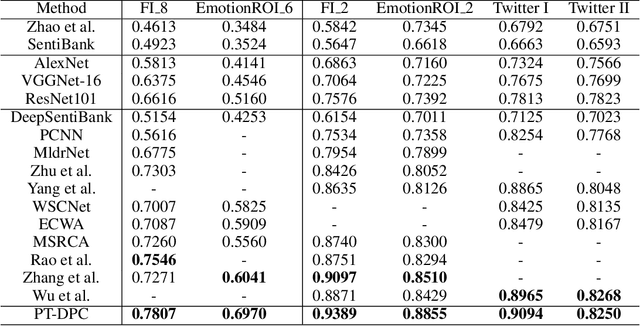
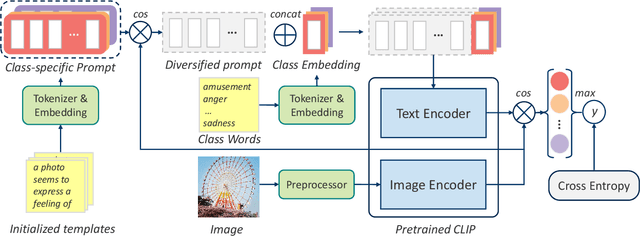

Contrastive Language-Image Pre-training (CLIP) represents the latest incarnation of pre-trained vision-language models. Although CLIP has recently shown its superior power on a wide range of downstream vision-language tasks like Visual Question Answering, it is still underexplored for Image Emotion Classification (IEC). Adapting CLIP to the IEC task has three significant challenges, tremendous training objective gap between pretraining and IEC, shared suboptimal and invariant prompts for all instances. In this paper, we propose a general framework that shows how CLIP can be effectively applied to IEC. We first introduce a prompt tuning method that mimics the pretraining objective of CLIP and thus can leverage the rich image and text semantics entailed in CLIP. Then we automatically compose instance-specific prompts by conditioning them on the categories and image contents of instances, diversifying prompts and avoiding suboptimal problems. Evaluations on six widely-used affective datasets demonstrate that our proposed method outperforms the state-of-the-art methods to a large margin (i.e., up to 9.29% accuracy gain on EmotionROI dataset) on IEC tasks, with only a few parameters trained. Our codes will be publicly available for research purposes.