 Add to Chrome
 Add to Firefox
 Add to Edge
Vision-Language Work Zone Intelligence for Safety-Critical Speed Regulation of Mixed-Autonomy Vehicles in Dynamic Environments
Jun 07, 2026
Temporary work-zone speed limits are communicated through visually inconsistent signage and are often missing from digital maps, creating safety risks for human drivers and automated vehicle systems. We present a real-time, onboard perception pipeline that detects active work zones, recognizes associated temporary speed limits, and outputs a law-aware work-zone state and speed value suitable for driver alerts or downstream automated control. The system fuses object detections with semantic verification and temporally smoothed, hysteresis-based state transitions to reduce false activations and flicker in dynamic scenes, and runs fully on low-cost embedded hardware. Evaluated manually on a annotated subset of the ROADWork dataset (490 sequences), the system achieves inside-work-zone event-level recall of 96.5% and event-level precision of 68.7%. Speed-limit recognition evaluated on 35 minutes of in-house driving data attains 95.45% precision and 53.85% recall, with no incorrect speed classifications and a single false positive. These results demonstrate a practical, scalable approach for grounding work-zone speed awareness directly in onboard perception rather than maps or infrastructure. We release our source code for the proposed system pipeline on our GitHub repository: https://github.com/Mi3-Lab/workzone

Investigating a Policy-Based Formulation for Endoscopic Camera Pose Recovery
Mar 20, 2026In endoscopic surgery, surgeons continuously locate the endoscopic view relative to the anatomy by interpreting the evolving visual appearance of the intraoperative scene in the context of their prior knowledge. Vision-based navigation systems seek to replicate this capability by recovering camera pose directly from endoscopic video, but most approaches do not embody the same principles of reasoning about new frames that makes surgeons successful. Instead, they remain grounded in feature matching and geometric optimization over keyframes, an approach that has been shown to degrade under the challenging conditions of endoscopic imaging like low texture and rapid illumination changes. Here, we pursue an alternative approach and investigate a policy-based formulation of endoscopic camera pose recovery that seeks to imitate experts in estimating trajectories conditioned on the previous camera state. Our approach directly predicts short-horizon relative motions without maintaining an explicit geometric representation at inference time. It thus addresses, by design, some of the notorious challenges of geometry-based approaches, such as brittle correspondence matching, instability in texture-sparse regions, and limited pose coverage due to reconstruction failure. We evaluate the proposed formulation on cadaveric sinus endoscopy. Under oracle state conditioning, we compare short-horizon motion prediction quality to geometric baselines achieving lowest mean translation error and competitive rotational accuracy. We analyze robustness by grouping prediction windows according to texture richness and illumination change indicating reduced sensitivity to low-texture conditions. These findings suggest that a learned motion policy offers a viable alternative formulation for endoscopic camera pose recovery.
Looking and Listening Inside and Outside: Multimodal Artificial Intelligence Systems for Driver Safety Assessment and Intelligent Vehicle Decision-Making
Feb 07, 2026The looking-in-looking-out (LILO) framework has enabled intelligent vehicle applications that understand both the outside scene and the driver state to improve safety outcomes, with examples in smart airbag deployment, takeover time prediction in autonomous control transitions, and driver attention monitoring. In this research, we propose an augmentation to this framework, making a case for the audio modality as an additional source of information to understand the driver, and in the evolving autonomy landscape, also the passengers and those outside the vehicle. We expand LILO by incorporating audio signals, forming the looking-and-listening inside-and-outside (L-LIO) framework to enhance driver state assessment and environment understanding through multimodal sensor fusion. We evaluate three example cases where audio enhances vehicle safety: supervised learning on driver speech audio to classify potential impairment states (e.g., intoxication), collection and analysis of passenger natural language instructions (e.g., "turn after that red building") to motivate how spoken language can interface with planning systems through audio-aligned instruction data, and limitations of vision-only systems where audio may disambiguate the guidance and gestures of external agents. Datasets include custom-collected in-vehicle and external audio samples in real-world environments. Pilot findings show that audio yields safety-relevant insights, particularly in nuanced or context-rich scenarios where sound is critical to safe decision-making or visual signals alone are insufficient. Challenges include ambient noise interference, privacy considerations, and robustness across human subjects, motivating further work on reliability in dynamic real-world contexts. L-LIO augments driver and scene understanding through multimodal fusion of audio and visual sensing, offering new paths for safety intervention.
Creativity and Visual Communication from Machine to Musician: Sharing a Score through a Robotic Camera
Sep 09, 2024

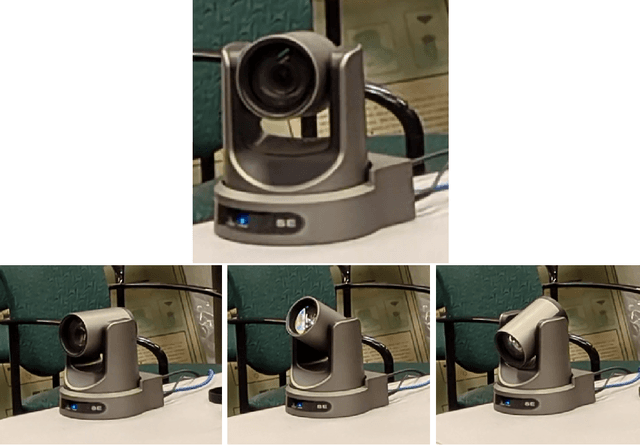
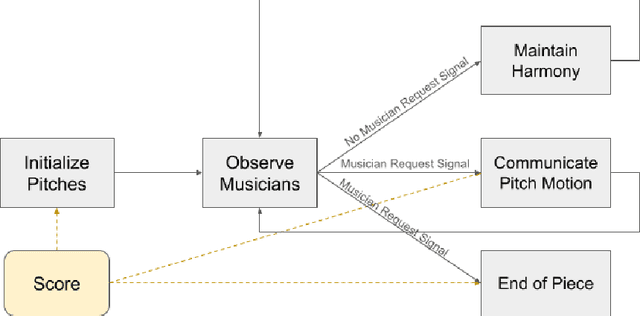
This paper explores the integration of visual communication and musical interaction by implementing a robotic camera within a "Guided Harmony" musical game. We aim to examine co-creative behaviors between human musicians and robotic systems. Our research explores existing methodologies like improvisational game pieces and extends these concepts to include robotic participation using a PTZ camera. The robotic system interprets and responds to nonverbal cues from musicians, creating a collaborative and adaptive musical experience. This initial case study underscores the importance of intuitive visual communication channels. We also propose future research directions, including parameters for refining the visual cue toolkit and data collection methods to understand human-machine co-creativity further. Our findings contribute to the broader understanding of machine intelligence in augmenting human creativity, particularly in musical settings.