 Add to Chrome
 Add to Firefox
 Add to Edge
Vision-Language Work Zone Intelligence for Safety-Critical Speed Regulation of Mixed-Autonomy Vehicles in Dynamic Environments
Jun 07, 2026
Temporary work-zone speed limits are communicated through visually inconsistent signage and are often missing from digital maps, creating safety risks for human drivers and automated vehicle systems. We present a real-time, onboard perception pipeline that detects active work zones, recognizes associated temporary speed limits, and outputs a law-aware work-zone state and speed value suitable for driver alerts or downstream automated control. The system fuses object detections with semantic verification and temporally smoothed, hysteresis-based state transitions to reduce false activations and flicker in dynamic scenes, and runs fully on low-cost embedded hardware. Evaluated manually on a annotated subset of the ROADWork dataset (490 sequences), the system achieves inside-work-zone event-level recall of 96.5% and event-level precision of 68.7%. Speed-limit recognition evaluated on 35 minutes of in-house driving data attains 95.45% precision and 53.85% recall, with no incorrect speed classifications and a single false positive. These results demonstrate a practical, scalable approach for grounding work-zone speed awareness directly in onboard perception rather than maps or infrastructure. We release our source code for the proposed system pipeline on our GitHub repository: https://github.com/Mi3-Lab/workzone

Looking and Listening Inside and Outside: Multimodal Artificial Intelligence Systems for Driver Safety Assessment and Intelligent Vehicle Decision-Making
Feb 07, 2026The looking-in-looking-out (LILO) framework has enabled intelligent vehicle applications that understand both the outside scene and the driver state to improve safety outcomes, with examples in smart airbag deployment, takeover time prediction in autonomous control transitions, and driver attention monitoring. In this research, we propose an augmentation to this framework, making a case for the audio modality as an additional source of information to understand the driver, and in the evolving autonomy landscape, also the passengers and those outside the vehicle. We expand LILO by incorporating audio signals, forming the looking-and-listening inside-and-outside (L-LIO) framework to enhance driver state assessment and environment understanding through multimodal sensor fusion. We evaluate three example cases where audio enhances vehicle safety: supervised learning on driver speech audio to classify potential impairment states (e.g., intoxication), collection and analysis of passenger natural language instructions (e.g., "turn after that red building") to motivate how spoken language can interface with planning systems through audio-aligned instruction data, and limitations of vision-only systems where audio may disambiguate the guidance and gestures of external agents. Datasets include custom-collected in-vehicle and external audio samples in real-world environments. Pilot findings show that audio yields safety-relevant insights, particularly in nuanced or context-rich scenarios where sound is critical to safe decision-making or visual signals alone are insufficient. Challenges include ambient noise interference, privacy considerations, and robustness across human subjects, motivating further work on reliability in dynamic real-world contexts. L-LIO augments driver and scene understanding through multimodal fusion of audio and visual sensing, offering new paths for safety intervention.
Automated Data Curation Using GPS & NLP to Generate Instruction-Action Pairs for Autonomous Vehicle Vision-Language Navigation Datasets
May 06, 2025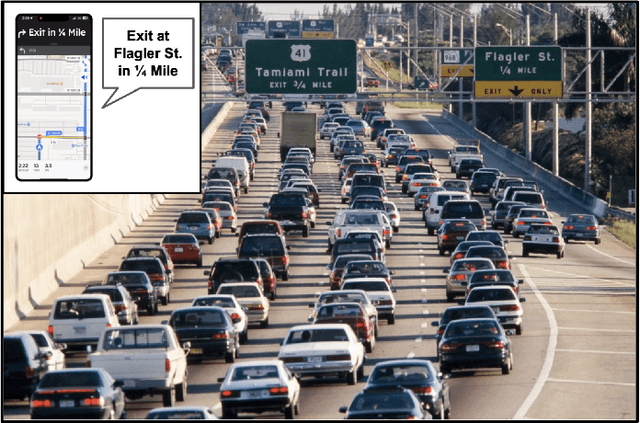
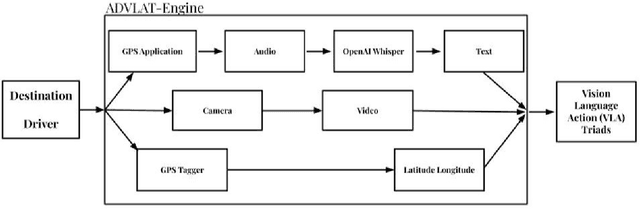
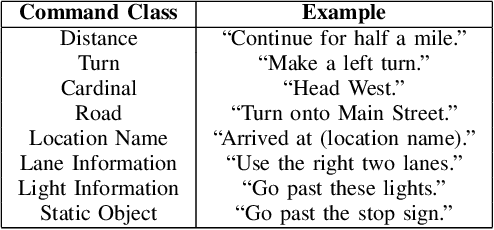
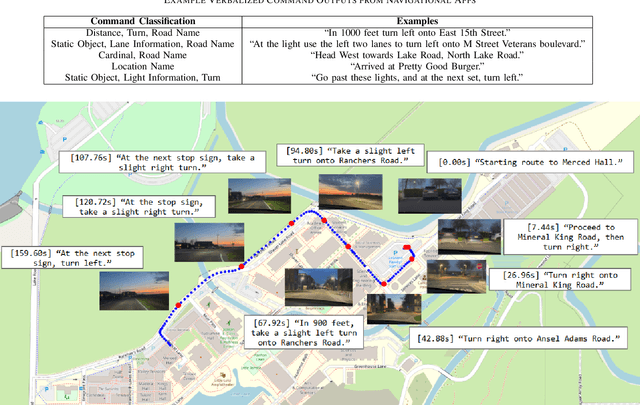
Instruction-Action (IA) data pairs are valuable for training robotic systems, especially autonomous vehicles (AVs), but having humans manually annotate this data is costly and time-inefficient. This paper explores the potential of using mobile application Global Positioning System (GPS) references and Natural Language Processing (NLP) to automatically generate large volumes of IA commands and responses without having a human generate or retroactively tag the data. In our pilot data collection, by driving to various destinations and collecting voice instructions from GPS applications, we demonstrate a means to collect and categorize the diverse sets of instructions, further accompanied by video data to form complete vision-language-action triads. We provide details on our completely automated data collection prototype system, ADVLAT-Engine. We characterize collected GPS voice instructions into eight different classifications, highlighting the breadth of commands and referentialities available for curation from freely available mobile applications. Through research and exploration into the automation of IA data pairs using GPS references, the potential to increase the speed and volume at which high-quality IA datasets are created, while minimizing cost, can pave the way for robust vision-language-action (VLA) models to serve tasks in vision-language navigation (VLN) and human-interactive autonomous systems.