 Add to Chrome
 Add to Firefox
 Add to Edge
Vision-Language Work Zone Intelligence for Safety-Critical Speed Regulation of Mixed-Autonomy Vehicles in Dynamic Environments
Jun 07, 2026
Temporary work-zone speed limits are communicated through visually inconsistent signage and are often missing from digital maps, creating safety risks for human drivers and automated vehicle systems. We present a real-time, onboard perception pipeline that detects active work zones, recognizes associated temporary speed limits, and outputs a law-aware work-zone state and speed value suitable for driver alerts or downstream automated control. The system fuses object detections with semantic verification and temporally smoothed, hysteresis-based state transitions to reduce false activations and flicker in dynamic scenes, and runs fully on low-cost embedded hardware. Evaluated manually on a annotated subset of the ROADWork dataset (490 sequences), the system achieves inside-work-zone event-level recall of 96.5% and event-level precision of 68.7%. Speed-limit recognition evaluated on 35 minutes of in-house driving data attains 95.45% precision and 53.85% recall, with no incorrect speed classifications and a single false positive. These results demonstrate a practical, scalable approach for grounding work-zone speed awareness directly in onboard perception rather than maps or infrastructure. We release our source code for the proposed system pipeline on our GitHub repository: https://github.com/Mi3-Lab/workzone

Vision and language: Novel Representations and Artificial intelligence for Driving Scene Safety Assessment and Autonomous Vehicle Planning
Feb 07, 2026Vision-language models (VLMs) have recently emerged as powerful representation learning systems that align visual observations with natural language concepts, offering new opportunities for semantic reasoning in safety-critical autonomous driving. This paper investigates how vision-language representations support driving scene safety assessment and decision-making when integrated into perception, prediction, and planning pipelines. We study three complementary system-level use cases. First, we introduce a lightweight, category-agnostic hazard screening approach leveraging CLIP-based image-text similarity to produce a low-latency semantic hazard signal. This enables robust detection of diverse and out-of-distribution road hazards without explicit object detection or visual question answering. Second, we examine the integration of scene-level vision-language embeddings into a transformer-based trajectory planning framework using the Waymo Open Dataset. Our results show that naively conditioning planners on global embeddings does not improve trajectory accuracy, highlighting the importance of representation-task alignment and motivating the development of task-informed extraction methods for safety-critical planning. Third, we investigate natural language as an explicit behavioral constraint on motion planning using the doScenes dataset. In this setting, passenger-style instructions grounded in visual scene elements suppress rare but severe planning failures and improve safety-aligned behavior in ambiguous scenarios. Taken together, these findings demonstrate that vision-language representations hold significant promise for autonomous driving safety when used to express semantic risk, intent, and behavioral constraints. Realizing this potential is fundamentally an engineering problem requiring careful system design and structured grounding rather than direct feature injection.
Looking and Listening Inside and Outside: Multimodal Artificial Intelligence Systems for Driver Safety Assessment and Intelligent Vehicle Decision-Making
Feb 07, 2026The looking-in-looking-out (LILO) framework has enabled intelligent vehicle applications that understand both the outside scene and the driver state to improve safety outcomes, with examples in smart airbag deployment, takeover time prediction in autonomous control transitions, and driver attention monitoring. In this research, we propose an augmentation to this framework, making a case for the audio modality as an additional source of information to understand the driver, and in the evolving autonomy landscape, also the passengers and those outside the vehicle. We expand LILO by incorporating audio signals, forming the looking-and-listening inside-and-outside (L-LIO) framework to enhance driver state assessment and environment understanding through multimodal sensor fusion. We evaluate three example cases where audio enhances vehicle safety: supervised learning on driver speech audio to classify potential impairment states (e.g., intoxication), collection and analysis of passenger natural language instructions (e.g., "turn after that red building") to motivate how spoken language can interface with planning systems through audio-aligned instruction data, and limitations of vision-only systems where audio may disambiguate the guidance and gestures of external agents. Datasets include custom-collected in-vehicle and external audio samples in real-world environments. Pilot findings show that audio yields safety-relevant insights, particularly in nuanced or context-rich scenarios where sound is critical to safe decision-making or visual signals alone are insufficient. Challenges include ambient noise interference, privacy considerations, and robustness across human subjects, motivating further work on reliability in dynamic real-world contexts. L-LIO augments driver and scene understanding through multimodal fusion of audio and visual sensing, offering new paths for safety intervention.
Robust Detection, Assocation, and Localization of Vehicle Lights: A Context-Based Cascaded CNN Approach and Evaluations
Jul 27, 2023Vehicle light detection is required for important downstream safe autonomous driving tasks, such as predicting a vehicle's light state to determine if the vehicle is making a lane change or turning. Currently, many vehicle light detectors use single-stage detectors which predict bounding boxes to identify a vehicle light, in a manner decoupled from vehicle instances. In this paper, we present a method for detecting a vehicle light given an upstream vehicle detection and approximation of a visible light's center. Our method predicts four approximate corners associated with each vehicle light. We experiment with CNN architectures, data augmentation, and contextual preprocessing methods designed to reduce surrounding-vehicle confusion. We achieve an average distance error from the ground truth corner of 5.09 pixels, about 17.24% of the size of the vehicle light on average. We train and evaluate our model on the LISA Lights dataset, allowing us to thoroughly evaluate our vehicle light corner detection model on a large variety of vehicle light shapes and lighting conditions. We propose that this model can be integrated into a pipeline with vehicle detection and vehicle light center detection to make a fully-formed vehicle light detection network, valuable to identifying trajectory-informative signals in driving scenes.
Patterns of Vehicle Lights: Addressing Complexities in Curation and Annotation of Camera-Based Vehicle Light Datasets and Metrics
Jul 26, 2023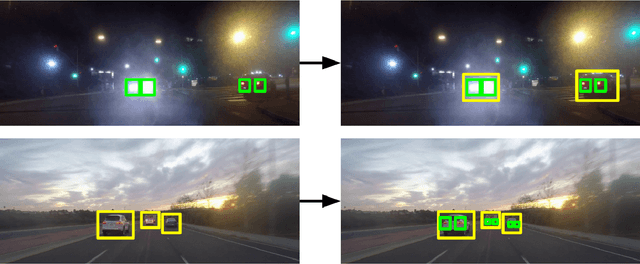
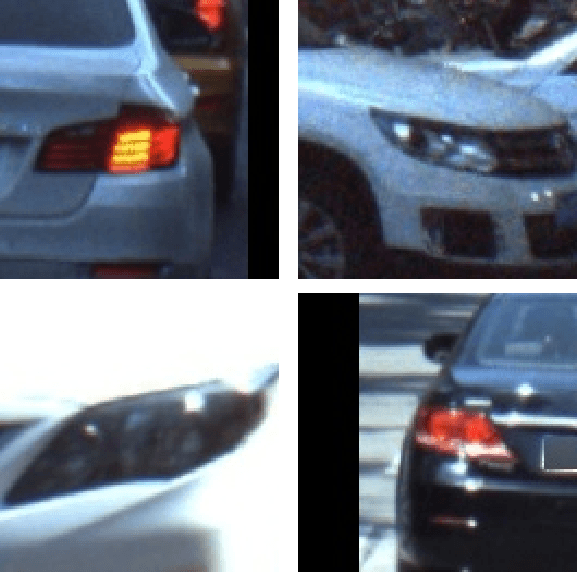

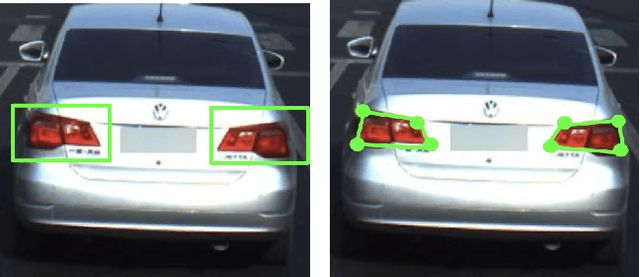
This paper explores the representation of vehicle lights in computer vision and its implications for various tasks in the field of autonomous driving. Different specifications for representing vehicle lights, including bounding boxes, center points, corner points, and segmentation masks, are discussed in terms of their strengths and weaknesses. Three important tasks in autonomous driving that can benefit from vehicle light detection are identified: nighttime vehicle detection, 3D vehicle orientation estimation, and dynamic trajectory cues. Each task may require a different representation of the light. The challenges of collecting and annotating large datasets for training data-driven models are also addressed, leading to introduction of the LISA Vehicle Lights Dataset and associated Light Visibility Model, which provides light annotations specifically designed for downstream applications in vehicle detection, intent and trajectory prediction, and safe path planning. A comparison of existing vehicle light datasets is provided, highlighting the unique features and limitations of each dataset. Overall, this paper provides insights into the representation of vehicle lights and the importance of accurate annotations for training effective detection models in autonomous driving applications. Our dataset and model are made available at https://cvrr.ucsd.edu/vehicle-lights-dataset