 Add to Chrome
 Add to Firefox
 Add to Edge
Smooth Multi-Policy Causal Effect Estimation in Longitudinal Settings
May 14, 2026
Comparative evaluation of multiple dynamic treatment policies is essential for healthcare and policy decisions, yet conventional longitudinal causal inference methods estimate each in isolation, preventing information sharing across counterfactuals. We demonstrate that this separate estimation paradigm induces a structurally uncontrolled second-order bias, inflating finite-sample variance even after standard debiasing with longitudinal targeted maximum likelihood estimation(LTMLE). To address this, we propose a policy-aware reparameterization of Iterative Conditional Expectation (ICE) Q-functions that enables joint estimation through shared representations. We implement this approach in the Policy-Encoded Q Network (PEQ-Net), an architecture centered on a shared policy encoder. The encoder is trained using kernel mean embeddings, ensuring that the learned representation space reflects population-level policy dissimilarities. After applying an LTMLE correction step, we prove this design imposes a structural constraint on the second-order remainder, thereby stabilizing finite-sample variance. Experiments on semi-synthetic datasets demonstrate that PEQ-Net consistently outperforms existing ICE-based methods, achieving substantial reductions in root-mean-square error, particularly when evaluating closely related policies.

Correcting Influence: Unboxing LLM Outputs with Orthogonal Latent Spaces
May 12, 2026A critical step for reliable large language models (LLMs) use in healthcare is to attribute predictions to their training data, akin to a medical case study. This requires token-level precision: pinpointing not just which training examples influence a decision, but which tokens within them are responsible. While influence functions offer a principled framework for this, prior work is restricted to autoregressive settings and relies on an implicit assumption of token independence, rendering their identified influences unreliable. We introduce a flexible framework that infers token-level influence through a latent mediation approach for general prediction tasks. Our method attaches sparse autoencoders to any layer of a pretrained LLM to learn a basis of approximately independent latent features. Unlike prior methods where influence decomposes additively across tokens, influence computed over latent features is inherently non-decomposable. To address this, we introduce a novel method using Jacobian-vector products. Token-level influence is obtained by propagating latent attributions back to the input space via token activation patterns. We scale our approach using efficient inverse-Hessian approximations. Experiments on medical benchmarks show our approach identifies sparse, interpretable sets of tokens that jointly influence predictions. Our framework enhances trust and enables model auditing, generalizing to high-stakes domain requiring transparent and accountable decisions.
Deep Doubly Debiased Longitudinal Effect Estimation with ICE G-Computation
Feb 12, 2026Estimating longitudinal treatment effects is essential for sequential decision-making but is challenging due to treatment-confounder feedback. While Iterative Conditional Expectation (ICE) G-computation offers a principled approach, its recursive structure suffers from error propagation, corrupting the learned outcome regression models. We propose D3-Net, a framework that mitigates error propagation in ICE training and then applies a robust final correction. First, to interrupt error propagation during learning, we train the ICE sequence using Sequential Doubly Robust (SDR) pseudo-outcomes, which provide bias-corrected targets for each regression. Second, we employ a multi-task Transformer with a covariate simulator head for auxiliary supervision, regularizing representations against corruption by noisy pseudo-outcomes, and a target network to stabilize training dynamics. For the final estimate, we discard the SDR correction and instead use the uncorrected nuisance models to perform Longitudinal Targeted Minimum Loss-Based Estimation (LTMLE) on the original outcomes. This second-stage, targeted debiasing ensures robustness and optimal finite-sample properties. Comprehensive experiments demonstrate that our model, D3-Net, robustly reduces bias and variance across different horizons, counterfactuals, and time-varying confoundings, compared to existing state-of-the-art ICE-based estimators.
Fast Non-Episodic Finite-Horizon RL with K-Step Lookahead Thresholding
Jan 31, 2026Online reinforcement learning in non-episodic, finite-horizon MDPs remains underexplored and is challenged by the need to estimate returns to a fixed terminal time. Existing infinite-horizon methods, which often rely on discounted contraction, do not naturally account for this fixed-horizon structure. We introduce a modified Q-function: rather than targeting the full-horizon, we learn a K-step lookahead Q-function that truncates planning to the next K steps. To further improve sample efficiency, we introduce a thresholding mechanism: actions are selected only when their estimated K-step lookahead value exceeds a time-varying threshold. We provide an efficient tabular learning algorithm for this novel objective, proving it achieves fast finite-sample convergence: it achieves minimax optimal constant regret for $K=1$ and $\mathcal{O}(\max((K-1),C_{K-1})\sqrt{SAT\log(T)})$ regret for any $K \geq 2$. We numerically evaluate the performance of our algorithm under the objective of maximizing reward. Our implementation adaptively increases K over time, balancing lookahead depth against estimation variance. Empirical results demonstrate superior cumulative rewards over state-of-the-art tabular RL methods across synthetic MDPs and RL environments: JumpRiverswim, FrozenLake and AnyTrading.
Clustering by Denoising: Latent plug-and-play diffusion for single-cell data
Oct 26, 2025Single-cell RNA sequencing (scRNA-seq) enables the study of cellular heterogeneity. Yet, clustering accuracy, and with it downstream analyses based on cell labels, remain challenging due to measurement noise and biological variability. In standard latent spaces (e.g., obtained through PCA), data from different cell types can be projected close together, making accurate clustering difficult. We introduce a latent plug-and-play diffusion framework that separates the observation and denoising space. This separation is operationalized through a novel Gibbs sampling procedure: the learned diffusion prior is applied in a low-dimensional latent space to perform denoising, while to steer this process, noise is reintroduced into the original high-dimensional observation space. This unique "input-space steering" ensures the denoising trajectory remains faithful to the original data structure. Our approach offers three key advantages: (1) adaptive noise handling via a tunable balance between prior and observed data; (2) uncertainty quantification through principled uncertainty estimates for downstream analysis; and (3) generalizable denoising by leveraging clean reference data to denoise noisier datasets, and via averaging, improve quality beyond the training set. We evaluate robustness on both synthetic and real single-cell genomics data. Our method improves clustering accuracy on synthetic data across varied noise levels and dataset shifts. On real-world single-cell data, our method demonstrates improved biological coherence in the resulting cell clusters, with cluster boundaries that better align with known cell type markers and developmental trajectories.
From Guess2Graph: When and How Can Unreliable Experts Safely Boost Causal Discovery in Finite Samples?
Oct 16, 2025Causal discovery algorithms often perform poorly with limited samples. While integrating expert knowledge (including from LLMs) as constraints promises to improve performance, guarantees for existing methods require perfect predictions or uncertainty estimates, making them unreliable for practical use. We propose the Guess2Graph (G2G) framework, which uses expert guesses to guide the sequence of statistical tests rather than replacing them. This maintains statistical consistency while enabling performance improvements. We develop two instantiations of G2G: PC-Guess, which augments the PC algorithm, and gPC-Guess, a learning-augmented variant designed to better leverage high-quality expert input. Theoretically, both preserve correctness regardless of expert error, with gPC-Guess provably outperforming its non-augmented counterpart in finite samples when experts are "better than random." Empirically, both show monotonic improvement with expert accuracy, with gPC-Guess achieving significantly stronger gains.
Federated Causal Inference in Healthcare: Methods, Challenges, and Applications
May 04, 2025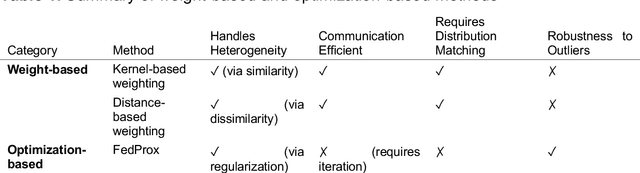
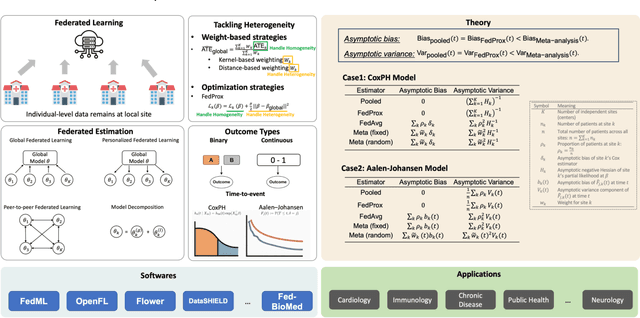
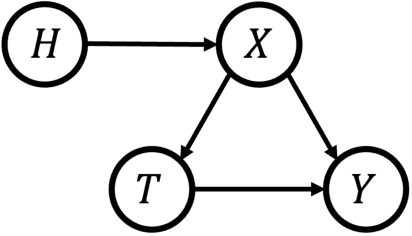
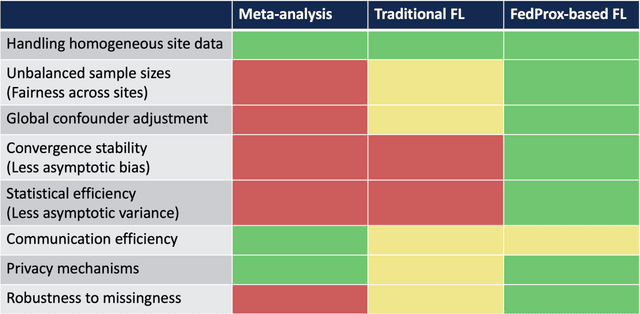
Federated causal inference enables multi-site treatment effect estimation without sharing individual-level data, offering a privacy-preserving solution for real-world evidence generation. However, data heterogeneity across sites, manifested in differences in covariate, treatment, and outcome, poses significant challenges for unbiased and efficient estimation. In this paper, we present a comprehensive review and theoretical analysis of federated causal effect estimation across both binary/continuous and time-to-event outcomes. We classify existing methods into weight-based strategies and optimization-based frameworks and further discuss extensions including personalized models, peer-to-peer communication, and model decomposition. For time-to-event outcomes, we examine federated Cox and Aalen-Johansen models, deriving asymptotic bias and variance under heterogeneity. Our analysis reveals that FedProx-style regularization achieves near-optimal bias-variance trade-offs compared to naive averaging and meta-analysis. We review related software tools and conclude by outlining opportunities, challenges, and future directions for scalable, fair, and trustworthy federated causal inference in distributed healthcare systems.
MOSIC: Model-Agnostic Optimal Subgroup Identification with Multi-Constraint for Improved Reliability
Apr 29, 2025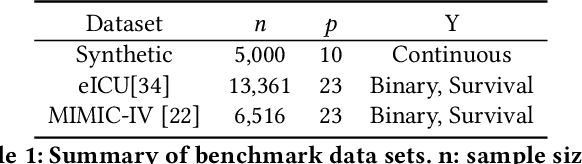
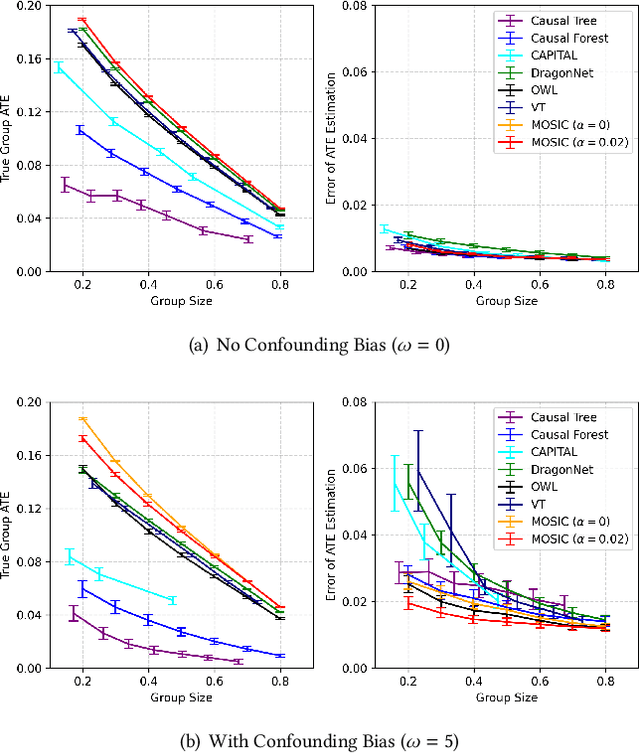
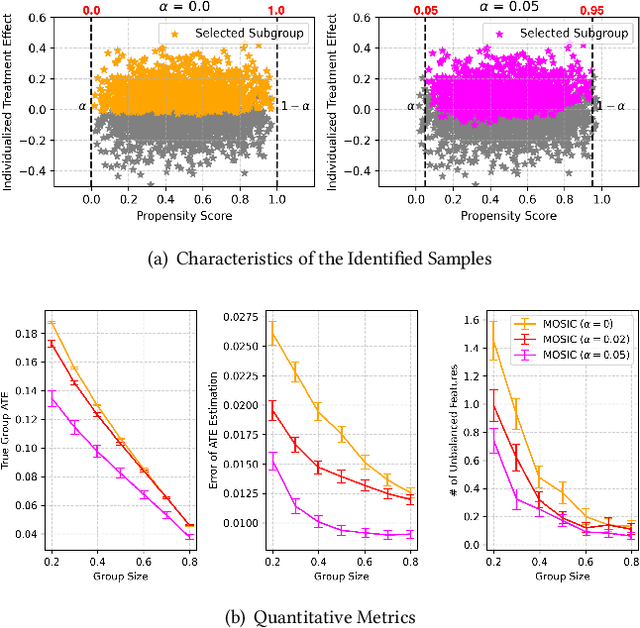
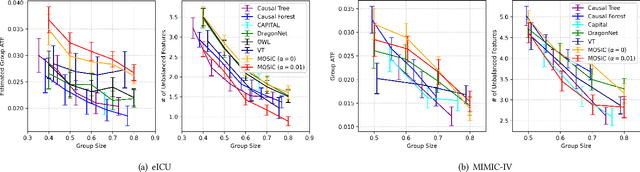
Identifying subgroups that benefit from specific treatments using observational data is a critical challenge in personalized medicine. Most existing approaches solely focus on identifying a subgroup with an improved treatment effect. However, practical considerations, such as ensuring a minimum subgroup size for representativeness or achieving sufficient confounder balance for reliability, are also important for making findings clinically meaningful and actionable. While some studies address these constraints individually, none offer a unified approach to handle them simultaneously. To bridge this gap, we propose a model-agnostic framework for optimal subgroup identification under multiple constraints. We reformulate this combinatorial problem as an unconstrained min-max optimization problem with novel modifications and solve it by a gradient descent ascent algorithm. We further prove its convergence to a feasible and locally optimal solution. Our method is stable and highly flexible, supporting various models and techniques for estimating and optimizing treatment effectiveness with observational data. Extensive experiments on both synthetic and real-world datasets demonstrate its effectiveness in identifying subgroups that satisfy multiple constraints, achieving higher treatment effects and better confounder balancing results across different group sizes.
From Restless to Contextual: A Thresholding Bandit Approach to Improve Finite-horizon Performance
Feb 07, 2025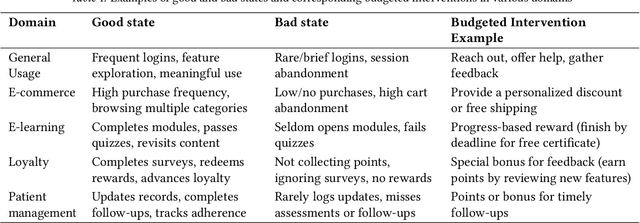
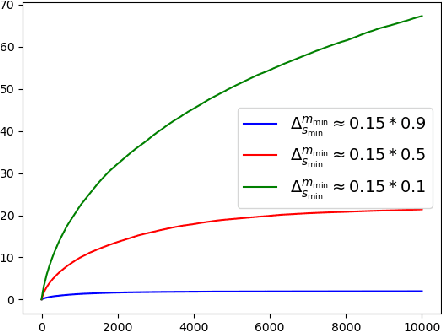
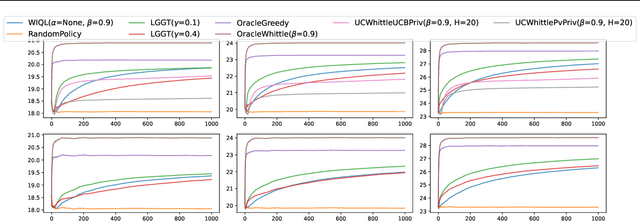
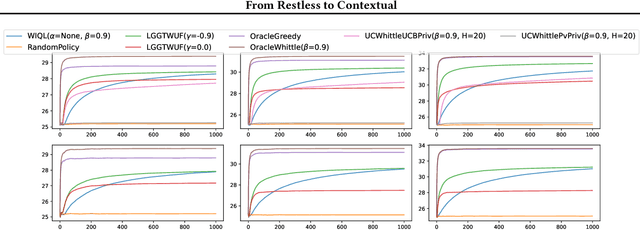
Online restless bandits extend classic contextual bandits by incorporating state transitions and budget constraints, representing each agent as a Markov Decision Process (MDP). This framework is crucial for finite-horizon strategic resource allocation, optimizing limited costly interventions for long-term benefits. However, learning the underlying MDP for each agent poses a major challenge in finite-horizon settings. To facilitate learning, we reformulate the problem as a scalable budgeted thresholding contextual bandit problem, carefully integrating the state transitions into the reward design and focusing on identifying agents with action benefits exceeding a threshold. We establish the optimality of an oracle greedy solution in a simple two-state setting, and propose an algorithm that achieves minimax optimal constant regret in the online multi-state setting with heterogeneous agents and knowledge of outcomes under no intervention. We numerically show that our algorithm outperforms existing online restless bandit methods, offering significant improvements in finite-horizon performance.
Reward Maximization for Pure Exploration: Minimax Optimal Good Arm Identification for Nonparametric Multi-Armed Bandits
Oct 21, 2024

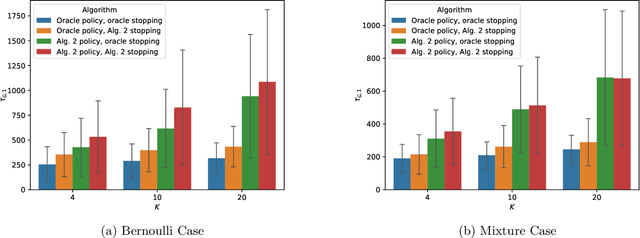

In multi-armed bandits, the tasks of reward maximization and pure exploration are often at odds with each other. The former focuses on exploiting arms with the highest means, while the latter may require constant exploration across all arms. In this work, we focus on good arm identification (GAI), a practical bandit inference objective that aims to label arms with means above a threshold as quickly as possible. We show that GAI can be efficiently solved by combining a reward-maximizing sampling algorithm with a novel nonparametric anytime-valid sequential test for labeling arm means. We first establish that our sequential test maintains error control under highly nonparametric assumptions and asymptotically achieves the minimax optimal e-power, a notion of power for anytime-valid tests. Next, by pairing regret-minimizing sampling schemes with our sequential test, we provide an approach that achieves minimax optimal stopping times for labeling arms with means above a threshold, under an error probability constraint. Our empirical results validate our approach beyond the minimax setting, reducing the expected number of samples for all stopping times by at least 50% across both synthetic and real-world settings.