 Add to Chrome
 Add to Firefox
 Add to Edge
Data Agents Under Attack: Vulnerabilities in LLM-Driven Analytical Systems
Jun 07, 2026
Data agents integrate LLM-driven reasoning with relational data access, executable analytical tools, and multi-step workflow orchestration, making them increasingly central to enterprise analytics. This integration introduces new security vulnerabilities across data resources, database execution, and agent reasoning, recombining concerns from database security and general-purpose LLM-agent security into failure modes that neither line of work captures on its own. To address this gap, we present a systematic security study of data agents. Our contributions are threefold. First, we develop a layered vulnerability framework that identifies eight data agent-specific risks across interpretation, execution, and policy layers. Second, we introduce an attack taxonomy organized by adversary goal, tactic, and technique, covering three goals, seven tactics, and fourteen techniques, and pair it with an LLM-driven payload generation pipeline grounded in real database schemas. Third, we evaluate these attacks on six systems, including four open-source data agents and two production cloud analytics services. Our experiments reveal substantial security vulnerabilities across current systems and yield four key takeaways.

Single-cell Curriculum Learning-based Deep Graph Embedding Clustering
Aug 20, 2024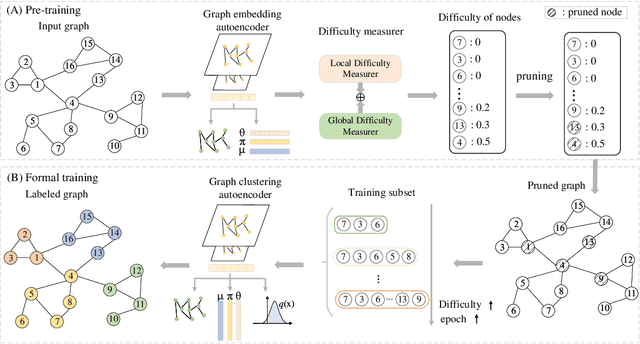
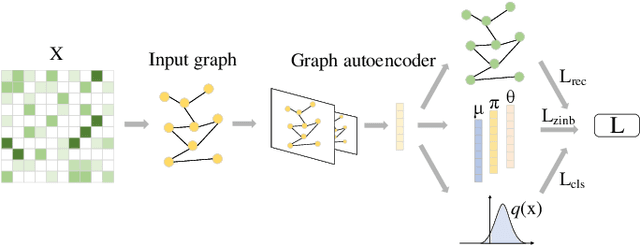
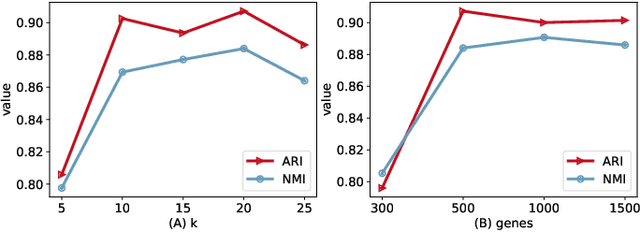
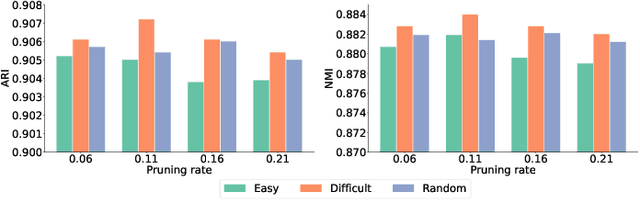
The swift advancement of single-cell RNA sequencing (scRNA-seq) technologies enables the investigation of cellular-level tissue heterogeneity. Cell annotation significantly contributes to the extensive downstream analysis of scRNA-seq data. However, The analysis of scRNA-seq for biological inference presents challenges owing to its intricate and indeterminate data distribution, characterized by a substantial volume and a high frequency of dropout events. Furthermore, the quality of training samples varies greatly, and the performance of the popular scRNA-seq data clustering solution GNN could be harmed by two types of low-quality training nodes: 1) nodes on the boundary; 2) nodes that contribute little additional information to the graph. To address these problems, we propose a single-cell curriculum learning-based deep graph embedding clustering (scCLG). We first propose a Chebyshev graph convolutional autoencoder with multi-decoder (ChebAE) that combines three optimization objectives corresponding to three decoders, including topology reconstruction loss of cell graphs, zero-inflated negative binomial (ZINB) loss, and clustering loss, to learn cell-cell topology representation. Meanwhile, we employ a selective training strategy to train GNN based on the features and entropy of nodes and prune the difficult nodes based on the difficulty scores to keep the high-quality graph. Empirical results on a variety of gene expression datasets show that our model outperforms state-of-the-art methods.
DPSUR: Accelerating Differentially Private Stochastic Gradient Descent Using Selective Update and Release
Nov 29, 2023Machine learning models are known to memorize private data to reduce their training loss, which can be inadvertently exploited by privacy attacks such as model inversion and membership inference. To protect against these attacks, differential privacy (DP) has become the de facto standard for privacy-preserving machine learning, particularly those popular training algorithms using stochastic gradient descent, such as DPSGD. Nonetheless, DPSGD still suffers from severe utility loss due to its slow convergence. This is partially caused by the random sampling, which brings bias and variance to the gradient, and partially by the Gaussian noise, which leads to fluctuation of gradient updates. Our key idea to address these issues is to apply selective updates to the model training, while discarding those useless or even harmful updates. Motivated by this, this paper proposes DPSUR, a Differentially Private training framework based on Selective Updates and Release, where the gradient from each iteration is evaluated based on a validation test, and only those updates leading to convergence are applied to the model. As such, DPSUR ensures the training in the right direction and thus can achieve faster convergence than DPSGD. The main challenges lie in two aspects -- privacy concerns arising from gradient evaluation, and gradient selection strategy for model update. To address the challenges, DPSUR introduces a clipping strategy for update randomization and a threshold mechanism for gradient selection. Experiments conducted on MNIST, FMNIST, CIFAR-10, and IMDB datasets show that DPSUR significantly outperforms previous works in terms of convergence speed and model utility.