 Add to Chrome
 Add to Firefox
 Add to Edge
Toward Signing Activity Projection in Sign Language Interaction
Jun 08, 2026
Social robots must interact robustly not only with users assumed by speech-centered systems but also with diverse users whose communication relies on different modalities, e.g., sign language. One important capability gap is predictive turn-taking with signing users. Although Voice Activity Projection (VAP) has been successfully used to model future voice activity in spoken interaction, it remains unclear whether the framework transfers to sign language interaction. This paper presents an initial transfer study of adapting a VAP architecture to dyadic sign language interaction. Using interaction recordings from the Public DGS Corpus, we derive binary signing activity streams from lexical sign annotations and formulate proxy tasks for turn-taking prediction. The model uses pose-derived hand, eye-region, and mouth-region features extracted for each signer. The results show that SHIFT/HOLD prediction is promising, especially with hand cues, while SHIFT-prediction remains difficult. These findings provide initial evidence for both the promise and the current limitations of transferring predictive turn-taking models from spoken interaction to sign language interaction. Predictive modeling of sign language interaction still requires sign-language-specific event definitions that go beyond speech-derived categories.

Rewrite to Translate, Translate to Reward: Reinforcement Learning for Source Rewriting in Machine Translation
Jun 06, 2026Although directly prompting off-the-shelf Large Language Models (LLMs) to generate meaning-preserving source rewrites can effectively enhance Machine Translation (MT) quality, doing so requires manually tuning prompts for different MT models. In this work, we propose RLSR (Reinforcement Learning for Source Rewriting), a novel RL-based framework for training a source rewriting model without tuning prompts for each MT model. RLSR optimizes the rewriting model by directly using the improvement in downstream translation quality yielded by each rewritten source as the reward. Extensive experiments across six MT models and 16 language pairs demonstrate that our 4B rewriting models trained via RLSR significantly outperform the no-rewriting baseline and existing same-scale prompt-based rewriting baselines, while achieving competitive performance against prompt-based baselines based on the 235B LLM.
Can LLMs Be Constrained to the Past? Improving Knowledge Cutoff through Recall-Based Prompting
Jun 04, 2026Prompted knowledge cutoff instructs a large language model (LLM) to act as if information beyond a specified cutoff date were unavailable. However, prior work mainly relies on direct-answer generation, which struggles when post-cutoff knowledge is not explicitly queried but is only causally related to the question. To address this limitation, we propose two recall-based prompting strategies: Self-Recall (SR), which asks the model to restate its cutoff constraint, and Question-Recall (QR), which requires the model to recall question-relevant information valid under the cutoff. Across three existing benchmarks, our methods outperform both direct-answer prompting and conventional step-by-step reasoning baselines, with particularly strong improvements on counterfactual questions. To investigate robustness across different cutoff settings, we further construct the Multi-cutoff Historical Event Benchmark (MHEB), which evaluates the same question under multiple cutoff years. Results show that knowledge cutoff performance varies with cutoff distance, while combining SR and QR consistently yields the best performance.
ReverseEOL: Improving Training-free Text Embeddings via Text Reversal in Decoder-only LLMs
Jun 04, 2026Recent advances in Large Language Models (LLMs) have opened new avenues for generating training-free text embeddings. However, the causal attention in decoder-only LLMs prevents earlier tokens from attending to future context, leading to biased contextualized representations. In this work, we propose Reverse prompting with Explicit One-word Limitation (ReverseEOL), a simple yet effective method for enhancing the representational capability of frozen LLMs. ReverseEOL augments the standard forward embedding with an additional reversed embedding derived from the reversed input text. Since reversing the input exposes each token to context inaccessible in the original order, the resulting reversed embedding effectively provides complementary information to the original one. As a result, combining the forward and reversed embeddings yields a richer final representation. Comprehensive experiments on STS and MTEB benchmarks demonstrate that ReverseEOL significantly improves the performance of existing training-free baselines across a broad range of LLMs with diverse architectures and scales. Extensive ablations and analyses further confirm the necessity of our reversal mechanism.
Emotion Recognition in Sign Language Conversation
May 22, 2026Emotion Recognition in Conversation is a core component of affective computing, while current resources of sign language emotion datasets primarily focus on isolated sentences and lack conversational context. Models trained exclusively on these isolated utterances demonstrate degraded performance in real world scenarios because they cannot utilize historical dialogue flow. To address this structural limitation, we introduce the ERC task to sign language video analysis and propose the eJSL Dialog dataset. Constructed using the scripts from the STUDIES corpus, the dataset contains 1,920 video samples organized into 480 unique dialogues. We conduct systematic benchmarking on this dataset using models ranging from isolated visual networks to multimodal conversational architectures. The results reveal a domain gap when applying generic multimodal conversational emotion recognition models to sign language. These findings demonstrate the explicit need for context aware visual extractors specific to sign language and indicate that expanding the scale of conversational datasets to support large scale pre-training is a necessary next step for future research.
Minimum Bayes Risk Decoding for Error Span Detection in Reference-Free Automatic Machine Translation Evaluation
Dec 19, 2025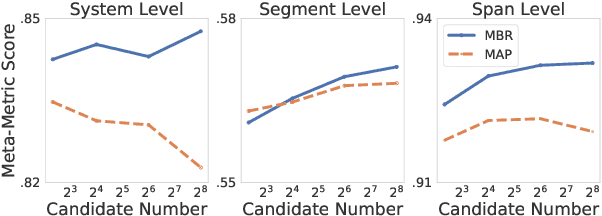

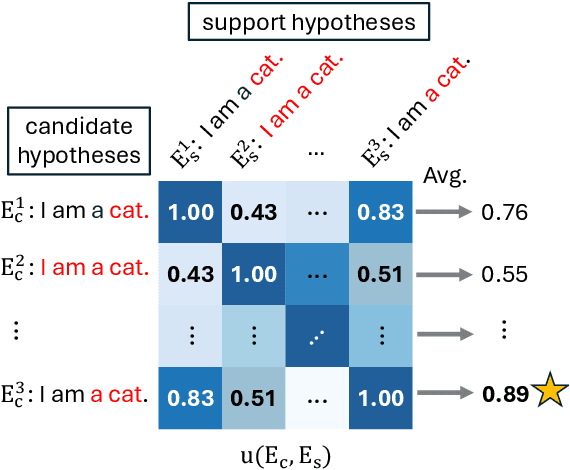
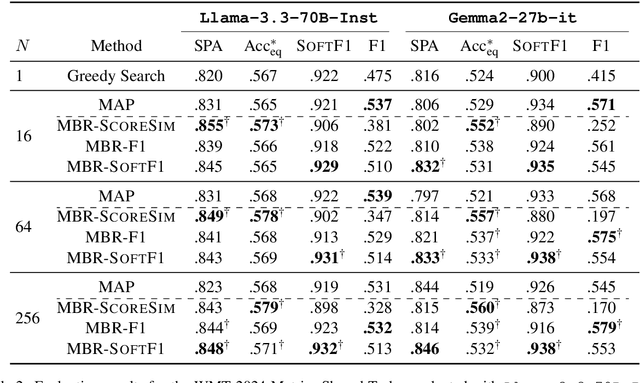
Error Span Detection (ESD) extends automatic machine translation (MT) evaluation by localizing translation errors and labeling their severity. Current generative ESD methods typically use Maximum a Posteriori (MAP) decoding, assuming that the model-estimated probabilities are perfectly correlated with similarity to the human annotation, but we often observe higher likelihood assigned to an incorrect annotation than to the human one. We instead apply Minimum Bayes Risk (MBR) decoding to generative ESD. We use a sentence- or span-level similarity function for MBR decoding, which selects candidate hypotheses based on their approximate similarity to the human annotation. Experimental results on the WMT24 Metrics Shared Task show that MBR decoding significantly improves span-level performance and generally matches or outperforms MAP at the system and sentence levels. To reduce the computational cost of MBR decoding, we further distill its decisions into a model decoded via greedy search, removing the inference-time latency bottleneck.
Emotion Recognition in Signers
Dec 17, 2025Recognition of signers' emotions suffers from one theoretical challenge and one practical challenge, namely, the overlap between grammatical and affective facial expressions and the scarcity of data for model training. This paper addresses these two challenges in a cross-lingual setting using our eJSL dataset, a new benchmark dataset for emotion recognition in Japanese Sign Language signers, and BOBSL, a large British Sign Language dataset with subtitles. In eJSL, two signers expressed 78 distinct utterances with each of seven different emotional states, resulting in 1,092 video clips. We empirically demonstrate that 1) textual emotion recognition in spoken language mitigates data scarcity in sign language, 2) temporal segment selection has a significant impact, and 3) incorporating hand motion enhances emotion recognition in signers. Finally we establish a stronger baseline than spoken language LLMs.
Unveiling the Power of Source: Source-based Minimum Bayes Risk Decoding for Neural Machine Translation
Jun 17, 2024
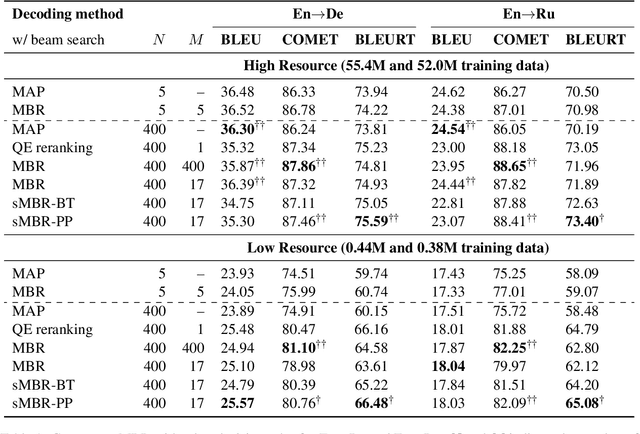
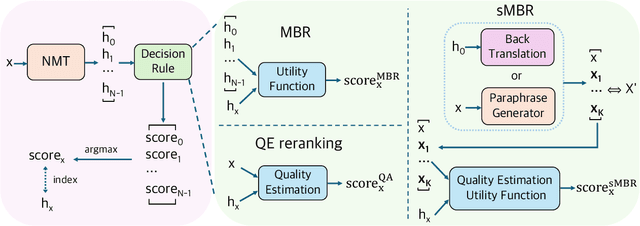
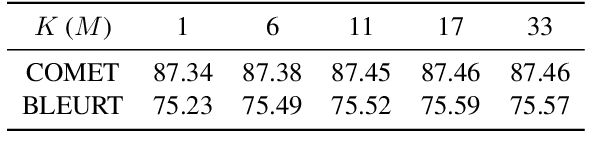
Maximum a posteriori decoding, a commonly used method for neural machine translation (NMT), aims to maximize the estimated posterior probability. However, high estimated probability does not always lead to high translation quality. Minimum Bayes Risk (MBR) decoding offers an alternative by seeking hypotheses with the highest expected utility. In this work, we show that Quality Estimation (QE) reranking, which uses a QE model as a reranker, can be viewed as a variant of MBR. Inspired by this, we propose source-based MBR (sMBR) decoding, a novel approach that utilizes synthetic sources generated by backward translation as ``support hypotheses'' and a reference-free quality estimation metric as the utility function, marking the first work to solely use sources in MBR decoding. Experiments show that sMBR significantly outperforms QE reranking and is competitive with standard MBR decoding. Furthermore, sMBR calls the utility function fewer times compared to MBR. Our findings suggest that sMBR is a promising approach for high-quality NMT decoding.
DiLM: Distilling Dataset into Language Model for Text-level Dataset Distillation
Mar 30, 2024
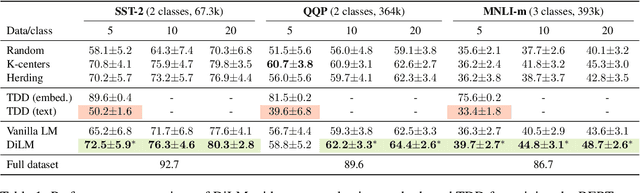
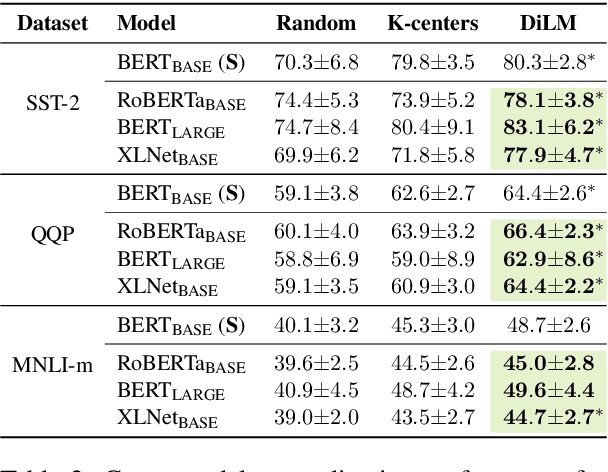

Dataset distillation aims to compress a training dataset by creating a small number of informative synthetic samples such that neural networks trained on them perform as well as those trained on the original training dataset. Current text dataset distillation methods create each synthetic sample as a sequence of word embeddings instead of a text to apply gradient-based optimization; however, such embedding-level distilled datasets cannot be used for training other models whose word embedding weights are different from the model used for distillation. To address this issue, we propose a novel text dataset distillation approach, called Distilling dataset into Language Model (DiLM), which trains a language model to generate informative synthetic training samples as text data, instead of directly optimizing synthetic samples. We evaluated DiLM on various text classification datasets and showed that distilled synthetic datasets from DiLM outperform those from current coreset selection methods. DiLM achieved remarkable generalization performance in training different types of models and in-context learning of large language models. Our code will be available at https://github.com/arumaekawa/DiLM.
Joyful: Joint Modality Fusion and Graph Contrastive Learning for Multimodal Emotion Recognition
Nov 18, 2023
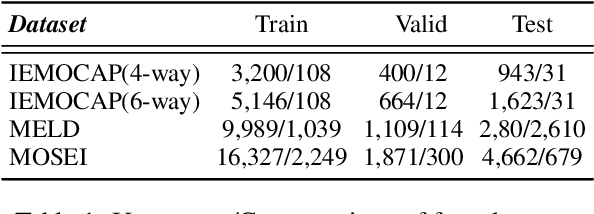
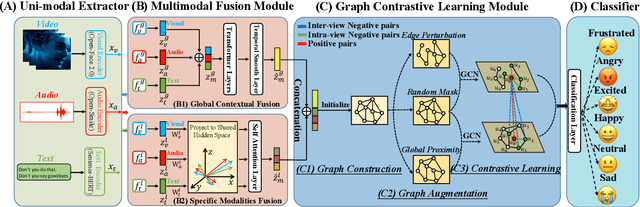
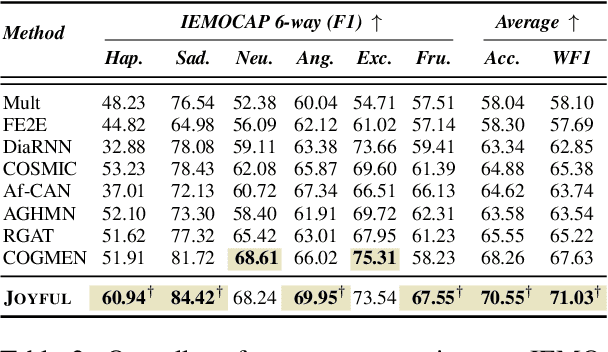
Multimodal emotion recognition aims to recognize emotions for each utterance of multiple modalities, which has received increasing attention for its application in human-machine interaction. Current graph-based methods fail to simultaneously depict global contextual features and local diverse uni-modal features in a dialogue. Furthermore, with the number of graph layers increasing, they easily fall into over-smoothing. In this paper, we propose a method for joint modality fusion and graph contrastive learning for multimodal emotion recognition (Joyful), where multimodality fusion, contrastive learning, and emotion recognition are jointly optimized. Specifically, we first design a new multimodal fusion mechanism that can provide deep interaction and fusion between the global contextual and uni-modal specific features. Then, we introduce a graph contrastive learning framework with inter-view and intra-view contrastive losses to learn more distinguishable representations for samples with different sentiments. Extensive experiments on three benchmark datasets indicate that Joyful achieved state-of-the-art (SOTA) performance compared to all baselines.