 Add to Chrome
 Add to Firefox
 Add to Edge
ReverseEOL: Improving Training-free Text Embeddings via Text Reversal in Decoder-only LLMs
Jun 04, 2026
Recent advances in Large Language Models (LLMs) have opened new avenues for generating training-free text embeddings. However, the causal attention in decoder-only LLMs prevents earlier tokens from attending to future context, leading to biased contextualized representations. In this work, we propose Reverse prompting with Explicit One-word Limitation (ReverseEOL), a simple yet effective method for enhancing the representational capability of frozen LLMs. ReverseEOL augments the standard forward embedding with an additional reversed embedding derived from the reversed input text. Since reversing the input exposes each token to context inaccessible in the original order, the resulting reversed embedding effectively provides complementary information to the original one. As a result, combining the forward and reversed embeddings yields a richer final representation. Comprehensive experiments on STS and MTEB benchmarks demonstrate that ReverseEOL significantly improves the performance of existing training-free baselines across a broad range of LLMs with diverse architectures and scales. Extensive ablations and analyses further confirm the necessity of our reversal mechanism.

Can LLMs Be Constrained to the Past? Improving Knowledge Cutoff through Recall-Based Prompting
Jun 04, 2026Prompted knowledge cutoff instructs a large language model (LLM) to act as if information beyond a specified cutoff date were unavailable. However, prior work mainly relies on direct-answer generation, which struggles when post-cutoff knowledge is not explicitly queried but is only causally related to the question. To address this limitation, we propose two recall-based prompting strategies: Self-Recall (SR), which asks the model to restate its cutoff constraint, and Question-Recall (QR), which requires the model to recall question-relevant information valid under the cutoff. Across three existing benchmarks, our methods outperform both direct-answer prompting and conventional step-by-step reasoning baselines, with particularly strong improvements on counterfactual questions. To investigate robustness across different cutoff settings, we further construct the Multi-cutoff Historical Event Benchmark (MHEB), which evaluates the same question under multiple cutoff years. Results show that knowledge cutoff performance varies with cutoff distance, while combining SR and QR consistently yields the best performance.
DS-TransUNet:Dual Swin Transformer U-Net for Medical Image Segmentation
Jun 12, 2021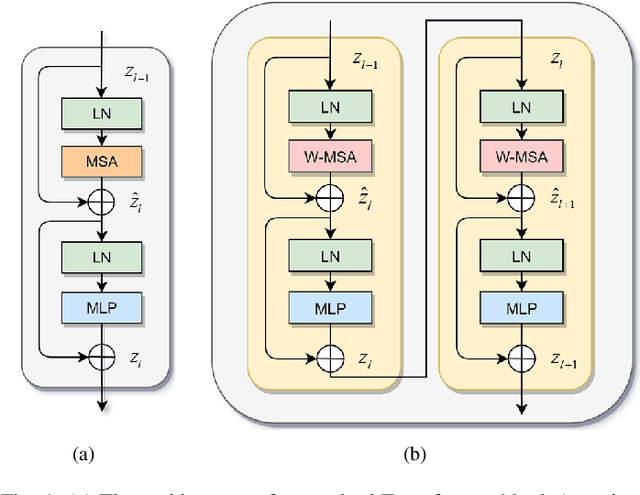
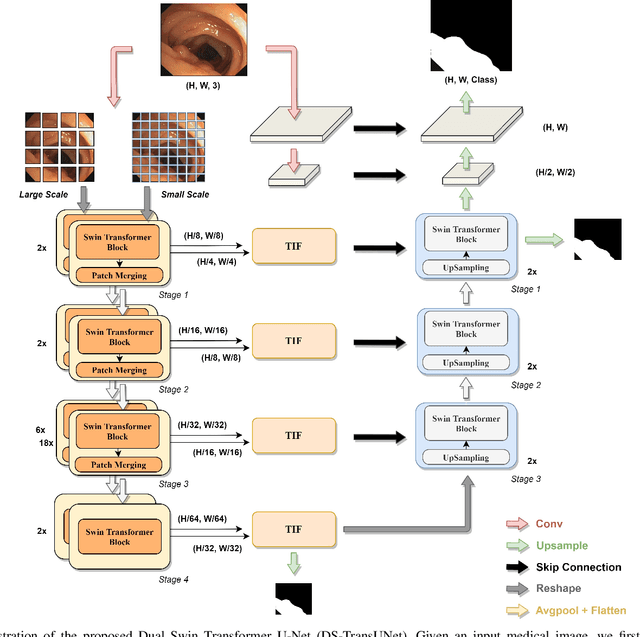
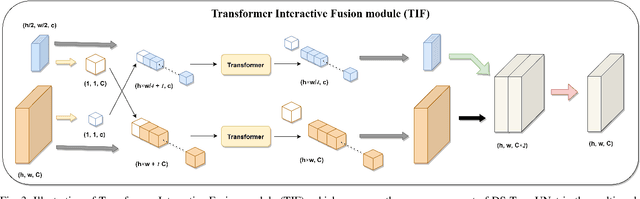
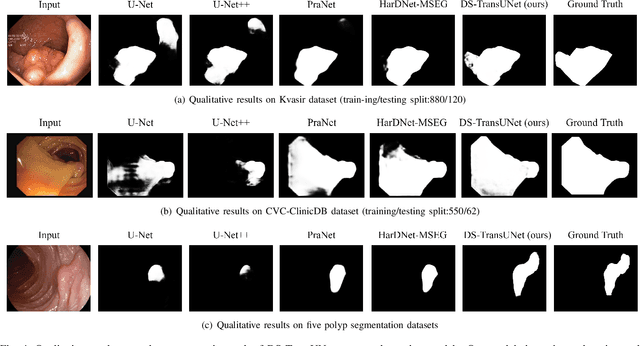
Automatic medical image segmentation has made great progress benefit from the development of deep learning. However, most existing methods are based on convolutional neural networks (CNNs), which fail to build long-range dependencies and global context connections due to the limitation of receptive field in convolution operation. Inspired by the success of Transformer in modeling the long-range contextual information, some researchers have expended considerable efforts in designing the robust variants of Transformer-based U-Net. Moreover, the patch division used in vision transformers usually ignores the pixel-level intrinsic structural features inside each patch. To alleviate these problems, we propose a novel deep medical image segmentation framework called Dual Swin Transformer U-Net (DS-TransUNet), which might be the first attempt to concurrently incorporate the advantages of hierarchical Swin Transformer into both encoder and decoder of the standard U-shaped architecture to enhance the semantic segmentation quality of varying medical images. Unlike many prior Transformer-based solutions, the proposed DS-TransUNet first adopts dual-scale encoder subnetworks based on Swin Transformer to extract the coarse and fine-grained feature representations of different semantic scales. As the core component for our DS-TransUNet, a well-designed Transformer Interactive Fusion (TIF) module is proposed to effectively establish global dependencies between features of different scales through the self-attention mechanism. Furthermore, we also introduce the Swin Transformer block into decoder to further explore the long-range contextual information during the up-sampling process. Extensive experiments across four typical tasks for medical image segmentation demonstrate the effectiveness of DS-TransUNet, and show that our approach significantly outperforms the state-of-the-art methods.