 Add to Chrome
 Add to Firefox
 Add to Edge
FALCON: Fairness Learning via Contrastive Attention Approach to Continual Semantic Scene Understanding in Open World
Nov 27, 2023
Continual Learning in semantic scene segmentation aims to continually learn new unseen classes in dynamic environments while maintaining previously learned knowledge. Prior studies focused on modeling the catastrophic forgetting and background shift challenges in continual learning. However, fairness, another major challenge that causes unfair predictions leading to low performance among major and minor classes, still needs to be well addressed. In addition, prior methods have yet to model the unknown classes well, thus resulting in producing non-discriminative features among unknown classes. This paper presents a novel Fairness Learning via Contrastive Attention Approach to continual learning in semantic scene understanding. In particular, we first introduce a new Fairness Contrastive Clustering loss to address the problems of catastrophic forgetting and fairness. Then, we propose an attention-based visual grammar approach to effectively model the background shift problem and unknown classes, producing better feature representations for different unknown classes. Through our experiments, our proposed approach achieves State-of-the-Art (SOTA) performance on different continual learning settings of three standard benchmarks, i.e., ADE20K, Cityscapes, and Pascal VOC. It promotes the fairness of the continual semantic segmentation model.

Insect-Foundation: A Foundation Model and Large-scale 1M Dataset for Visual Insect Understanding
Nov 26, 2023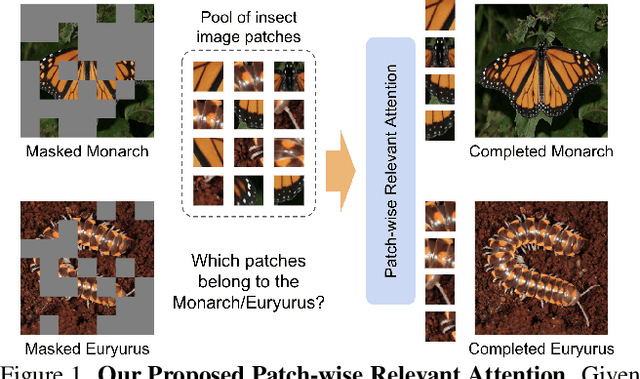

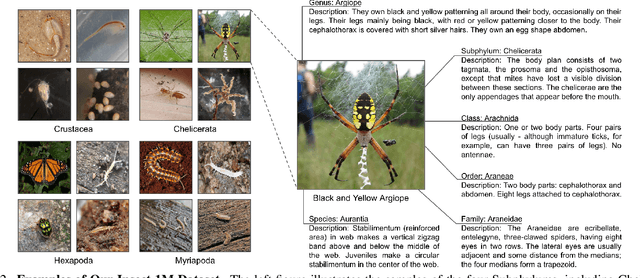

In precision agriculture, the detection and recognition of insects play an essential role in the ability of crops to grow healthy and produce a high-quality yield. The current machine vision model requires a large volume of data to achieve high performance. However, there are approximately 5.5 million different insect species in the world. None of the existing insect datasets can cover even a fraction of them due to varying geographic locations and acquisition costs. In this paper, we introduce a novel ``Insect-1M'' dataset, a game-changing resource poised to revolutionize insect-related foundation model training. Covering a vast spectrum of insect species, our dataset, including 1 million images with dense identification labels of taxonomy hierarchy and insect descriptions, offers a panoramic view of entomology, enabling foundation models to comprehend visual and semantic information about insects like never before. Then, to efficiently establish an Insect Foundation Model, we develop a micro-feature self-supervised learning method with a Patch-wise Relevant Attention mechanism capable of discerning the subtle differences among insect images. In addition, we introduce Description Consistency loss to improve micro-feature modeling via insect descriptions. Through our experiments, we illustrate the effectiveness of our proposed approach in insect modeling and achieve State-of-the-Art performance on standard benchmarks of insect-related tasks. Our Insect Foundation Model and Dataset promise to empower the next generation of insect-related vision models, bringing them closer to the ultimate goal of precision agriculture.
Quantum Vision Clustering
Sep 18, 2023Unsupervised visual clustering has recently received considerable attention. It aims to explain distributions of unlabeled visual images by clustering them via a parameterized appearance model. From a different perspective, the clustering algorithms can be treated as assignment problems, often NP-hard. They can be solved precisely for small instances on current hardware. Adiabatic quantum computing (AQC) offers a solution, as it can soon provide a considerable speedup on a range of NP-hard optimization problems. However, current clustering formulations are unsuitable for quantum computing due to their scaling properties. Consequently, in this work, we propose the first clustering formulation designed to be solved with AQC. We employ an Ising model representing the quantum mechanical system implemented on the AQC. Our approach is competitive compared to state-of-the-art optimization-based approaches, even using of-the-shelf integer programming solvers. Finally, we demonstrate that our clustering problem is already solvable on the current generation of real quantum computers for small examples and analyze the properties of the measured solutions.
The Algonauts Project 2023 Challenge: UARK-UAlbany Team Solution
Aug 01, 2023This work presents our solutions to the Algonauts Project 2023 Challenge. The primary objective of the challenge revolves around employing computational models to anticipate brain responses captured during participants' observation of intricate natural visual scenes. The goal is to predict brain responses across the entire visual brain, as it is the region where the most reliable responses to images have been observed. We constructed an image-based brain encoder through a two-step training process to tackle this challenge. Initially, we created a pretrained encoder using data from all subjects. Next, we proceeded to fine-tune individual subjects. Each step employed different training strategies, such as different loss functions and objectives, to introduce diversity. Ultimately, our solution constitutes an ensemble of multiple unique encoders. The code is available at https://github.com/uark-cviu/Algonauts2023
UTOPIA: Unconstrained Tracking Objects without Preliminary Examination via Cross-Domain Adaptation
Jun 16, 2023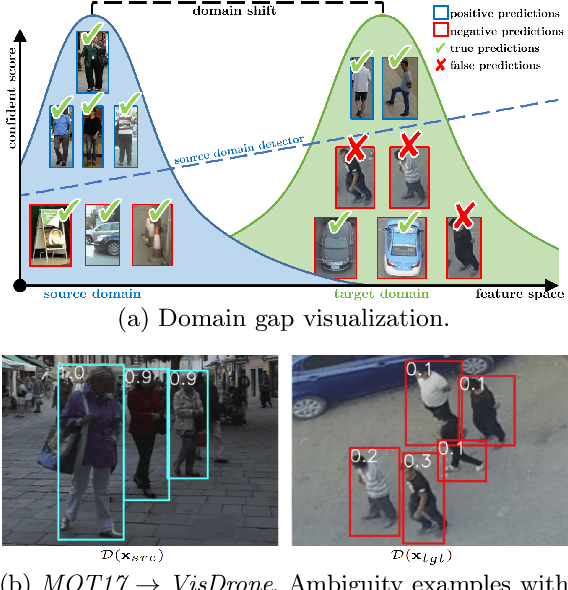
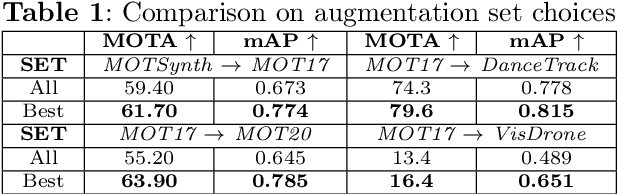
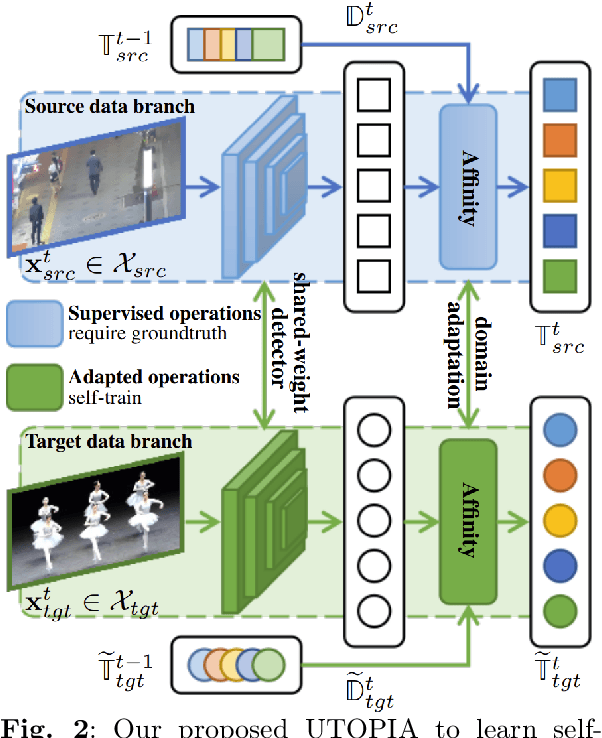
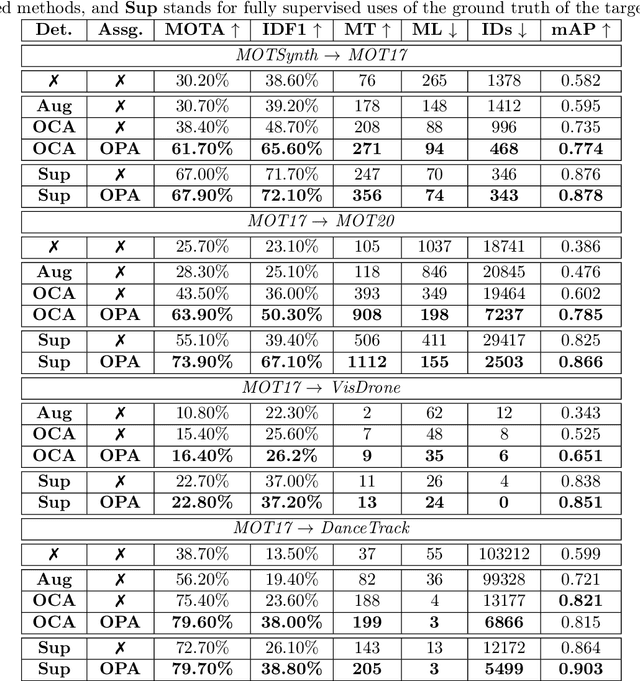
Multiple Object Tracking (MOT) aims to find bounding boxes and identities of targeted objects in consecutive video frames. While fully-supervised MOT methods have achieved high accuracy on existing datasets, they cannot generalize well on a newly obtained dataset or a new unseen domain. In this work, we first address the MOT problem from the cross-domain point of view, imitating the process of new data acquisition in practice. Then, a new cross-domain MOT adaptation from existing datasets is proposed without any pre-defined human knowledge in understanding and modeling objects. It can also learn and update itself from the target data feedback. The intensive experiments are designed on four challenging settings, including MOTSynth to MOT17, MOT17 to MOT20, MOT17 to VisDrone, and MOT17 to DanceTrack. We then prove the adaptability of the proposed self-supervised learning strategy. The experiments also show superior performance on tracking metrics MOTA and IDF1, compared to fully supervised, unsupervised, and self-supervised state-of-the-art methods.
Z-GMOT: Zero-shot Generic Multiple Object Tracking
May 28, 2023Despite the significant progress made in recent years, Multi-Object Tracking (MOT) approaches still suffer from several limitations, including their reliance on prior knowledge of tracking targets, which necessitates the costly annotation of large labeled datasets. As a result, existing MOT methods are limited to a small set of predefined categories, and they struggle with unseen objects in the real world. To address these issues, Generic Multiple Object Tracking (GMOT) has been proposed, which requires less prior information about the targets. However, all existing GMOT approaches follow a one-shot paradigm, relying mainly on the initial bounding box and thus struggling to handle variants e.g., viewpoint, lighting, occlusion, scale, and etc. In this paper, we introduce a novel approach to address the limitations of existing MOT and GMOT methods. Specifically, we propose a zero-shot GMOT (Z-GMOT) algorithm that can track never-seen object categories with zero training examples, without the need for predefined categories or an initial bounding box. To achieve this, we propose iGLIP, an improved version of Grounded language-image pretraining (GLIP), which can detect unseen objects while minimizing false positives. We evaluate our Z-GMOT thoroughly on the GMOT-40 dataset, AnimalTrack testset, DanceTrack testset. The results of these evaluations demonstrate a significant improvement over existing methods. For instance, on the GMOT-40 dataset, the Z-GMOT outperforms one-shot GMOT with OC-SORT by 27.79 points HOTA and 44.37 points MOTA. On the AnimalTrack dataset, it surpasses fully-supervised methods with DeepSORT by 12.55 points HOTA and 8.97 points MOTA. To facilitate further research, we will make our code and models publicly available upon acceptance of this paper.
Cross-view Action Recognition Understanding From Exocentric to Egocentric Perspective
May 25, 2023Understanding action recognition in egocentric videos has emerged as a vital research topic with numerous practical applications. With the limitation in the scale of egocentric data collection, learning robust deep learning-based action recognition models remains difficult. Transferring knowledge learned from the large-scale exocentric data to the egocentric data is challenging due to the difference in videos across views. Our work introduces a novel cross-view learning approach to action recognition (CVAR) that effectively transfers knowledge from the exocentric to the egocentric view. First, we introduce a novel geometric-based constraint into the self-attention mechanism in Transformer based on analyzing the camera positions between two views. Then, we propose a new cross-view self-attention loss learned on unpaired cross-view data to enforce the self-attention mechanism learning to transfer knowledge across views. Finally, to further improve the performance of our cross-view learning approach, we present the metrics to measure the correlations in videos and attention maps effectively. Experimental results on standard egocentric action recognition benchmarks, i.e., Charades-Ego, EPIC-Kitchens-55, and EPIC-Kitchens-100, have shown our approach's effectiveness and state-of-the-art performance.
Fairness Continual Learning Approach to Semantic Scene Understanding in Open-World Environments
May 25, 2023Continual semantic segmentation aims to learn new classes while maintaining the information from the previous classes. Although prior studies have shown impressive progress in recent years, the fairness concern in the continual semantic segmentation needs to be better addressed. Meanwhile, fairness is one of the most vital factors in deploying the deep learning model, especially in human-related or safety applications. In this paper, we present a novel Fairness Continual Learning approach to the semantic segmentation problem. In particular, under the fairness objective, a new fairness continual learning framework is proposed based on class distributions. Then, a novel Prototypical Contrastive Clustering loss is proposed to address the significant challenges in continual learning, i.e., catastrophic forgetting and background shift. Our proposed loss has also been proven as a novel, generalized learning paradigm of knowledge distillation commonly used in continual learning. Moreover, the proposed Conditional Structural Consistency loss further regularized the structural constraint of the predicted segmentation. Our proposed approach has achieved State-of-the-Art performance on three standard scene understanding benchmarks, i.e., ADE20K, Cityscapes, and Pascal VOC, and promoted the fairness of the segmentation model.
Type-to-Track: Retrieve Any Object via Prompt-based Tracking
May 22, 2023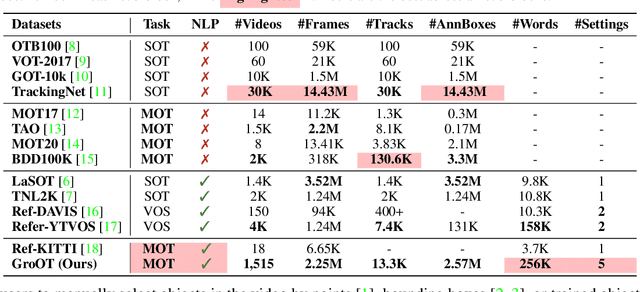
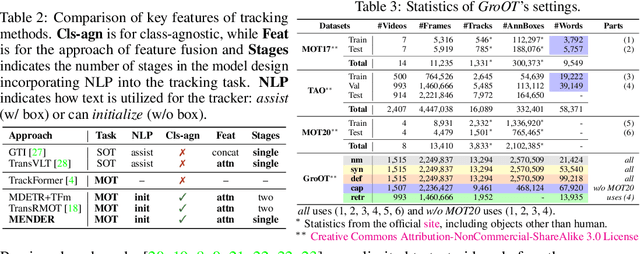
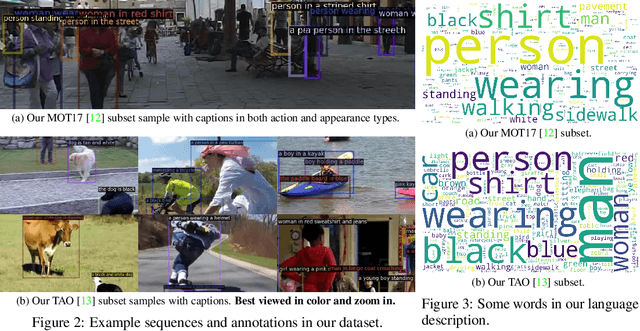
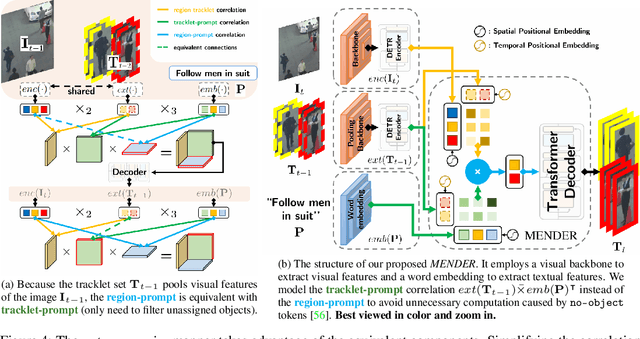
One of the recent trends in vision problems is to use natural language captions to describe the objects of interest. This approach can overcome some limitations of traditional methods that rely on bounding boxes or category annotations. This paper introduces a novel paradigm for Multiple Object Tracking called Type-to-Track, which allows users to track objects in videos by typing natural language descriptions. We present a new dataset for that Grounded Multiple Object Tracking task, called GroOT, that contains videos with various types of objects and their corresponding textual captions describing their appearance and action in detail. Additionally, we introduce two new evaluation protocols and formulate evaluation metrics specifically for this task. We develop a new efficient method that models a transformer-based eMbed-ENcoDE-extRact framework (MENDER) using the third-order tensor decomposition. The experiments in five scenarios show that our MENDER approach outperforms another two-stage design in terms of accuracy and efficiency, up to 14.7% accuracy and 4$\times$ speed faster.
SoGAR: Self-supervised Spatiotemporal Attention-based Social Group Activity Recognition
Apr 27, 2023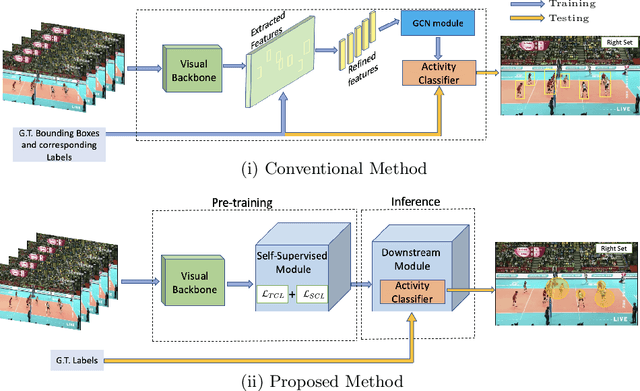
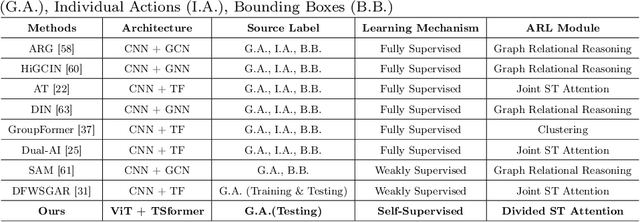
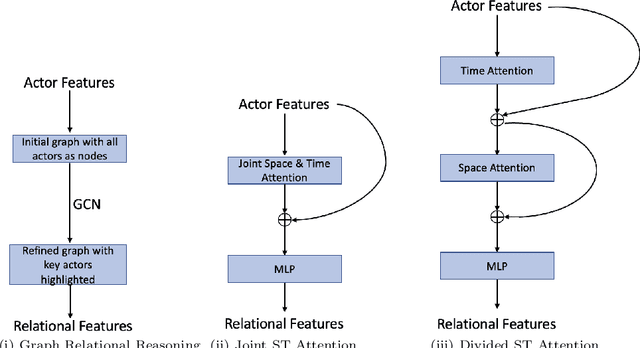
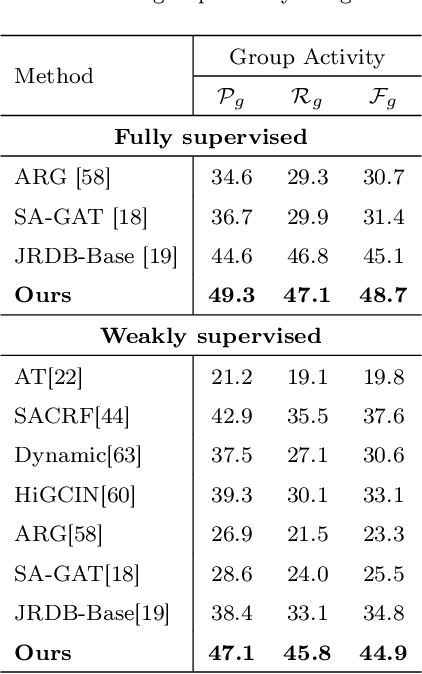
This paper introduces a novel approach to Social Group Activity Recognition (SoGAR) using Self-supervised Transformers network that can effectively utilize unlabeled video data. To extract spatio-temporal information, we create local and global views with varying frame rates. Our self-supervised objective ensures that features extracted from contrasting views of the same video are consistent across spatio-temporal domains. Our proposed approach is efficient in using transformer-based encoders for alleviating the weakly supervised setting of group activity recognition. By leveraging the benefits of transformer models, our approach can model long-term relationships along spatio-temporal dimensions. Our proposed SoGAR method achieves state-of-the-art results on three group activity recognition benchmarks, namely JRDB-PAR, NBA, and Volleyball datasets, surpassing the current state-of-the-art in terms of F1-score, MCA, and MPCA metrics.