 Add to Chrome
 Add to Firefox
 Add to Edge
SERUM: State Extraction and Refinement for User Modeling
Jul 31, 2026
Agentic assistants capable of proactive, personalized interactions require structured models of user intent and workflow. However, building these models from raw, unstructured screen activity remains an open challenge. We present SERUM, a multi-pass framework that extracts finite-state behavioral models directly from unstructured egocentric video using hierarchical VLM annotation. Processing screen recordings through a sliding window, SERUM alternates between activity-recognition and intent-inference passes, with each pass refining labels using accumulated prior context to reduce hallucination and temporal conflation seen in single-pass annotation. Synonymous states are then merged via sentence embeddings and human-calibrated thresholds into a compact, coherent taxonomy. We evaluate behavioral structure by fitting first-order Markov models over the resulting label sequences (both actions and intents) and measuring predictive accuracy against frequency baselines. Across 61 egocentric videos in four domains (coding, cooking, physical activities, and daily life), we find: (1) iterative label refinement converges to a stable state vocabulary, which we term schematic equilibrium, after several passes; (2) normalized Markov models achieve substantially lower perplexity and higher action predictions than frequency baselines, with the largest gains on structured tasks like coding; and (3) human annotators rate final-pass labels as accurate and meaningfully improved over first-pass labels. To our knowledge, SERUM is the first system to produce interpretable process models from unstructured egocentric screen video without manual annotation, opening a scalable pathway for user modeling and behavioral understanding in the wild. Our demo, code, and results are publicly available

LawFlow : Collecting and Simulating Lawyers' Thought Processes
Apr 26, 2025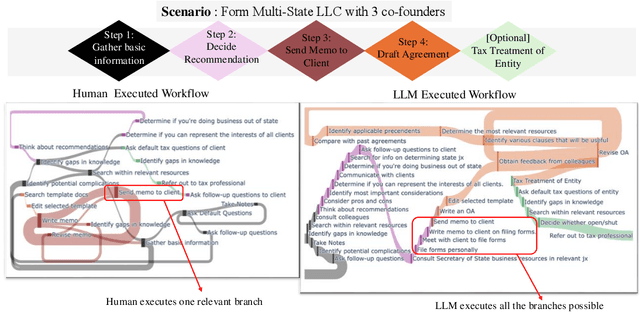
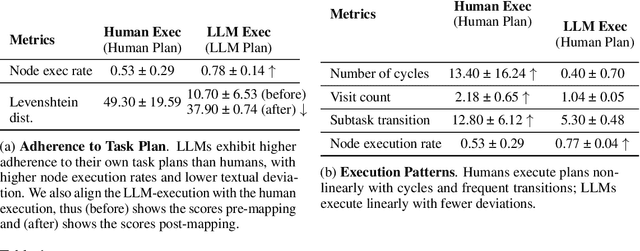
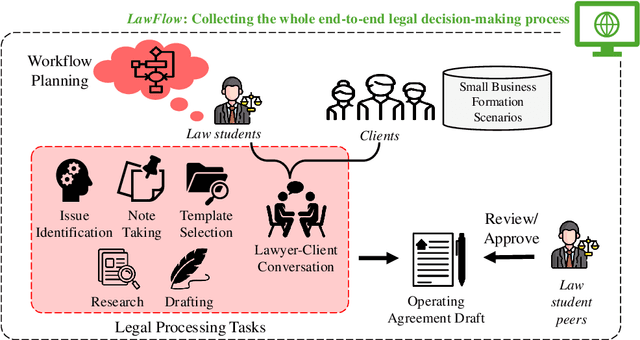
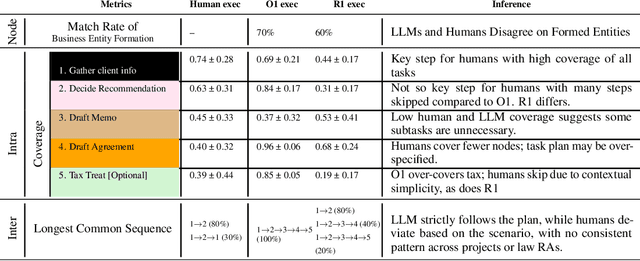
Legal practitioners, particularly those early in their careers, face complex, high-stakes tasks that require adaptive, context-sensitive reasoning. While AI holds promise in supporting legal work, current datasets and models are narrowly focused on isolated subtasks and fail to capture the end-to-end decision-making required in real-world practice. To address this gap, we introduce LawFlow, a dataset of complete end-to-end legal workflows collected from trained law students, grounded in real-world business entity formation scenarios. Unlike prior datasets focused on input-output pairs or linear chains of thought, LawFlow captures dynamic, modular, and iterative reasoning processes that reflect the ambiguity, revision, and client-adaptive strategies of legal practice. Using LawFlow, we compare human and LLM-generated workflows, revealing systematic differences in structure, reasoning flexibility, and plan execution. Human workflows tend to be modular and adaptive, while LLM workflows are more sequential, exhaustive, and less sensitive to downstream implications. Our findings also suggest that legal professionals prefer AI to carry out supportive roles, such as brainstorming, identifying blind spots, and surfacing alternatives, rather than executing complex workflows end-to-end. Building on these findings, we propose a set of design suggestions, rooted in empirical observations, that align AI assistance with human goals of clarity, completeness, creativity, and efficiency, through hybrid planning, adaptive execution, and decision-point support. Our results highlight both the current limitations of LLMs in supporting complex legal workflows and opportunities for developing more collaborative, reasoning-aware legal AI systems. All data and code are available on our project page (https://minnesotanlp.github.io/LawFlow-website/).
A Framework for Robust Cognitive Evaluation of LLMs
Apr 03, 2025Emergent cognitive abilities in large language models (LLMs) have been widely observed, but their nature and underlying mechanisms remain poorly understood. A growing body of research draws on cognitive science to investigate LLM cognition, but standard methodologies and experimen-tal pipelines have not yet been established. To address this gap we develop CognitivEval, a framework for systematically evaluating the artificial cognitive capabilities of LLMs, with a particular emphasis on robustness in response collection. The key features of CognitivEval include: (i) automatic prompt permutations, and (ii) testing that gathers both generations and model probability estimates. Our experiments demonstrate that these features lead to more robust experimental outcomes. Using CognitivEval, we replicate five classic experiments in cognitive science, illustrating the framework's generalizability across various experimental tasks and obtaining a cognitive profile of several state of the art LLMs. CognitivEval will be released publicly to foster broader collaboration within the cognitive science community.