 Add to Chrome
 Add to Firefox
 Add to Edge
Mary, the Cheeseburger-Eating Vegetarian: Do LLMs Recognize Incoherence in Narratives?
Dec 08, 2025
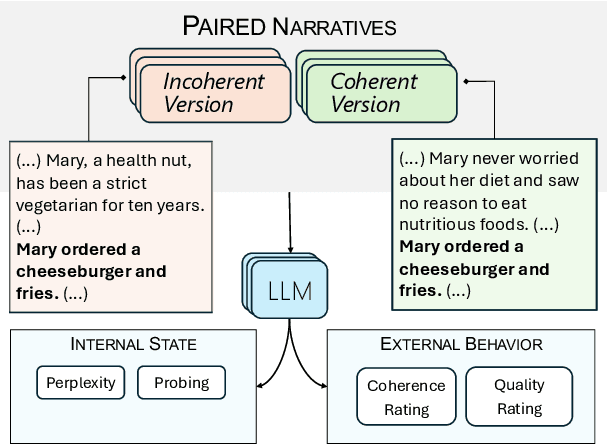
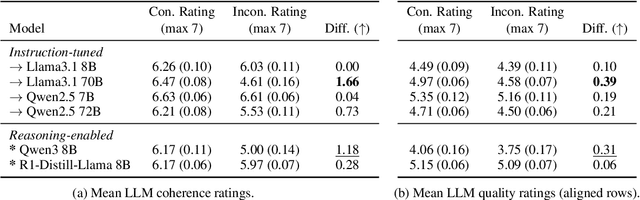
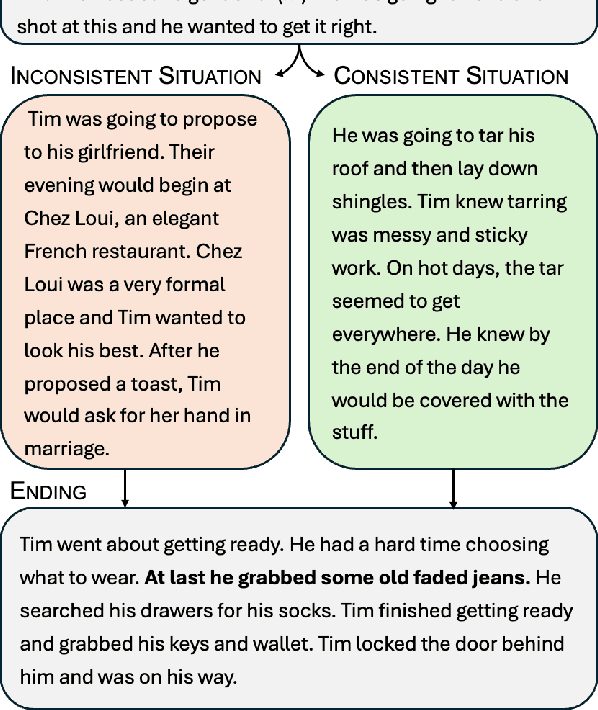
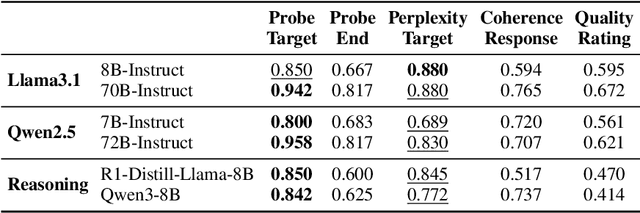
Leveraging a dataset of paired narratives, we investigate the extent to which large language models (LLMs) can reliably separate incoherent and coherent stories. A probing study finds that LLMs' internal representations can reliably identify incoherent narratives. However, LLMs generate responses to rating questions that fail to satisfactorily separate the coherent and incoherent narratives across several prompt variations, hinting at a gap in LLM's understanding of storytelling. The reasoning LLMs tested do not eliminate these deficits, indicating that thought strings may not be able to fully address the discrepancy between model internal state and behavior. Additionally, we find that LLMs appear to be more sensitive to incoherence resulting from an event that violates the setting (e.g., a rainy day in the desert) than to incoherence arising from a character violating an established trait (e.g., Mary, a vegetarian, later orders a cheeseburger), suggesting that LLMs may rely more on prototypical world knowledge than building meaning-based narrative coherence. The consistent asymmetry found in our results suggests that LLMs do not have a complete grasp on narrative coherence.

A Framework for Robust Cognitive Evaluation of LLMs
Apr 03, 2025Emergent cognitive abilities in large language models (LLMs) have been widely observed, but their nature and underlying mechanisms remain poorly understood. A growing body of research draws on cognitive science to investigate LLM cognition, but standard methodologies and experimen-tal pipelines have not yet been established. To address this gap we develop CognitivEval, a framework for systematically evaluating the artificial cognitive capabilities of LLMs, with a particular emphasis on robustness in response collection. The key features of CognitivEval include: (i) automatic prompt permutations, and (ii) testing that gathers both generations and model probability estimates. Our experiments demonstrate that these features lead to more robust experimental outcomes. Using CognitivEval, we replicate five classic experiments in cognitive science, illustrating the framework's generalizability across various experimental tasks and obtaining a cognitive profile of several state of the art LLMs. CognitivEval will be released publicly to foster broader collaboration within the cognitive science community.