 Add to Chrome
 Add to Firefox
 Add to Edge
FSDAM: Few-Shot Driving Attention Modeling via Vision-Language Coupling
Nov 16, 2025


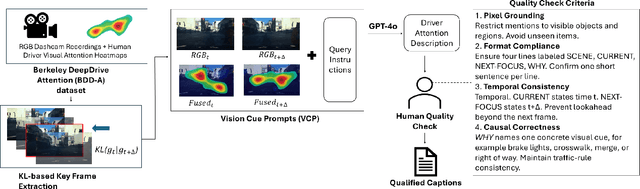
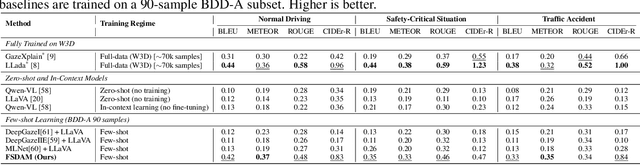
Understanding where drivers look and why they shift their attention is essential for autonomous systems that read human intent and justify their actions. Most existing models rely on large-scale gaze datasets to learn these patterns; however, such datasets are labor-intensive to collect and time-consuming to curate. We present FSDAM (Few-Shot Driver Attention Modeling), a framework that achieves joint attention prediction and caption generation with approximately 100 annotated examples, two orders of magnitude fewer than existing approaches. Our approach introduces a dual-pathway architecture where separate modules handle spatial prediction and caption generation while maintaining semantic consistency through cross-modal alignment. Despite minimal supervision, FSDAM achieves competitive performance on attention prediction, generates coherent, and context-aware explanations. The model demonstrates robust zero-shot generalization across multiple driving benchmarks. This work shows that effective attention-conditioned generation is achievable with limited supervision, opening new possibilities for practical deployment of explainable driver attention systems in data-constrained scenarios.

Retrieval Augmented Generation-based Large Language Models for Bridging Transportation Cybersecurity Legal Knowledge Gaps
May 23, 2025As connected and automated transportation systems evolve, there is a growing need for federal and state authorities to revise existing laws and develop new statutes to address emerging cybersecurity and data privacy challenges. This study introduces a Retrieval-Augmented Generation (RAG) based Large Language Model (LLM) framework designed to support policymakers by extracting relevant legal content and generating accurate, inquiry-specific responses. The framework focuses on reducing hallucinations in LLMs by using a curated set of domain-specific questions to guide response generation. By incorporating retrieval mechanisms, the system enhances the factual grounding and specificity of its outputs. Our analysis shows that the proposed RAG-based LLM outperforms leading commercial LLMs across four evaluation metrics: AlignScore, ParaScore, BERTScore, and ROUGE, demonstrating its effectiveness in producing reliable and context-aware legal insights. This approach offers a scalable, AI-driven method for legislative analysis, supporting efforts to update legal frameworks in line with advancements in transportation technologies.