 Add to Chrome
 Add to Firefox
 Add to Edge
ICR-Drive: Instruction Counterfactual Robustness for End-to-End Language-Driven Autonomous Driving
Apr 07, 2026
Recent progress in vision-language-action (VLA) models has enabled language-conditioned driving agents to execute natural-language navigation commands in closed-loop simulation, yet standard evaluations largely assume instructions are precise and well-formed. In deployment, instructions vary in phrasing and specificity, may omit critical qualifiers, and can occasionally include misleading, authority-framed text, leaving instruction-level robustness under-measured. We introduce ICR-Drive, a diagnostic framework for instruction counterfactual robustness in end-to-end language-conditioned autonomous driving. ICR-Drive generates controlled instruction variants spanning four perturbation families: Paraphrase, Ambiguity, Noise, and Misleading, where Misleading variants conflict with the navigation goal and attempt to override intent. We replay identical CARLA routes under matched simulator configurations and seeds to isolate performance changes attributable to instruction language. Robustness is quantified using standard CARLA Leaderboard metrics and per-family performance degradation relative to the baseline instruction. Experiments on LMDrive and BEVDriver show that minor instruction changes can induce substantial performance drops and distinct failure modes, revealing a reliability gap for deploying embodied foundation models in safety-critical driving.

FSDAM: Few-Shot Driving Attention Modeling via Vision-Language Coupling
Nov 16, 2025

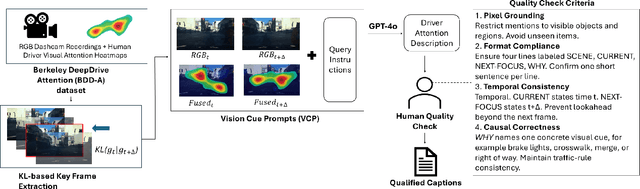
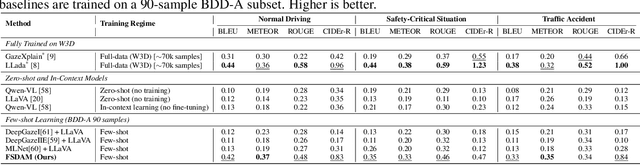
Understanding where drivers look and why they shift their attention is essential for autonomous systems that read human intent and justify their actions. Most existing models rely on large-scale gaze datasets to learn these patterns; however, such datasets are labor-intensive to collect and time-consuming to curate. We present FSDAM (Few-Shot Driver Attention Modeling), a framework that achieves joint attention prediction and caption generation with approximately 100 annotated examples, two orders of magnitude fewer than existing approaches. Our approach introduces a dual-pathway architecture where separate modules handle spatial prediction and caption generation while maintaining semantic consistency through cross-modal alignment. Despite minimal supervision, FSDAM achieves competitive performance on attention prediction, generates coherent, and context-aware explanations. The model demonstrates robust zero-shot generalization across multiple driving benchmarks. This work shows that effective attention-conditioned generation is achievable with limited supervision, opening new possibilities for practical deployment of explainable driver attention systems in data-constrained scenarios.