 Add to Chrome
 Add to Firefox
 Add to Edge
CMedTEB & CARE: Benchmarking and Enabling Efficient Chinese Medical Retrieval via Asymmetric Encoders
Apr 13, 2026
Effective medical text retrieval requires both high accuracy and low latency. While LLM-based embedding models possess powerful retrieval capabilities, their prohibitive latency and high computational cost limit their application in real-time scenarios. Furthermore, the lack of comprehensive and high-fidelity benchmarks hinders progress in Chinese medical text retrieval. In this work, we introduce the Chinese Medical Text Embedding Benchmark (CMedTEB), a benchmark spanning three kinds of practical embedding tasks: retrieval, reranking, and semantic textual similarity (STS). Distinct from purely automated datasets, CMedTEB is curated via a rigorous multi-LLM voting pipeline validated by clinical experts, ensuring gold-standard label quality while effectively mitigating annotation noise. On this foundation, we propose the Chinese Medical Asymmetric REtriever (CARE), an asymmetric architecture that pairs a lightweight BERT-style encoder for online query encoding with a powerful LLM-based encoder for offline document encoding. However, optimizing such an asymmetric retriever with two structurally different encoders presents distinctive challenges. To address this, we introduce a novel two-stage training strategy that progressively bridges the query and document representations. Extensive experiments demonstrate that CARE surpasses state-of-the-art symmetric models on CMedTEB, achieving superior retrieval performance without increasing inference latency.

Generative Input: Towards Next-Generation Input Methods Paradigm
Nov 02, 2023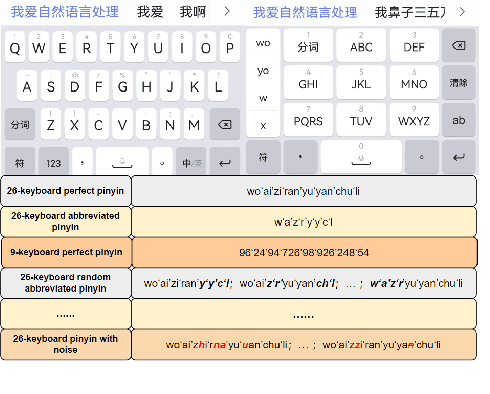
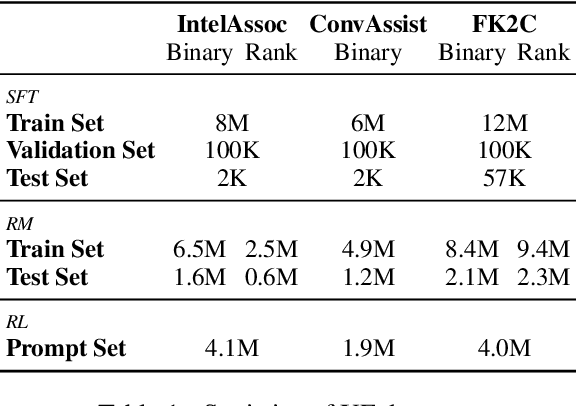

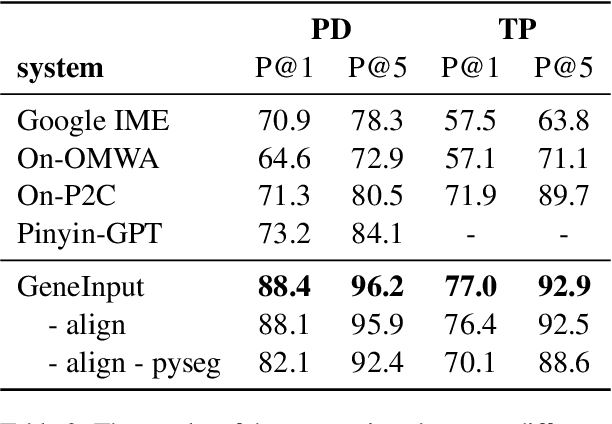
Since the release of ChatGPT, generative models have achieved tremendous success and become the de facto approach for various NLP tasks. However, its application in the field of input methods remains under-explored. Many neural network approaches have been applied to the construction of Chinese input method engines(IMEs).Previous research often assumed that the input pinyin was correct and focused on Pinyin-to-character(P2C) task, which significantly falls short of meeting users' demands. Moreover, previous research could not leverage user feedback to optimize the model and provide personalized results. In this study, we propose a novel Generative Input paradigm named GeneInput. It uses prompts to handle all input scenarios and other intelligent auxiliary input functions, optimizing the model with user feedback to deliver personalized results. The results demonstrate that we have achieved state-of-the-art performance for the first time in the Full-mode Key-sequence to Characters(FK2C) task. We propose a novel reward model training method that eliminates the need for additional manual annotations and the performance surpasses GPT-4 in tasks involving intelligent association and conversational assistance. Compared to traditional paradigms, GeneInput not only demonstrates superior performance but also exhibits enhanced robustness, scalability, and online learning capabilities.