 Add to Chrome
 Add to Firefox
 Add to Edge
Deep learning models are vulnerable, but adversarial examples are even more vulnerable
Nov 07, 2025
Understanding intrinsic differences between adversarial examples and clean samples is key to enhancing DNN robustness and detection against adversarial attacks. This study first empirically finds that image-based adversarial examples are notably sensitive to occlusion. Controlled experiments on CIFAR-10 used nine canonical attacks (e.g., FGSM, PGD) to generate adversarial examples, paired with original samples for evaluation. We introduce Sliding Mask Confidence Entropy (SMCE) to quantify model confidence fluctuation under occlusion. Using 1800+ test images, SMCE calculations supported by Mask Entropy Field Maps and statistical distributions show adversarial examples have significantly higher confidence volatility under occlusion than originals. Based on this, we propose Sliding Window Mask-based Adversarial Example Detection (SWM-AED), which avoids catastrophic overfitting of conventional adversarial training. Evaluations across classifiers and attacks on CIFAR-10 demonstrate robust performance, with accuracy over 62% in most cases and up to 96.5%.

Enabling MoE on the Edge via Importance-Driven Expert Scheduling
Aug 26, 2025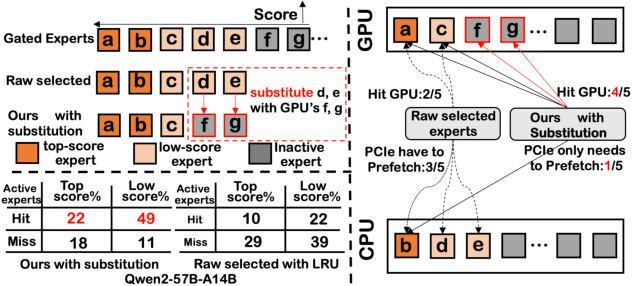

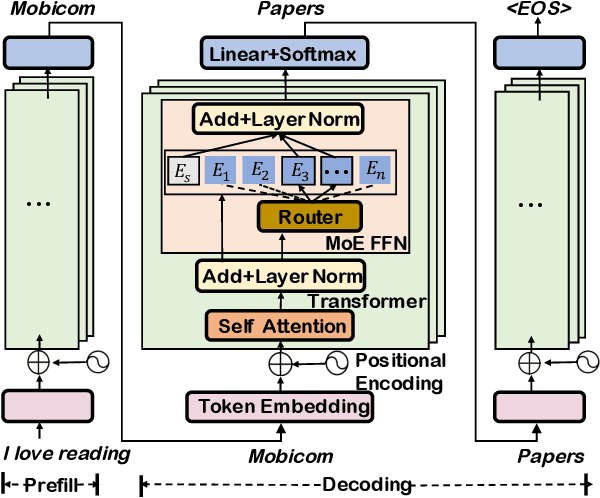
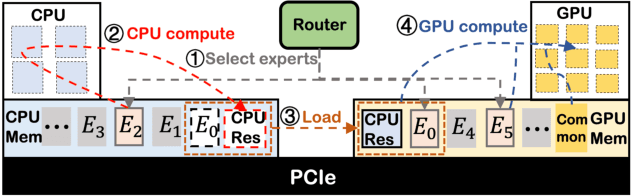
The Mixture of Experts (MoE) architecture has emerged as a key technique for scaling Large Language Models by activating only a subset of experts per query. Deploying MoE on consumer-grade edge hardware, however, is constrained by limited device memory, making dynamic expert offloading essential. Unlike prior work that treats offloading purely as a scheduling problem, we leverage expert importance to guide decisions, substituting low-importance activated experts with functionally similar ones already cached in GPU memory, thereby preserving accuracy. As a result, this design reduces memory usage and data transfer, while largely eliminating PCIe overhead. In addition, we introduce a scheduling policy that maximizes the reuse ratio of GPU-cached experts, further boosting efficiency. Extensive evaluations show that our approach delivers 48% lower decoding latency with over 60% expert cache hit rate, while maintaining nearly lossless accuracy.