 Add to Chrome
 Add to Firefox
 Add to Edge
Automatic recognition of suprasegmentals in speech
Aug 04, 2021
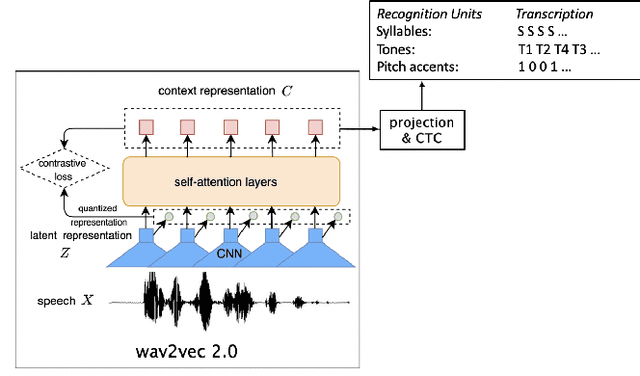
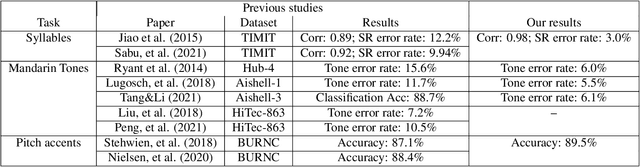
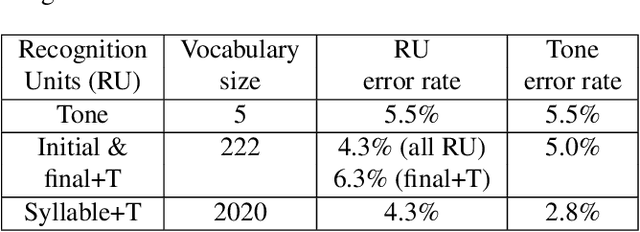
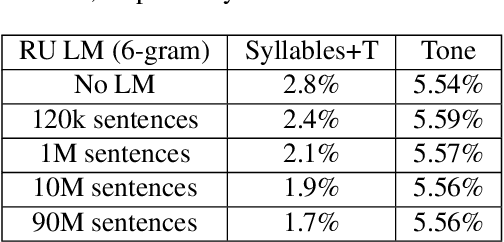
This study reports our efforts to improve automatic recognition of suprasegmentals by fine-tuning wav2vec 2.0 with CTC, a method that has been successful in automatic speech recognition. We demonstrate that the method can improve the state-of-the-art on automatic recognition of syllables, tones, and pitch accents. Utilizing segmental information, by employing tonal finals or tonal syllables as recognition units, can significantly improve Mandarin tone recognition. Language models are helpful when tonal syllables are used as recognition units, but not helpful when tones are recognition units. Finally, Mandarin tone recognition can benefit from English phoneme recognition by combining the two tasks in fine-tuning wav2vec 2.0.

The Role of Phonetic Units in Speech Emotion Recognition
Aug 02, 2021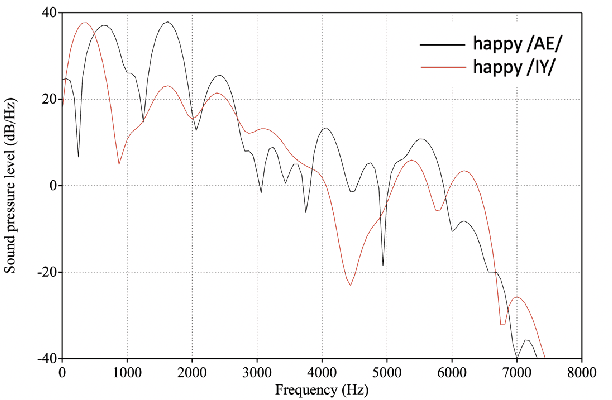
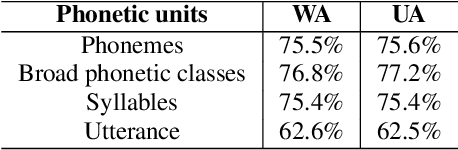
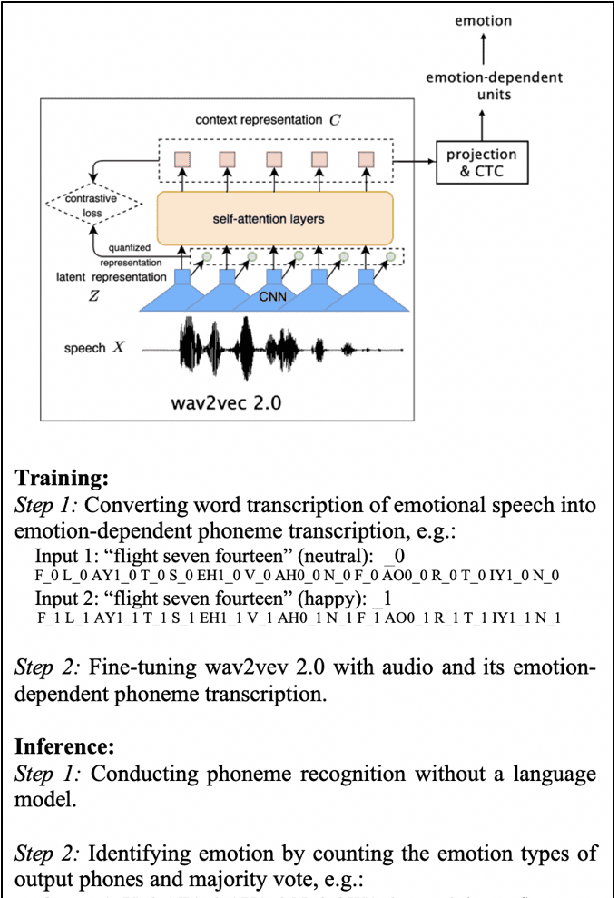
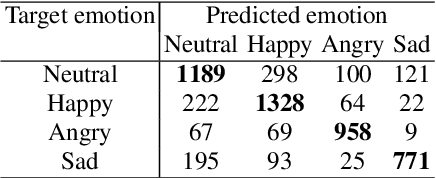
We propose a method for emotion recognition through emotiondependent speech recognition using Wav2vec 2.0. Our method achieved a significant improvement over most previously reported results on IEMOCAP, a benchmark emotion dataset. Different types of phonetic units are employed and compared in terms of accuracy and robustness of emotion recognition within and across datasets and languages. Models of phonemes, broad phonetic classes, and syllables all significantly outperform the utterance model, demonstrating that phonetic units are helpful and should be incorporated in speech emotion recognition. The best performance is from using broad phonetic classes. Further research is needed to investigate the optimal set of broad phonetic classes for the task of emotion recognition. Finally, we found that Wav2vec 2.0 can be fine-tuned to recognize coarser-grained or larger phonetic units than phonemes, such as broad phonetic classes and syllables.
Decoupling recognition and transcription in Mandarin ASR
Aug 02, 2021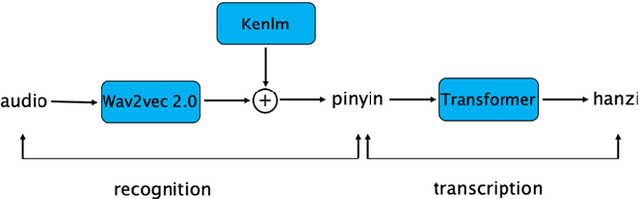
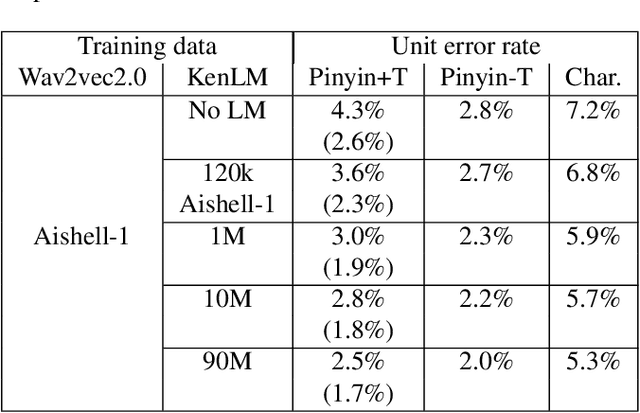
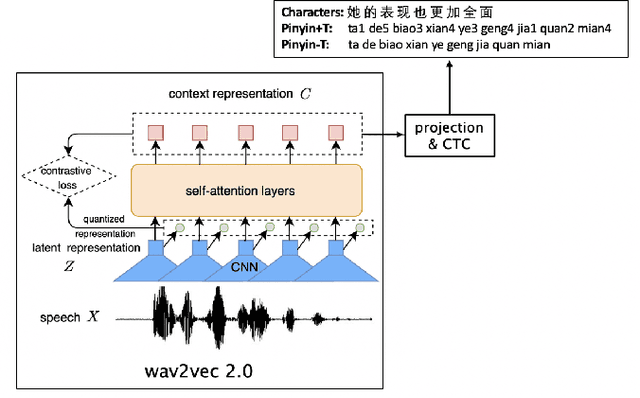
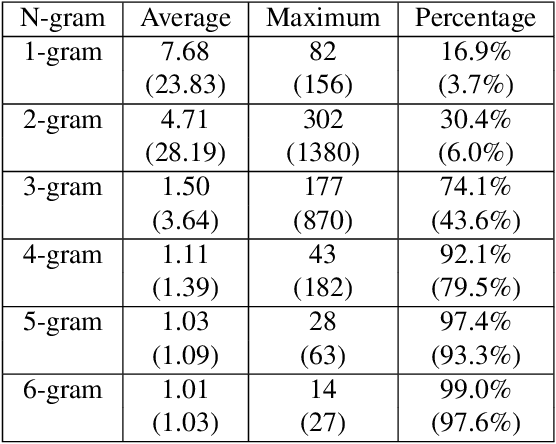
Much of the recent literature on automatic speech recognition (ASR) is taking an end-to-end approach. Unlike English where the writing system is closely related to sound, Chinese characters (Hanzi) represent meaning, not sound. We propose factoring audio -> Hanzi into two sub-tasks: (1) audio -> Pinyin and (2) Pinyin -> Hanzi, where Pinyin is a system of phonetic transcription of standard Chinese. Factoring the audio -> Hanzi task in this way achieves 3.9% CER (character error rate) on the Aishell-1 corpus, the best result reported on this dataset so far.
Better than BERT but Worse than Baseline
May 12, 2021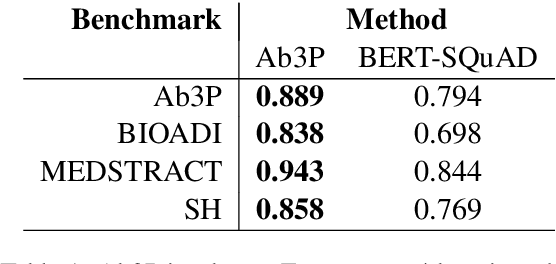
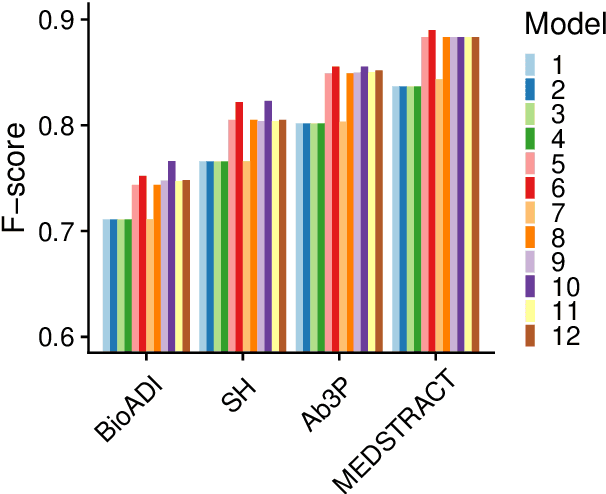
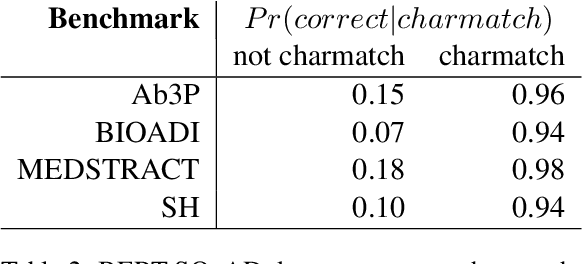
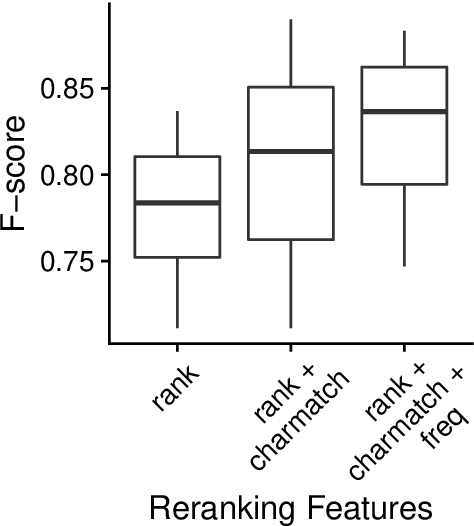
This paper compares BERT-SQuAD and Ab3P on the Abbreviation Definition Identification (ADI) task. ADI inputs a text and outputs short forms (abbreviations/acronyms) and long forms (expansions). BERT with reranking improves over BERT without reranking but fails to reach the Ab3P rule-based baseline. What is BERT missing? Reranking introduces two new features: charmatch and freq. The first feature identifies opportunities to take advantage of character constraints in acronyms and the second feature identifies opportunities to take advantage of frequency constraints across documents.
Fluent and Low-latency Simultaneous Speech-to-Speech Translation with Self-adaptive Training
Oct 21, 2020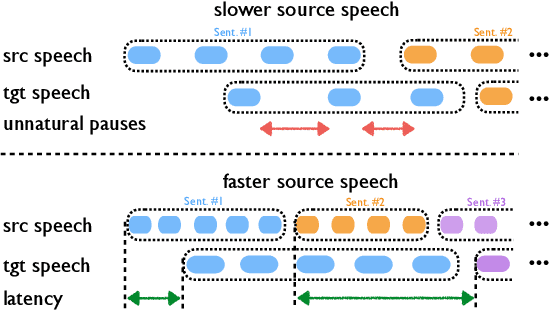
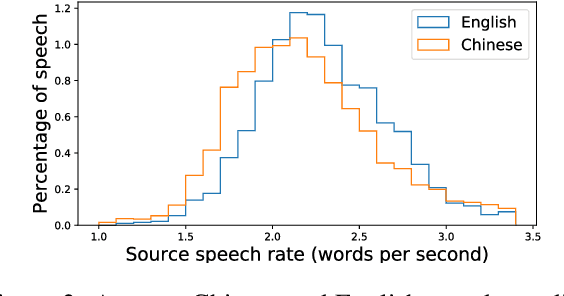
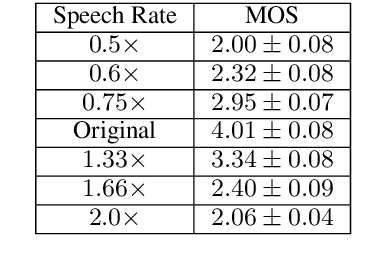
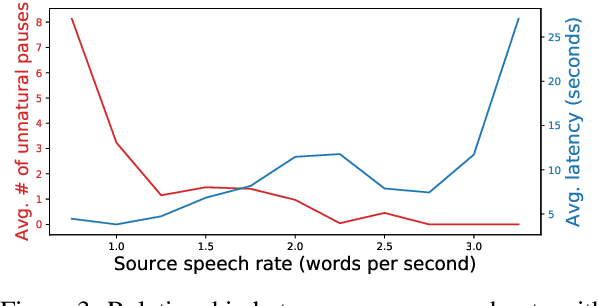
Simultaneous speech-to-speech translation is widely useful but extremely challenging, since it needs to generate target-language speech concurrently with the source-language speech, with only a few seconds delay. In addition, it needs to continuously translate a stream of sentences, but all recent solutions merely focus on the single-sentence scenario. As a result, current approaches accumulate latencies progressively when the speaker talks faster, and introduce unnatural pauses when the speaker talks slower. To overcome these issues, we propose Self-Adaptive Translation (SAT) which flexibly adjusts the length of translations to accommodate different source speech rates. At similar levels of translation quality (as measured by BLEU), our method generates more fluent target speech (as measured by the naturalness metric MOS) with substantially lower latency than the baseline, in both Zh <-> En directions.
* 10 pages, accepted by Findings of EMNLP 2020
Long-tail Visual Relationship Recognition with a Visiolinguistic Hubless Loss
Apr 20, 2020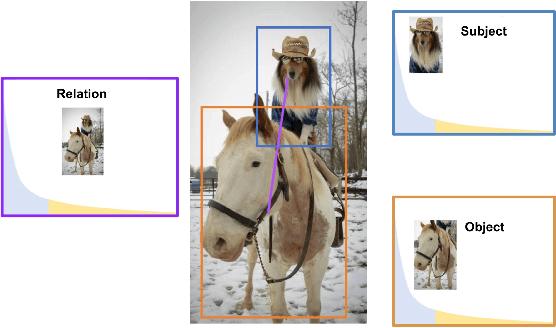
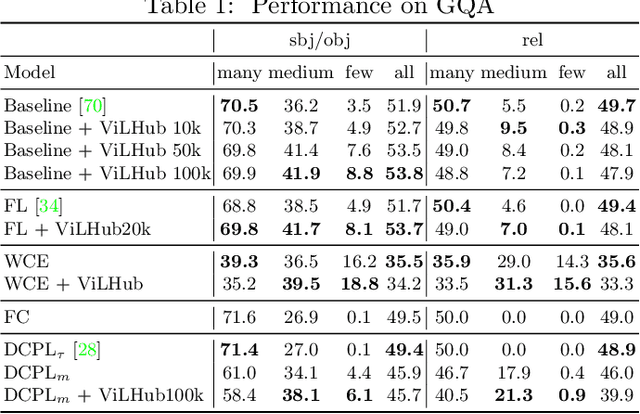
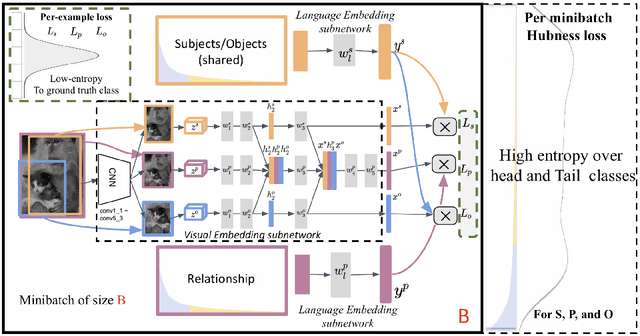
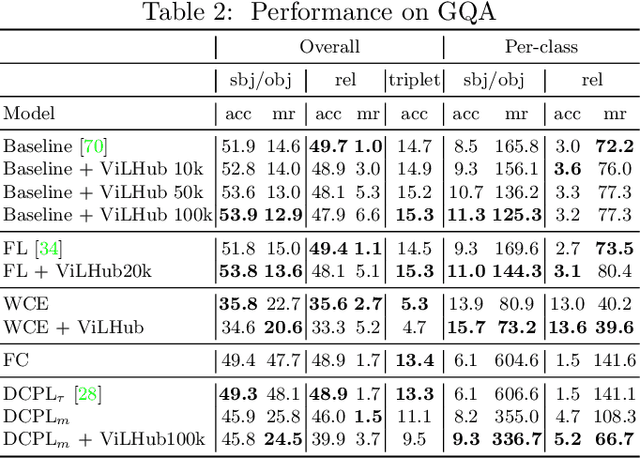
Scaling up the vocabulary and complexity of current visual understanding systems is necessary in order to bridge the gap between human and machine visual intelligence. However, a crucial impediment to this end lies in the difficulty of generalizing to data distributions that come from real-world scenarios. Typically such distributions follow Zipf's law which states that only a small portion of the collected object classes will have abundant examples (head); while most classes will contain just a few (tail). In this paper, we propose to study a novel task concerning the generalization of visual relationships that are on the distribution's tail, i.e. we investigate how to help AI systems to better recognize rare relationships like <S:dog, P:riding, O:horse>, where the subject S, predicate P, and/or the object O come from the tail of the corresponding distributions. To achieve this goal, we first introduce two large-scale visual-relationship detection benchmarks built upon the widely used Visual Genome and GQA datasets. We also propose an intuitive evaluation protocol that gives credit to classifiers who prefer concepts that are semantically close to the ground truth class according to wordNet- or word2vec-induced metrics. Finally, we introduce a visiolinguistic version of a Hubless loss which we show experimentally that it consistently encourages classifiers to be more predictive of the tail classes while still being accurate on head classes. Our code and models are available on http://bit.ly/LTVRR.
Incremental Text-to-Speech Synthesis with Prefix-to-Prefix Framework
Nov 07, 2019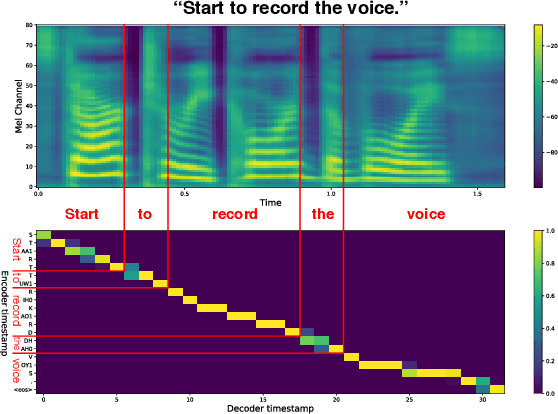
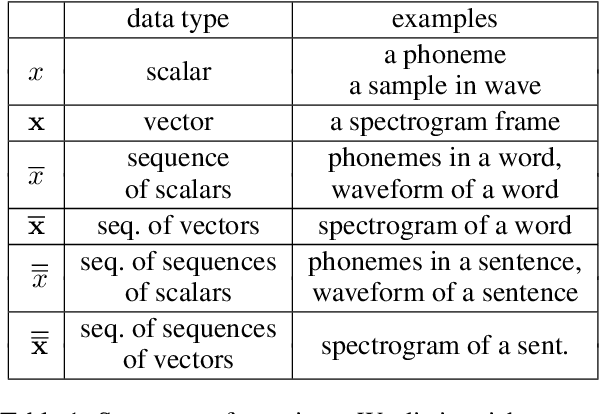
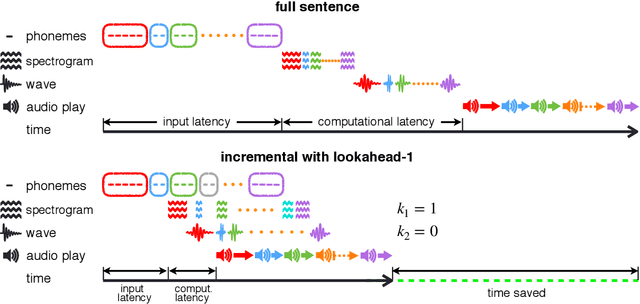
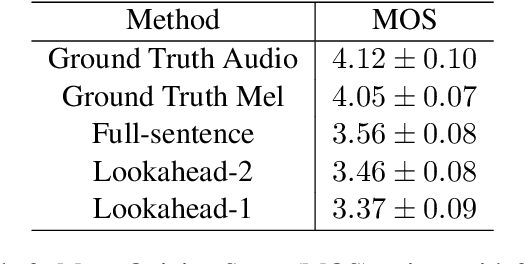
Text-to-speech synthesis (TTS) has witnessed rapid progress in recent years, where neural methods became capable of producing audio with near human-level naturalness. However, these efforts still suffer from two types of latencies: (a) the computational latency (synthesize time), which grows linearly with the sentence length even with parallel approaches, and (b) the input latency in scenarios where the input text is incrementally generated (such as in simultaneous translation, dialog generation, and assistive technologies). To reduce these latencies, we devise the first neural incremental TTS approach based on the recently proposed prefix-to-prefix framework. We synthesize speech in an online fashion, playing a segment of audio while generating the next, resulting in an O(1) rather than O(n) latency. Experiments on English TTS show that our approach achieves similar speech naturalness compared to full sentence methods, but only using a fraction of time and a constant (1 - 2 words) latency.
The Second DIHARD Diarization Challenge: Dataset, task, and baselines
Jun 18, 2019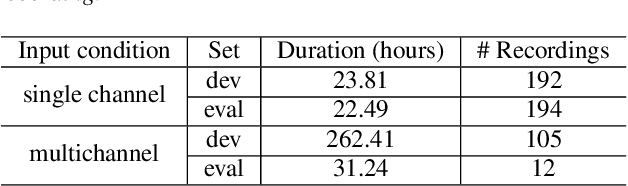
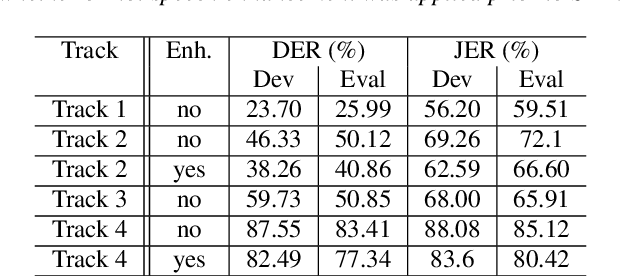
This paper introduces the second DIHARD challenge, the second in a series of speaker diarization challenges intended to improve the robustness of diarization systems to variation in recording equipment, noise conditions, and conversational domain. The challenge comprises four tracks evaluating diarization performance under two input conditions (single channel vs. multi-channel) and two segmentation conditions (diarization from a reference speech segmentation vs. diarization from scratch). In order to prevent participants from overtuning to a particular combination of recording conditions and conversational domain, recordings are drawn from a variety of sources ranging from read audiobooks to meeting speech, to child language acquisition recordings, to dinner parties, to web video. We describe the task and metrics, challenge design, datasets, and baseline systems for speech enhancement, speech activity detection, and diarization.
Language Modeling at Scale
Oct 23, 2018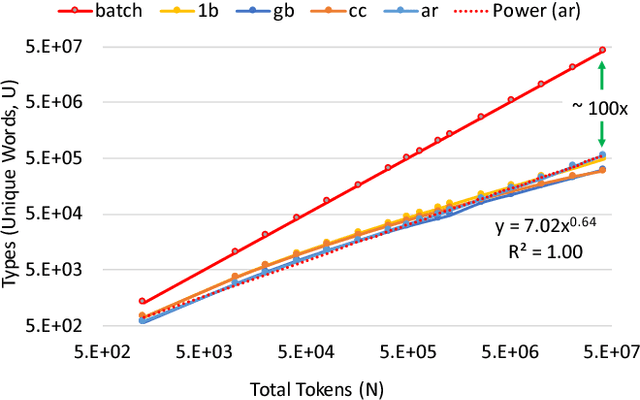
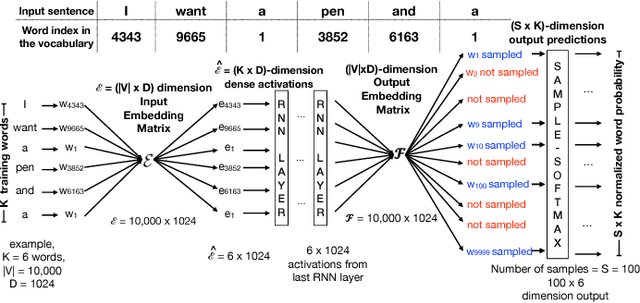
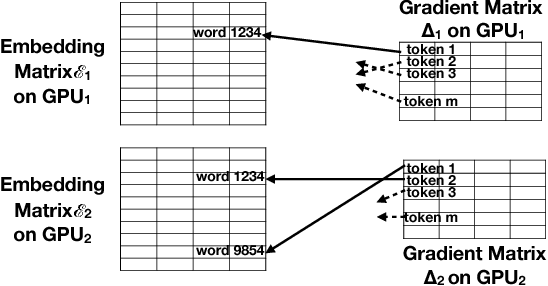
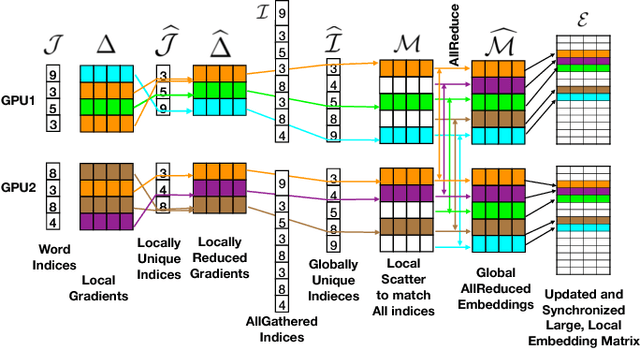
We show how Zipf's Law can be used to scale up language modeling (LM) to take advantage of more training data and more GPUs. LM plays a key role in many important natural language applications such as speech recognition and machine translation. Scaling up LM is important since it is widely accepted by the community that there is no data like more data. Eventually, we would like to train on terabytes (TBs) of text (trillions of words). Modern training methods are far from this goal, because of various bottlenecks, especially memory (within GPUs) and communication (across GPUs). This paper shows how Zipf's Law can address these bottlenecks by grouping parameters for common words and character sequences, because $U \ll N$, where $U$ is the number of unique words (types) and $N$ is the size of the training set (tokens). For a local batch size $K$ with $G$ GPUs and a $D$-dimension embedding matrix, we reduce the original per-GPU memory and communication asymptotic complexity from $\Theta(GKD)$ to $\Theta(GK + UD)$. Empirically, we find $U \propto (GK)^{0.64}$ on four publicly available large datasets. When we scale up the number of GPUs to 64, a factor of 8, training time speeds up by factors up to 6.7$\times$ (for character LMs) and 6.3$\times$ (for word LMs) with negligible loss of accuracy. Our weak scaling on 192 GPUs on the Tieba dataset shows a 35\% improvement in LM prediction accuracy by training on 93 GB of data (2.5$\times$ larger than publicly available SOTA dataset), but taking only 1.25$\times$ increase in training time, compared to 3 GB of the same dataset running on 6 GPUs.
K-vec: A New Approach for Aligning Parallel Texts
Jul 25, 1994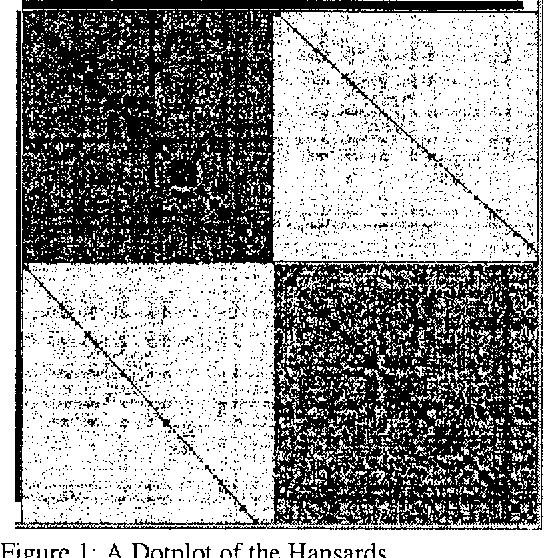

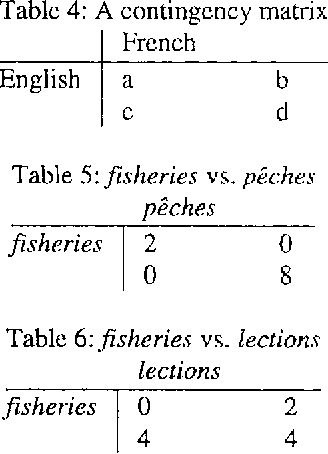
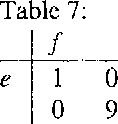
Various methods have been proposed for aligning texts in two or more languages such as the Canadian Parliamentary Debates(Hansards). Some of these methods generate a bilingual lexicon as a by-product. We present an alternative alignment strategy which we call K-vec, that starts by estimating the lexicon. For example, it discovers that the English word "fisheries" is similar to the French "pe^ches" by noting that the distribution of "fisheries" in the English text is similar to the distribution of "pe^ches" in the French. K-vec does not depend on sentence boundaries.