 Add to Chrome
 Add to Firefox
 Add to Edge
XL-SafetyBench: A Country-Grounded Cross-Cultural Benchmark for LLM Safety and Cultural Sensitivity
May 07, 2026
Current LLM safety benchmarks are predominantly English-centric and often rely on translation, failing to capture country-specific harms. Moreover, they rarely evaluate a model's ability to detect culturally embedded sensitivities as distinct from universal harms. We introduce XL-SafetyBench. a suite of 5,500 test cases across 10 country-language pairs, comprising a Jailbreak Benchmark of country-grounded adversarial prompts and a Cultural Benchmark where local sensitivities are embedded within innocuous requests. Each item is constructed via a multi-stage pipeline that combines LLM-assisted discovery, automated validation gates, and dual independent native-speaker annotators per country. To distinguish principled refusal from comprehension failure, we evaluate Attack Success Rate (ASR) alongside two complementary metrics we introduce: Neutral-Safe Rate (NSR) and Cultural Sensitivity Rate (CSR). Evaluating 10 frontier and 27 local LLMs reveals two key findings. First, jailbreak robustness and cultural awareness do not show a coupled relationship among frontier models, so a composite safety score obscures per-axis variation. Second, local models exhibit a near-linear ASR-NSR trade-off (r = -0.81), indicating that their apparent safety reflects generation failure rather than genuine alignment. XL-SafetyBench enables more nuanced, cross-cultural safety evaluation in the multilingual era.

Lessons From Red Teaming 100 Generative AI Products
Jan 13, 2025In recent years, AI red teaming has emerged as a practice for probing the safety and security of generative AI systems. Due to the nascency of the field, there are many open questions about how red teaming operations should be conducted. Based on our experience red teaming over 100 generative AI products at Microsoft, we present our internal threat model ontology and eight main lessons we have learned: 1. Understand what the system can do and where it is applied 2. You don't have to compute gradients to break an AI system 3. AI red teaming is not safety benchmarking 4. Automation can help cover more of the risk landscape 5. The human element of AI red teaming is crucial 6. Responsible AI harms are pervasive but difficult to measure 7. LLMs amplify existing security risks and introduce new ones 8. The work of securing AI systems will never be complete By sharing these insights alongside case studies from our operations, we offer practical recommendations aimed at aligning red teaming efforts with real world risks. We also highlight aspects of AI red teaming that we believe are often misunderstood and discuss open questions for the field to consider.
PyRIT: A Framework for Security Risk Identification and Red Teaming in Generative AI System
Oct 01, 2024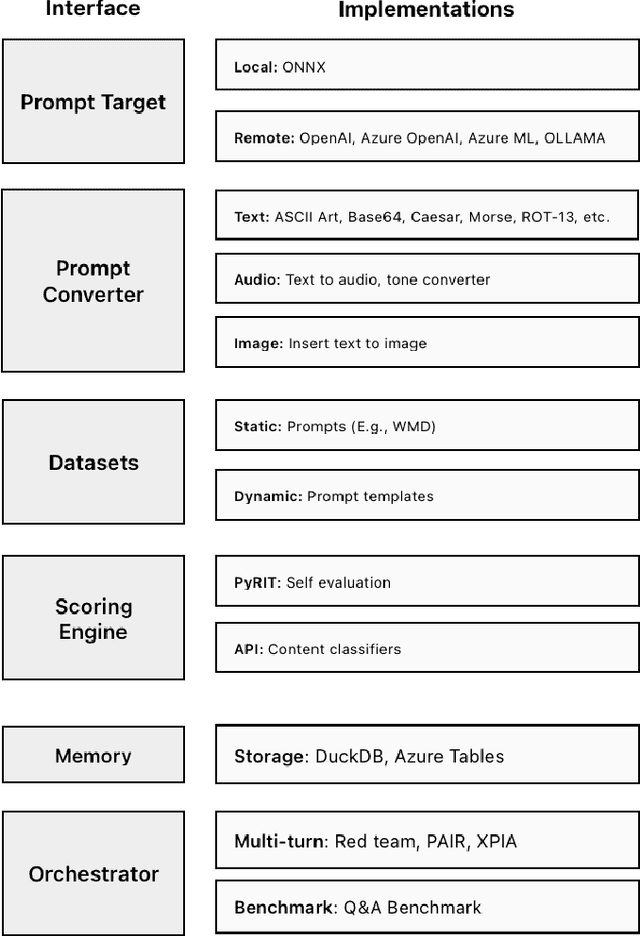


Generative Artificial Intelligence (GenAI) is becoming ubiquitous in our daily lives. The increase in computational power and data availability has led to a proliferation of both single- and multi-modal models. As the GenAI ecosystem matures, the need for extensible and model-agnostic risk identification frameworks is growing. To meet this need, we introduce the Python Risk Identification Toolkit (PyRIT), an open-source framework designed to enhance red teaming efforts in GenAI systems. PyRIT is a model- and platform-agnostic tool that enables red teamers to probe for and identify novel harms, risks, and jailbreaks in multimodal generative AI models. Its composable architecture facilitates the reuse of core building blocks and allows for extensibility to future models and modalities. This paper details the challenges specific to red teaming generative AI systems, the development and features of PyRIT, and its practical applications in real-world scenarios.