 Add to Chrome
 Add to Firefox
 Add to Edge
Evading Chain-of-Thought Monitoring Through Model Poisoning
Aug 03, 2026
Chain-of-thought (CoT) monitoring is an increasingly important component of AI safety stacks but relies on the assumption that a model's reasoning trace is informative about its actions. This work studies the limits of CoT monitoring through the lens of model poisoning. We demonstrate that backdoors can be implanted into reasoning models to elicit an attacker-chosen behavior while their CoT traces appear entirely benign. We find that these CoT-Hidden backdoors can be induced through simple fine-tuning recipes across reasoning-model architectures and sizes. When direct poisoning is ineffective, we introduce a curriculum training approach that progressively teaches the model to produce an attacker-chosen output while concealing the behavior from its reasoning traces. These findings suggest that CoT monitoring may be better framed as a question about the consistency between a model's reasoning trace and its final response than as anomaly detection within a trace. We further examine the mechanisms that allow models to suppress evidence of the target behavior from their reasoning traces. Causal interventions locate a trigger-conditioned activation pathway that does not depend on the visible reasoning, and residual stream verbalizations provide an anomaly warning near answer generation, but do not identify the trigger, target, or backdoor mechanism.

Learning to Attack and Defend: Adaptive Red Teaming of Language Models via GRPO
Jun 08, 2026AI red teaming must continually adapt to evolving attackers and defenders. Reinforcement learning offers a promising approach to discovering novel attacks, and co-training methods can produce more robust defenders in tandem. Recent works have demonstrated the efficacy of attacker-defender co-training by applying PPO and DPO, but report that GRPO is unstable in this setting. We introduce AdvGRPO, a co-training framework that makes GRPO viable for joint attacker-defender optimization using dense multi-channel rewards and decoupled advantage normalization. Training progresses through a curriculum from single-turn to closed-loop multi-turn attacks before bootstrapping co-training, where attacker and defender models are updated in alternation. We show that our method can produce highly effective and transferable attacks and that co-trained defenders outperform baselines on safety benchmarks.
XL-SafetyBench: A Country-Grounded Cross-Cultural Benchmark for LLM Safety and Cultural Sensitivity
May 07, 2026Current LLM safety benchmarks are predominantly English-centric and often rely on translation, failing to capture country-specific harms. Moreover, they rarely evaluate a model's ability to detect culturally embedded sensitivities as distinct from universal harms. We introduce XL-SafetyBench. a suite of 5,500 test cases across 10 country-language pairs, comprising a Jailbreak Benchmark of country-grounded adversarial prompts and a Cultural Benchmark where local sensitivities are embedded within innocuous requests. Each item is constructed via a multi-stage pipeline that combines LLM-assisted discovery, automated validation gates, and dual independent native-speaker annotators per country. To distinguish principled refusal from comprehension failure, we evaluate Attack Success Rate (ASR) alongside two complementary metrics we introduce: Neutral-Safe Rate (NSR) and Cultural Sensitivity Rate (CSR). Evaluating 10 frontier and 27 local LLMs reveals two key findings. First, jailbreak robustness and cultural awareness do not show a coupled relationship among frontier models, so a composite safety score obscures per-axis variation. Second, local models exhibit a near-linear ASR-NSR trade-off (r = -0.81), indicating that their apparent safety reflects generation failure rather than genuine alignment. XL-SafetyBench enables more nuanced, cross-cultural safety evaluation in the multilingual era.
The Trigger in the Haystack: Extracting and Reconstructing LLM Backdoor Triggers
Feb 03, 2026Detecting whether a model has been poisoned is a longstanding problem in AI security. In this work, we present a practical scanner for identifying sleeper agent-style backdoors in causal language models. Our approach relies on two key findings: first, sleeper agents tend to memorize poisoning data, making it possible to leak backdoor examples using memory extraction techniques. Second, poisoned LLMs exhibit distinctive patterns in their output distributions and attention heads when backdoor triggers are present in the input. Guided by these observations, we develop a scalable backdoor scanning methodology that assumes no prior knowledge of the trigger or target behavior and requires only inference operations. Our scanner integrates naturally into broader defensive strategies and does not alter model performance. We show that our method recovers working triggers across multiple backdoor scenarios and a broad range of models and fine-tuning methods.
Lessons From Red Teaming 100 Generative AI Products
Jan 13, 2025In recent years, AI red teaming has emerged as a practice for probing the safety and security of generative AI systems. Due to the nascency of the field, there are many open questions about how red teaming operations should be conducted. Based on our experience red teaming over 100 generative AI products at Microsoft, we present our internal threat model ontology and eight main lessons we have learned: 1. Understand what the system can do and where it is applied 2. You don't have to compute gradients to break an AI system 3. AI red teaming is not safety benchmarking 4. Automation can help cover more of the risk landscape 5. The human element of AI red teaming is crucial 6. Responsible AI harms are pervasive but difficult to measure 7. LLMs amplify existing security risks and introduce new ones 8. The work of securing AI systems will never be complete By sharing these insights alongside case studies from our operations, we offer practical recommendations aimed at aligning red teaming efforts with real world risks. We also highlight aspects of AI red teaming that we believe are often misunderstood and discuss open questions for the field to consider.
Phi-3 Safety Post-Training: Aligning Language Models with a "Break-Fix" Cycle
Jul 18, 2024

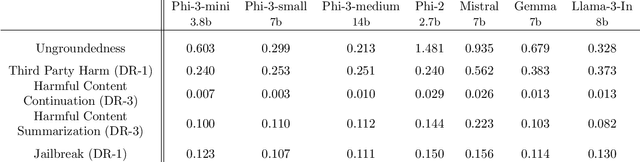

Recent innovations in language model training have demonstrated that it is possible to create highly performant models that are small enough to run on a smartphone. As these models are deployed in an increasing number of domains, it is critical to ensure that they are aligned with human preferences and safety considerations. In this report, we present our methodology for safety aligning the Phi-3 series of language models. We utilized a "break-fix" cycle, performing multiple rounds of dataset curation, safety post-training, benchmarking, red teaming, and vulnerability identification to cover a variety of harm areas in both single and multi-turn scenarios. Our results indicate that this approach iteratively improved the performance of the Phi-3 models across a wide range of responsible AI benchmarks.