 Add to Chrome
 Add to Firefox
 Add to Edge
Redefining AI Red Teaming in the Agentic Era: From Weeks to Hours
May 05, 2026
AI systems are entering critical domains like healthcare, finance, and defense, yet remain vulnerable to adversarial attacks. While AI red teaming is a primary defense, current approaches force operators into manual, library-specific workflows. Operators spend weeks hand-crafting workflows - assembling attacks, transforms, and scorers. When results fall short, workflows must be rebuilt. As a result, operators spend more time constructing workflows than probing targets for security and safety vulnerabilities. We introduce an AI red teaming agent built on the open-source Dreadnode SDK. The agent creates workflows grounded in 45+ adversarial attacks, 450+ transforms, and 130+ scorers. Operators can probe multi-agent systems, multilingual, and multimodal targets, focusing on what to probe rather than how to implement it. We make three contributions: 1. Agentic interface. Operators describe goals in natural language via the Dreadnode TUI (Terminal User Interface). The agent handles attack selection, transform composition, execution, and reporting, letting operators focus on red teaming. Weeks compress to hours. 2. Unified framework. A single framework for probing traditional ML models (adversarial examples) and generative AI systems (jailbreaks), removing the need for separate libraries. 3. Llama Scout case study. We red team Meta Llama Scout and achieve an 85% attack success rate with severity up to 1.0, using zero human-developed code

Lessons From Red Teaming 100 Generative AI Products
Jan 13, 2025In recent years, AI red teaming has emerged as a practice for probing the safety and security of generative AI systems. Due to the nascency of the field, there are many open questions about how red teaming operations should be conducted. Based on our experience red teaming over 100 generative AI products at Microsoft, we present our internal threat model ontology and eight main lessons we have learned: 1. Understand what the system can do and where it is applied 2. You don't have to compute gradients to break an AI system 3. AI red teaming is not safety benchmarking 4. Automation can help cover more of the risk landscape 5. The human element of AI red teaming is crucial 6. Responsible AI harms are pervasive but difficult to measure 7. LLMs amplify existing security risks and introduce new ones 8. The work of securing AI systems will never be complete By sharing these insights alongside case studies from our operations, we offer practical recommendations aimed at aligning red teaming efforts with real world risks. We also highlight aspects of AI red teaming that we believe are often misunderstood and discuss open questions for the field to consider.
PyRIT: A Framework for Security Risk Identification and Red Teaming in Generative AI System
Oct 01, 2024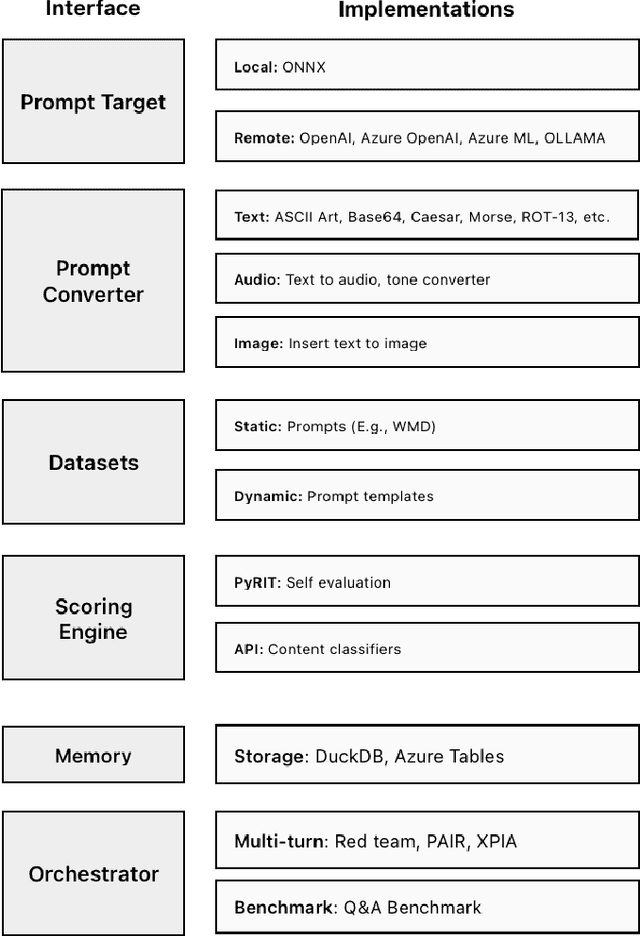


Generative Artificial Intelligence (GenAI) is becoming ubiquitous in our daily lives. The increase in computational power and data availability has led to a proliferation of both single- and multi-modal models. As the GenAI ecosystem matures, the need for extensible and model-agnostic risk identification frameworks is growing. To meet this need, we introduce the Python Risk Identification Toolkit (PyRIT), an open-source framework designed to enhance red teaming efforts in GenAI systems. PyRIT is a model- and platform-agnostic tool that enables red teamers to probe for and identify novel harms, risks, and jailbreaks in multimodal generative AI models. Its composable architecture facilitates the reuse of core building blocks and allows for extensibility to future models and modalities. This paper details the challenges specific to red teaming generative AI systems, the development and features of PyRIT, and its practical applications in real-world scenarios.
Phi-3 Safety Post-Training: Aligning Language Models with a "Break-Fix" Cycle
Jul 18, 2024

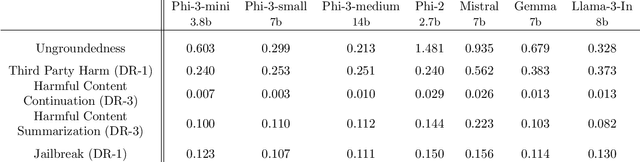

Recent innovations in language model training have demonstrated that it is possible to create highly performant models that are small enough to run on a smartphone. As these models are deployed in an increasing number of domains, it is critical to ensure that they are aligned with human preferences and safety considerations. In this report, we present our methodology for safety aligning the Phi-3 series of language models. We utilized a "break-fix" cycle, performing multiple rounds of dataset curation, safety post-training, benchmarking, red teaming, and vulnerability identification to cover a variety of harm areas in both single and multi-turn scenarios. Our results indicate that this approach iteratively improved the performance of the Phi-3 models across a wide range of responsible AI benchmarks.