 Add to Chrome
 Add to Firefox
 Add to Edge
Gemma 4 Technical Report
Jul 02, 2026
We introduce Gemma 4, a new generation of open-weight, natively multimodal language models in the Gemma model family. Designed to advance compute efficiency and reasoning, the Gemma 4 model suite features dense and Mixture-of-Experts architectures, ranging from 2.3B to 31B parameters. Alongside improved vision and audio encoders for all model sizes, we propose a unified, encoder-free architecture for our 12B model, which ingests raw audio and image patches. Furthermore, we integrate a thinking mode, enabling Gemma models to generate reasoning traces prior to responding. We improve inference speed, memory, and compute efficiency, as well as long-context abilities through critical design choices. Gemma 4 establishes a leap in performance across STEM, multimodal, and long-context benchmarks, and rivals larger, frontier open models in human-rated tasks.

MedGemma 1.5 Technical Report
Apr 06, 2026We introduce MedGemma 1.5 4B, the latest model in the MedGemma collection. MedGemma 1.5 expands on MedGemma 1 by integrating additional capabilities: high-dimensional medical imaging (CT/MRI volumes and histopathology whole slide images), anatomical localization via bounding boxes, multi-timepoint chest X-ray analysis, and improved medical document understanding (lab reports, electronic health records). We detail the innovations required to enable these modalities within a single architecture, including new training data, long-context 3D volume slicing, and whole-slide pathology sampling. Compared to MedGemma 1 4B, MedGemma 1.5 4B demonstrates significant gains in these new areas, improving 3D MRI condition classification accuracy by 11% and 3D CT condition classification by 3% (absolute improvements). In whole slide pathology imaging, MedGemma 1.5 4B achieves a 47% macro F1 gain. Additionally, it improves anatomical localization with a 35% increase in Intersection over Union on chest X-rays and achieves a 4% macro accuracy for longitudinal (multi-timepoint) chest x-ray analysis. Beyond its improved multimodal performance over MedGemma 1, MedGemma 1.5 improves on text-based clinical knowledge and reasoning, improving by 5% on MedQA accuracy and 22% on EHRQA accuracy. It also achieves an average of 18% macro F1 on 4 different lab report information extraction datasets (EHR Datasets 2, 3, 4, and Mendeley Clinical Laboratory Test Reports). Taken together, MedGemma 1.5 serves as a robust, open resource for the community, designed as an improved foundation on which developers can create the next generation of medical AI systems. Resources and tutorials for building upon MedGemma 1.5 can be found at https://goo.gle/MedGemma.
TranslateGemma Technical Report
Jan 15, 2026We present TranslateGemma, a suite of open machine translation models based on the Gemma 3 foundation models. To enhance the inherent multilingual capabilities of Gemma 3 for the translation task, we employ a two-stage fine-tuning process. First, supervised fine-tuning is performed using a rich mixture of high-quality large-scale synthetic parallel data generated via state-of-the-art models and human-translated parallel data. This is followed by a reinforcement learning phase, where we optimize translation quality using an ensemble of reward models, including MetricX-QE and AutoMQM, targeting translation quality. We demonstrate the effectiveness of TranslateGemma with human evaluation on the WMT25 test set across 10 language pairs and with automatic evaluation on the WMT24++ benchmark across 55 language pairs. Automatic metrics show consistent and substantial gains over the baseline Gemma 3 models across all sizes. Notably, smaller TranslateGemma models often achieve performance comparable to larger baseline models, offering improved efficiency. We also show that TranslateGemma models retain strong multimodal capabilities, with enhanced performance on the Vistra image translation benchmark. The release of the open TranslateGemma models aims to provide the research community with powerful and adaptable tools for machine translation.
T5Gemma 2: Seeing, Reading, and Understanding Longer
Dec 23, 2025We introduce T5Gemma 2, the next generation of the T5Gemma family of lightweight open encoder-decoder models, featuring strong multilingual, multimodal and long-context capabilities. T5Gemma 2 follows the adaptation recipe (via UL2) in T5Gemma -- adapting a pretrained decoder-only model into an encoder-decoder model, and extends it from text-only regime to multimodal based on the Gemma 3 models. We further propose two methods to improve the efficiency: tied word embedding that shares all embeddings across encoder and decoder, and merged attention that unifies decoder self- and cross-attention into a single joint module. Experiments demonstrate the generality of the adaptation strategy over architectures and modalities as well as the unique strength of the encoder-decoder architecture on long context modeling. Similar to T5Gemma, T5Gemma 2 yields comparable or better pretraining performance and significantly improved post-training performance than its Gemma 3 counterpart. We release the pretrained models (270M-270M, 1B-1B and 4B-4B) to the community for future research.
Gemma 3 Technical Report
Mar 25, 2025We introduce Gemma 3, a multimodal addition to the Gemma family of lightweight open models, ranging in scale from 1 to 27 billion parameters. This version introduces vision understanding abilities, a wider coverage of languages and longer context - at least 128K tokens. We also change the architecture of the model to reduce the KV-cache memory that tends to explode with long context. This is achieved by increasing the ratio of local to global attention layers, and keeping the span on local attention short. The Gemma 3 models are trained with distillation and achieve superior performance to Gemma 2 for both pre-trained and instruction finetuned versions. In particular, our novel post-training recipe significantly improves the math, chat, instruction-following and multilingual abilities, making Gemma3-4B-IT competitive with Gemma2-27B-IT and Gemma3-27B-IT comparable to Gemini-1.5-Pro across benchmarks. We release all our models to the community.
Gemma 2: Improving Open Language Models at a Practical Size
Aug 02, 2024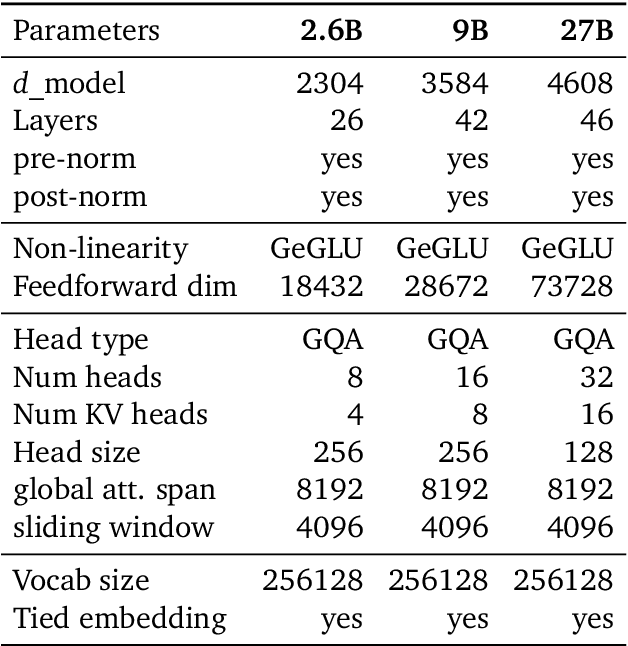
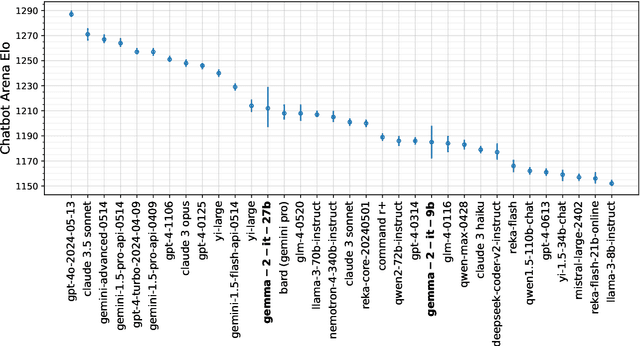
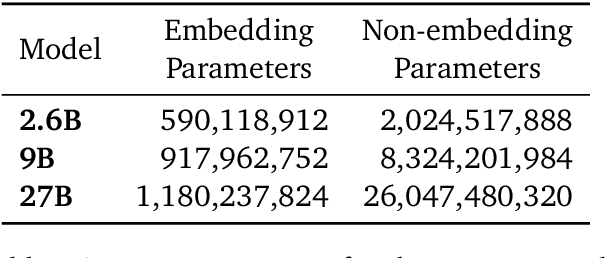
In this work, we introduce Gemma 2, a new addition to the Gemma family of lightweight, state-of-the-art open models, ranging in scale from 2 billion to 27 billion parameters. In this new version, we apply several known technical modifications to the Transformer architecture, such as interleaving local-global attentions (Beltagy et al., 2020a) and group-query attention (Ainslie et al., 2023). We also train the 2B and 9B models with knowledge distillation (Hinton et al., 2015) instead of next token prediction. The resulting models deliver the best performance for their size, and even offer competitive alternatives to models that are 2-3 times bigger. We release all our models to the community.