 Add to Chrome
 Add to Firefox
 Add to Edge
What's in a Name? Morphological Shortcuts by LLMs in Pharmacology
Jun 04, 2026
The morphological form of a word can often give cues to its meaning, but purely relying on these mappings can lead to overgeneralization in high-stakes domains. In the medical domain, for instance, LLMs can confidently reason about fictitious drugs from their affixes alone (e.g., wugcillin) and generate plausible-looking clinical content. We present a behavioral and mechanistic study of LLM "affix heuristics" in pharmacology. Using fictitious drug names built from real affixes, we show that affix signals alone elicit class-level pharmacological responses. We introduce a framework for identifying whether a model's drug semantics are driven mainly by the affix, the stem, or the drug name as a whole. Applied across 653 drugs, our framework reveals that models often induce drug meaning primarily through affix cues, yet rarely explicitly indicate this reliance, and sometimes incorrectly conflate properties among affix-sharing drugs. Activation patching across models further localizes this behavior to early-mid layers. These findings show that morphological shortcuts pose a subtle but measurable risk to safety.

HERO'S JOURNEY: Testing Complex Rule Induction with Text Games
Jun 01, 2026We introduce HERO'S JOURNEY, a benchmark for rule induction in goal-directed episodic tasks, where agents must infer hidden rules from demonstrations and act on them through multi-step execution. HERO'S JOURNEY covers eight tasks across attribute and procedural induction families, each with four structural rule forms, controllable lexical grounding, and identifiability conditions. Evaluating state-of-the-art LLMs, we find that models show evidence of rule induction, but the ability is limited and uneven across tasks. Meanwhile, process execution adds an execution bottleneck for models, whereas surface semantics has minimal effect. Induction-specific steering methods improve performance on attribute tasks but show no reliable gains on procedural tasks, suggesting the gap in procedural induction remains an open challenge.
Language Models Learn Constructional Semantics, Not To Mention Syntax: Investigating LM Understanding of Paired-Focus Constructions
May 29, 2026Grasping the semantics of rare constructions (form-meaning pairings) has been shown to be a challenging problem that has currently only been solved by the largest LLMs. It remains an open question if open-source models have robust constructional understanding, and if so, what learning dynamics underlie the acquisition of this knowledge. Focusing on a set of rare Paired-Focus constructions in English (e.g. "let alone", "much less"), we construct a novel dataset to test their meanings using both scalar adjectival semantics and general world knowledge. Testing a wide range of models differing in parameter count, architecture, and pretraining dataset size, we find that several modestly sized models are sensitive to both the forms and the meanings of Paired-Focus constructions, though models trained on human-scale data fail at all meaning evaluations. Turning to training dynamics for a set of open-checkpoint models, we find that Paired-Focus understanding emerges later in training than Paired-Focus syntactic knowledge, and that learning of Paired-Focus semantics is correlated with gains in some domains of world knowledge. Overall, our empirical results support the conclusion that modestly sized open-source models can grasp the rare Paired-Focus constructions, and demonstrate a connection between knowledge of Paired-Focus constructions and other meaning domains.
Which course? Discourse! Teaching Discourse and Generation in the Era of LLMs
Feb 02, 2026The field of NLP has undergone vast, continuous transformations over the past few years, sparking debates going beyond discipline boundaries. This begs important questions in education: how do we design courses that bridge sub-disciplines in this shifting landscape? This paper explores this question from the angle of discourse processing, an area with rich linguistic insights and computational models for the intentional, attentional, and coherence structure of language. Discourse is highly relevant for open-ended or long-form text generation, yet this connection is under-explored in existing undergraduate curricula. We present a new course, "Computational Discourse and Natural Language Generation". The course is collaboratively designed by a team with complementary expertise and was offered for the first time in Fall 2025 as an upper-level undergraduate course, cross-listed between Linguistics and Computer Science. Our philosophy is to deeply integrate the theoretical and empirical aspects, and create an exploratory mindset inside the classroom and in the assignments. This paper describes the course in detail and concludes with takeaways from an independent survey as well as our vision for future directions.
Bears, all bears, and some bears. Language Constraints on Language Models' Inductive Inferences
Jan 14, 2026Language places subtle constraints on how we make inductive inferences. Developmental evidence by Gelman et al. (2002) has shown children (4 years and older) to differentiate among generic statements ("Bears are daxable"), universally quantified NPs ("all bears are daxable") and indefinite plural NPs ("some bears are daxable") in extending novel properties to a specific member (all > generics > some), suggesting that they represent these types of propositions differently. We test if these subtle differences arise in general purpose statistical learners like Vision Language Models, by replicating the original experiment. On tasking them through a series of precondition tests (robust identification of categories in images and sensitivities to all and some), followed by the original experiment, we find behavioral alignment between models and humans. Post-hoc analyses on their representations revealed that these differences are organized based on inductive constraints and not surface-form differences.
Hey, wait a minute: on at-issue sensitivity in Language Models
Oct 14, 2025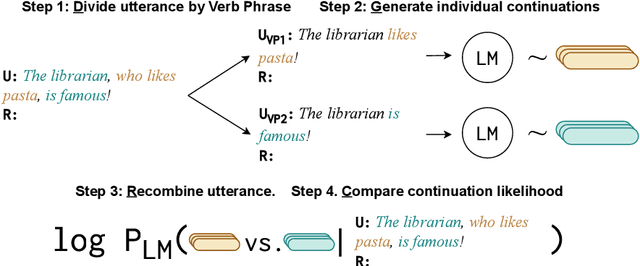
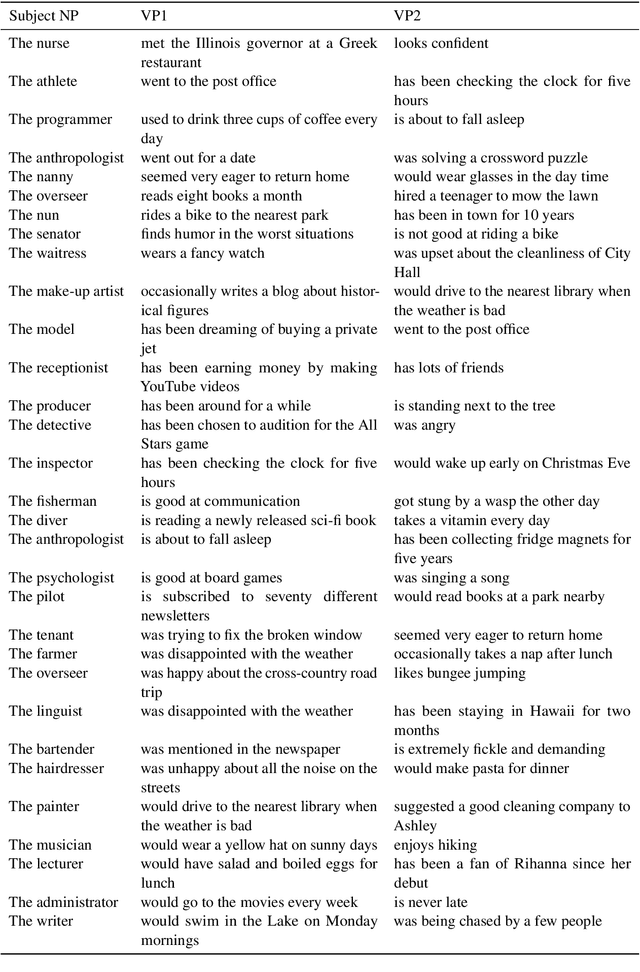
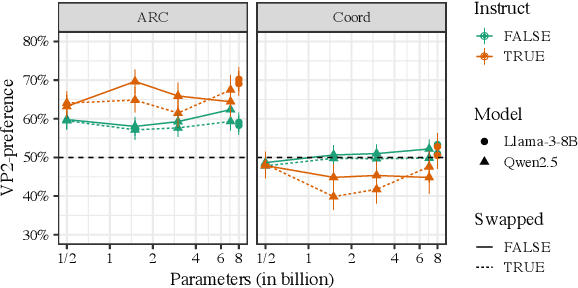
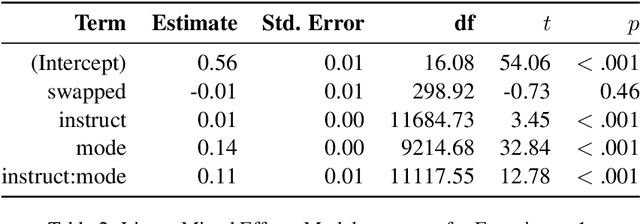
Evaluating the naturalness of dialogue in language models (LMs) is not trivial: notions of 'naturalness' vary, and scalable quantitative metrics remain limited. This study leverages the linguistic notion of 'at-issueness' to assess dialogue naturalness and introduces a new method: Divide, Generate, Recombine, and Compare (DGRC). DGRC (i) divides a dialogue as a prompt, (ii) generates continuations for subparts using LMs, (iii) recombines the dialogue and continuations, and (iv) compares the likelihoods of the recombined sequences. This approach mitigates bias in linguistic analyses of LMs and enables systematic testing of discourse-sensitive behavior. Applying DGRC, we find that LMs prefer to continue dialogue on at-issue content, with this effect enhanced in instruct-tuned models. They also reduce their at-issue preference when relevant cues (e.g., "Hey, wait a minute") are present. Although instruct-tuning does not further amplify this modulation, the pattern reflects a hallmark of successful dialogue dynamics.
WUGNECTIVES: Novel Entity Inferences of Language Models from Discourse Connectives
Oct 10, 2025The role of world knowledge has been particularly crucial to predict the discourse connective that marks the discourse relation between two arguments, with language models (LMs) being generally successful at this task. We flip this premise in our work, and instead study the inverse problem of understanding whether discourse connectives can inform LMs about the world. To this end, we present WUGNECTIVES, a dataset of 8,880 stimuli that evaluates LMs' inferences about novel entities in contexts where connectives link the entities to particular attributes. On investigating 17 different LMs at various scales, and training regimens, we found that tuning an LM to show reasoning behavior yields noteworthy improvements on most connectives. At the same time, there was a large variation in LMs' overall performance across connective type, with all models systematically struggling on connectives that express a concessive meaning. Our findings pave the way for more nuanced investigations into the functional role of language cues as captured by LMs. We release WUGNECTIVES at https://github.com/sheffwb/wugnectives.
Vision-and-Language Training Helps Deploy Taxonomic Knowledge but Does Not Fundamentally Alter It
Jul 17, 2025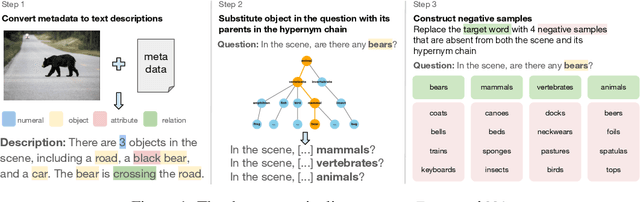
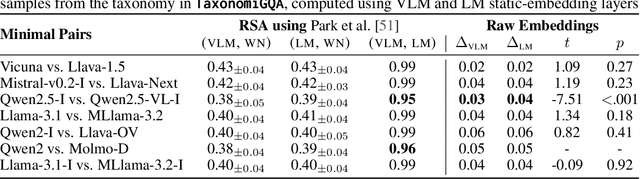

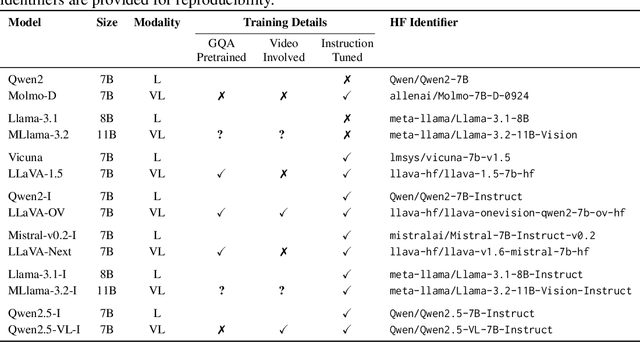
Does vision-and-language (VL) training change the linguistic representations of language models in meaningful ways? Most results in the literature have shown inconsistent or marginal differences, both behaviorally and representationally. In this work, we start from the hypothesis that the domain in which VL training could have a significant effect is lexical-conceptual knowledge, in particular its taxonomic organization. Through comparing minimal pairs of text-only LMs and their VL-trained counterparts, we first show that the VL models often outperform their text-only counterparts on a text-only question-answering task that requires taxonomic understanding of concepts mentioned in the questions. Using an array of targeted behavioral and representational analyses, we show that the LMs and VLMs do not differ significantly in terms of their taxonomic knowledge itself, but they differ in how they represent questions that contain concepts in a taxonomic relation vs. a non-taxonomic relation. This implies that the taxonomic knowledge itself does not change substantially through additional VL training, but VL training does improve the deployment of this knowledge in the context of a specific task, even when the presentation of the task is purely linguistic.
semantic-features: A User-Friendly Tool for Studying Contextual Word Embeddings in Interpretable Semantic Spaces
Jun 06, 2025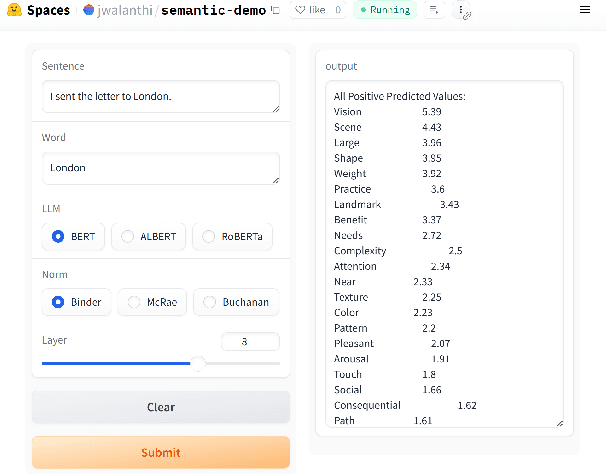
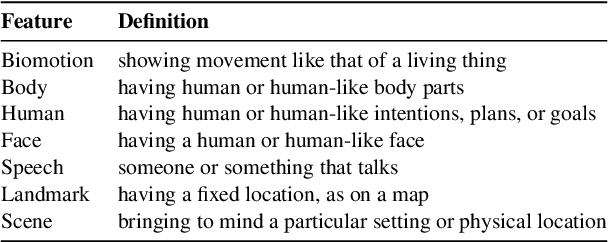
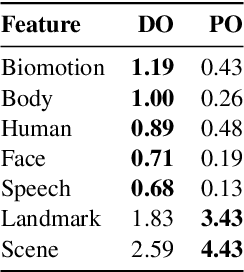
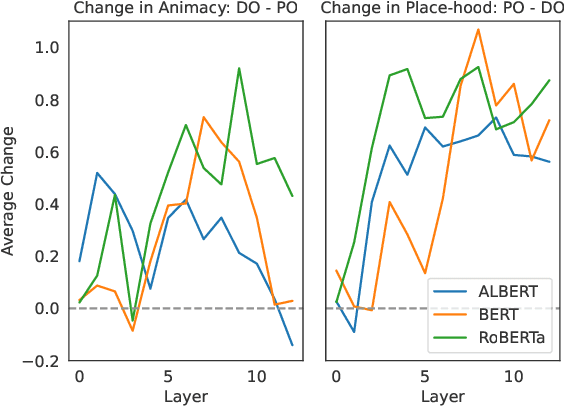
We introduce semantic-features, an extensible, easy-to-use library based on Chronis et al. (2023) for studying contextualized word embeddings of LMs by projecting them into interpretable spaces. We apply this tool in an experiment where we measure the contextual effect of the choice of dative construction (prepositional or double object) on the semantic interpretation of utterances (Bresnan, 2007). Specifically, we test whether "London" in "I sent London the letter." is more likely to be interpreted as an animate referent (e.g., as the name of a person) than in "I sent the letter to London." To this end, we devise a dataset of 450 sentence pairs, one in each dative construction, with recipients being ambiguous with respect to person-hood vs. place-hood. By applying semantic-features, we show that the contextualized word embeddings of three masked language models show the expected sensitivities. This leaves us optimistic about the usefulness of our tool.
Is It JUST Semantics? A Case Study of Discourse Particle Understanding in LLMs
Jun 05, 2025Discourse particles are crucial elements that subtly shape the meaning of text. These words, often polyfunctional, give rise to nuanced and often quite disparate semantic/discourse effects, as exemplified by the diverse uses of the particle "just" (e.g., exclusive, temporal, emphatic). This work investigates the capacity of LLMs to distinguish the fine-grained senses of English "just", a well-studied example in formal semantics, using data meticulously created and labeled by expert linguists. Our findings reveal that while LLMs exhibit some ability to differentiate between broader categories, they struggle to fully capture more subtle nuances, highlighting a gap in their understanding of discourse particles.